How to Monitor Brand Mentions in ChatGPT
Run unbranded buyer prompts in ChatGPT, each prompt once a day until it has about 10 runs, and log how often ChatGPT names your brand and cites your pages.
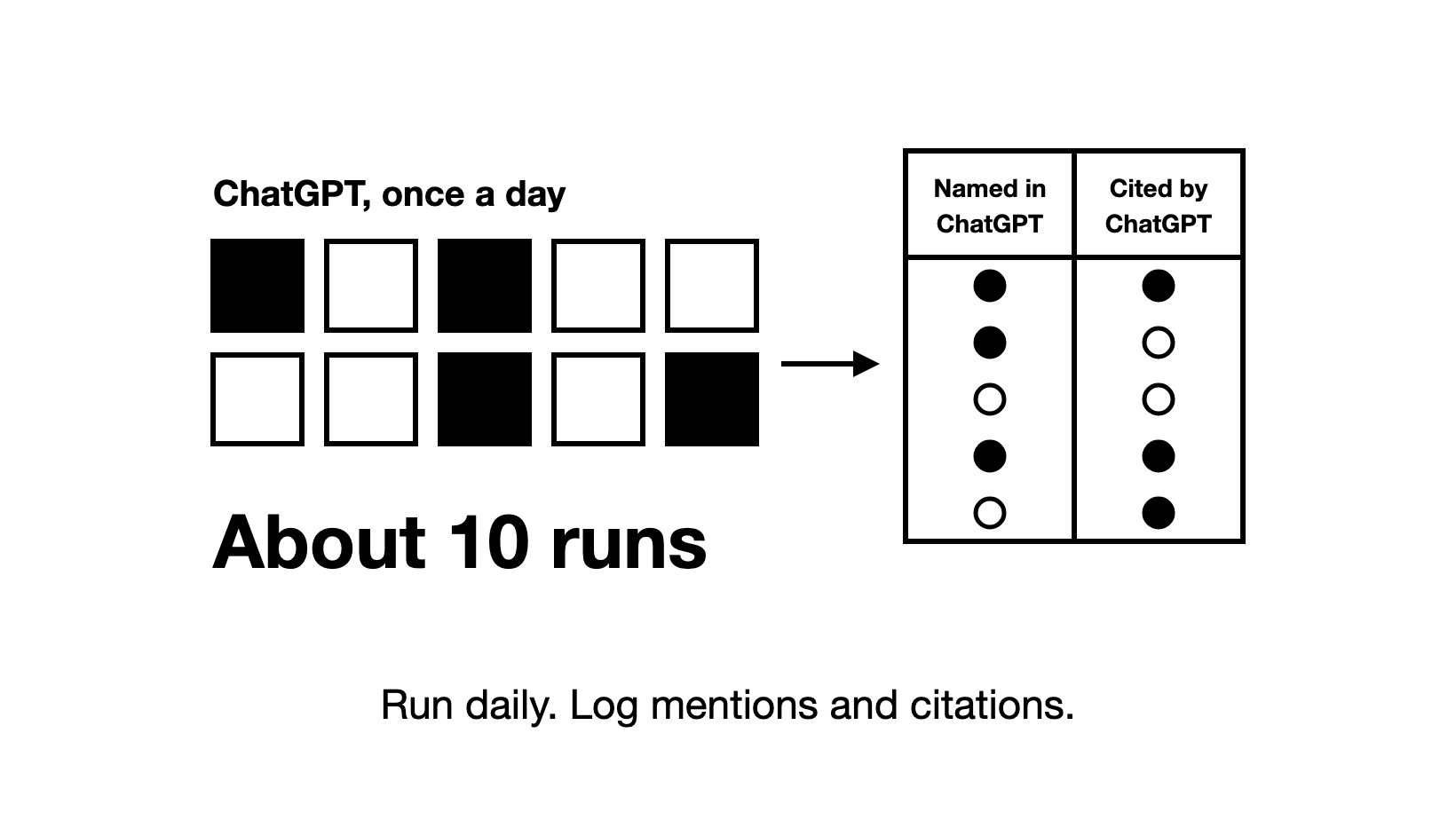
To monitor brand mentions in ChatGPT, run a set of unbranded buyer prompts, each prompt once a day until it has about 10 runs, and log how often ChatGPT names your brand and cites your pages.
An unbranded buyer prompt is a buyer question that does not name your brand, such as "best help desk software for a B2B SaaS support team". A ChatGPT answer is written for one person, out of public view, so any external tool cannot see it. No engine's own tool counts how often its answers name your brand: Google's and Bing's AI reports count your pages, not your brand.
Why can't one ChatGPT check tell you whether your brand shows up?
The most common mistake we see is one check, often made while logged in, read as the truth. ChatGPT's answer changes from one run to the next, and OpenAI says the same question may get different answers.
We looked at ChatGPT data from the Zadoosh data platform: B2B brands across software and other fields, April to October 2026. Two runs of the same prompt on the same day shared only 53% of the brands they named and 22% of the pages they cited.
The real share also moves over the months. In the same data, a prompt's share of answers naming the brand moved a median 13 points from its first 28 days to its last 28. Chance alone would move it about 4 points.
What should you count in each ChatGPT answer?
Log three things for every answer, each in its own column. Your brand is mentioned when ChatGPT names it anywhere in its answer text, with a link or without one. Your visibility is the share of answers that mention you. Your brand is recommended when ChatGPT names it as the best fit for the buyer's need, not just as one name in a list.
A citation is a page an AI answer shows as a source for what it says. It can be your own page, a third-party page (a competitor's page, a listicle, etc.) or a community page (a Reddit thread, a forum post, etc.). Buyers rarely click citations, but ChatGPT uses the cited pages to decide which brands to name.
In ChatGPT, citations show as links in the answer. The Sources button, when shown, lists the pages ChatGPT retrieved for the answer (OpenAI's help page calls them "cited sources and other relevant links").
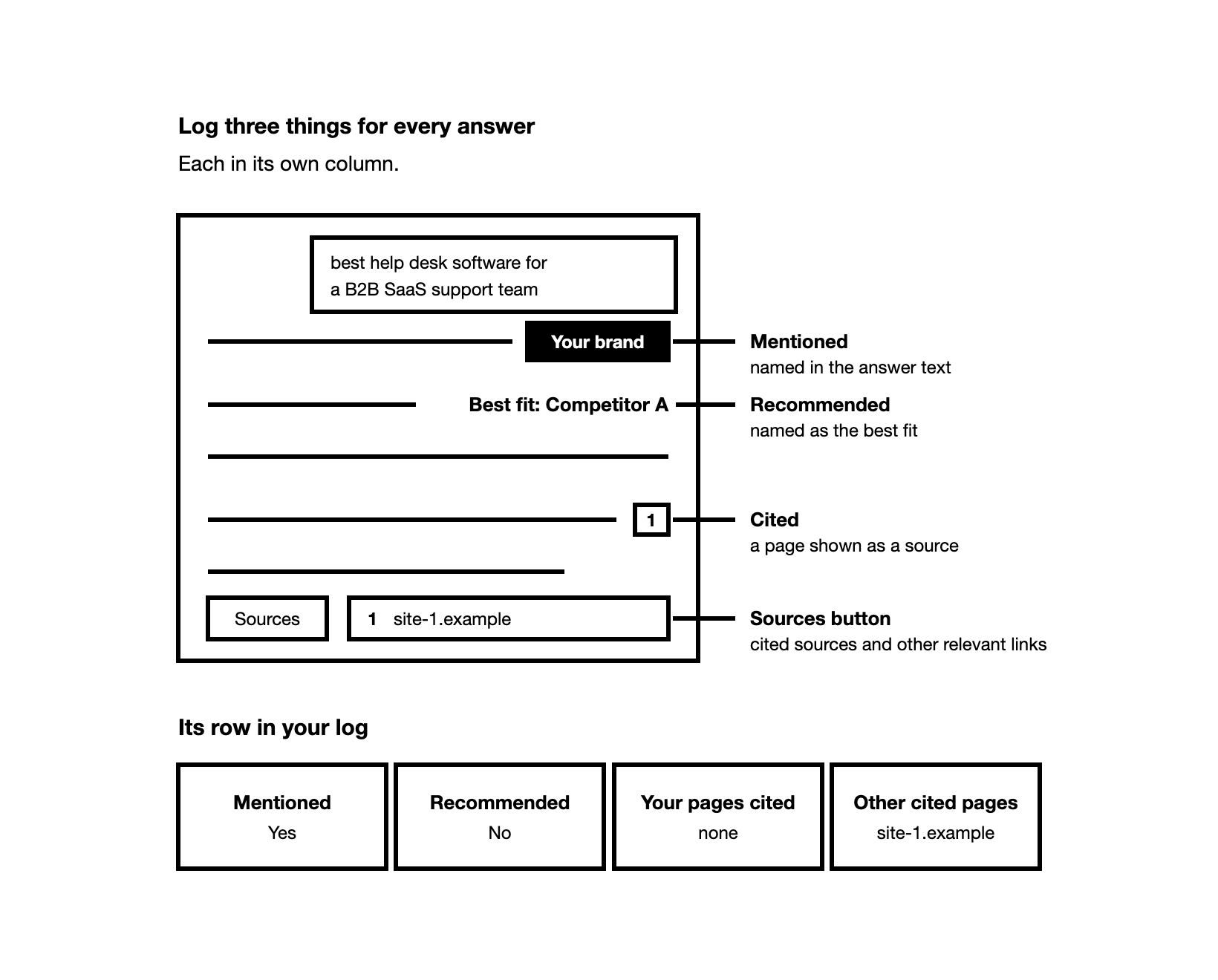
Keep mentions and citations in separate columns, because the two do not always go together. Say ChatGPT names you, but every link in the answer points to a review site. That answer is a mention with none of your pages cited.
We looked at ChatGPT answers that cited any pages, in our data from B2B brands across software and other fields, April to October 2026. In 8.1% of them, ChatGPT named the brand without citing one of its pages. In 5.2%, it cited one of the brand's pages without naming the brand.
If ChatGPT names you often but rarely cites your own pages, it is most likely naming you from the third-party pages it cites, where most mentions come from, or from its training data. Your own pages may also be hard for it to use.
How do you track brand mentions in ChatGPT by hand?
Which prompts should you run in ChatGPT?
Your prompt set is the list of buyer questions you run on AI engines again and again to measure visibility. Every visibility number is a share of answers to that set, so the set decides what the number means. Start with 20 to 30 unbranded buyer prompts. How many prompts to track explains how to size the set as it grows.
Leave your brand's name out of every prompt you count toward visibility, because your name in the question makes ChatGPT talk about you. These unbranded prompts are your visibility prompts. Branded prompts, such as "What is [brand]?", and "[brand] vs [competitor]" prompts are positioning prompts. Track them as a separate list, to see how ChatGPT describes and positions you.
How should you run each prompt in ChatGPT?
Run each prompt the way a stranger in your market would see it. ChatGPT may use your saved memories when it turns your question into searches, and it estimates your location from your IP address, which a VPN changes.
| Setting | What to do | Why |
|---|---|---|
| Account | Log out before you run the set | Your saved memories cannot shape the searches |
| Chat | Open a new chat for every prompt | Earlier questions in the same chat change what ChatGPT takes your intent to be |
| Country | Connect through a VPN in the country you sell in | ChatGPT takes your location from your IP address |
| Timing | Run each prompt once a day | Daily runs follow the answers as they change through the month |
How many runs does a ChatGPT prompt need?
Say ChatGPT names your brand in 4 of every 10 answers to a prompt this month. One run shows you only a yes or a no.
That is the usual case. A prompt window is one prompt's answers over a 30-day period. In our data (B2B brands across software and other fields, April to October 2026), ChatGPT named the brand in some answers but not all in 72% of prompt windows.
For those prompts, the table shows how often a few random runs came close to the brand's 30-day share. The typical miss is how far such a sample usually was from that share:
| Runs of the prompt | Came within 10 points | Came within 20 points | Typical miss |
|---|---|---|---|
| 1 | 35% | 53% | 18 points |
| 3 | 42% | 67% | 12 points |
| 5 | 49% | 79% | 11 points |
| 10 | 64% | 88% | 8 points |
So give each prompt about 10 or more daily runs before you read it, as a monthly trend. Judge your brand on the share pooled across the whole set, which rests on far more answers than any one prompt.
What should your ChatGPT log record?
Give every answer its own row, so you can count anything later.
| Column | What to write |
|---|---|
| Date | The day of the run |
| Prompt | The exact prompt text |
| Country | The VPN country you ran it from |
| Mentioned | Yes or no |
| Recommended | Yes or no |
| Order named | 1 if your brand is the first brand named, 2 if second, and so on |
| Competitors named | Every other brand in the answer |
| Your pages cited | The URLs of your pages that ChatGPT linked |
| Other cited pages | Each URL, marked community or third-party |
| Retrieved | Pages listed under Sources that the answer does not link |
| Description | The words ChatGPT used about your brand |
| Answer | The full answer text |
Count a mention under every name your brand goes by, such as a product name or a former name. If your name is also a common word or another product's name, count only the mentions that clearly mean your brand. For such a name, also add your category to your branded prompts, so ChatGPT answers about the right product.
Review sites hold two kinds of pages: count their user reviews as community pages, and their lists, articles and comparisons as third-party pages.
Read the order named only once ChatGPT names you often. With few mentions, it jumps around too much to mean anything.
What should a monthly ChatGPT mentions report show?
Once a month, turn the log into a few numbers and give them a section of their own, next to your SEO numbers.
| Number | How to work it out | What it tells you |
|---|---|---|
| Visibility | Answers that mention you, divided by all answers | How often a buyer asking these questions sees your name |
| Share of voice | Your mentions as a share of all brand mentions in the answers | How you compare with the brands ChatGPT names |
| Recommended rate | Answers that recommend you, divided by all answers | Whether ChatGPT picks you or only lists you |
| Your pages cited | Answers that cite at least one of your pages, and which pages | Which of your pages ChatGPT uses |
| Cited pages by group | Cited pages split into your own, community and third-party | Which kinds of pages ChatGPT uses for your prompts |
| Description | The words ChatGPT repeats about you in branded prompts | Whether ChatGPT positions you the way you sell |
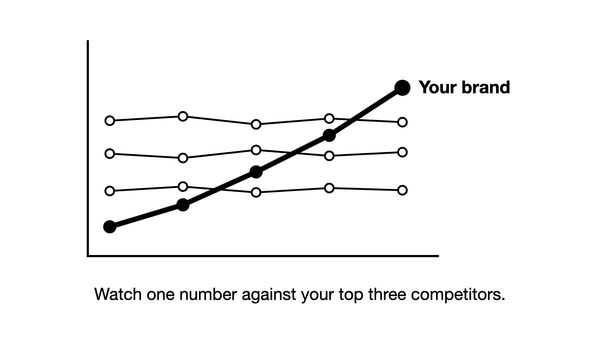
Judge these against your top three competitors on the same prompts, not against a fixed target. A good quarter shows rising visibility and a closing gap to those competitors.
When pages you created or updated start being cited, show it in the report. It is an early, clear sign that your changes are working, before mentions follow. When visibility moves, compare the share of cited pages in each group before and after: the group that grew is the likely cause.
ChatGPT has no fixed positions 1 to 10, so there is no ranking to track over time. What moves is how often ChatGPT names you and, once that is often, how early in the answer.
How big a change in ChatGPT visibility is real?
Say your ChatGPT visibility was 20% last week and 25% this week. Before you report a win, check that move against the noise: the change you get from chance alone.
In our data (B2B brands across software and other fields, March to October 2026), most week-to-week moves in a prompt set's ChatGPT visibility were noise. The median weekly move was about 3 points.
In the same data, a weekly change was at least 80% likely to be real from about 11 points across all prompt sets. On sets with 100 to 299 answers a week, the same was true from about 7 points. Under 100 answers a week, no weekly change could be told from noise.
Act on a weekly change of about 10 points or more when your set has 100 or more answers a week. With one run a day per prompt, that means at least 15 prompts. By that bar, the move from 20% to 25% is not yet a signal.
Read smaller moves over a month, where the bar is lower. In the same data (March to October 2026), changes of 3 to 6 points from one 4-week block to the next were already likely real.
How do you check whether your brand shows up in ChatGPT and other AI answers?
Run the same prompt set on every engine you track. Then a gap between ChatGPT and Gemini tells you how the engines differ, not how your questions differ. How to measure AI search visibility and How to monitor brand mentions in AI search cover the full method across engines.
For B2B, the engines to add are usually Gemini, Perplexity, Microsoft Copilot, Google AI Overviews and AI Mode, and Claude, which buyers in the tech space increasingly use. Meta AI, Grok and DeepSeek typically see less B2B use, so a check by hand from time to time is enough unless your buyers are there.
Each engine draws on its own mix of pages, so ChatGPT's result does not stand in for the others. In our data (B2B brands across software and other fields, April to October 2026), the brand's own pages were about 4% of the pages ChatGPT cited. From June to October 2026, they were about 14% in Perplexity and about 13% in Copilot.
Treat Google AI Overviews and AI Mode as two separate engines, and measure each on its own. AI Overviews works more like next-generation Google Search, and AI Mode more like ChatGPT. Tracking AI Overviews has its own catch, because only some searches show one.
For each market, run the same prompts on the same engines, in that market's language and from that country. For buyers in Germany, that means the German version of every prompt, run through a VPN in Germany.
On a tight budget, cut engines before you cut prompts or runs. Ten prompts run daily in ChatGPT tell you more than many prompts run once a week on every engine.
For one headline number, pool the answers from every engine and market into one visibility figure, instead of averaging each engine's percentage. Then read each engine on its own as well, so a weak engine does not hide inside a good total.
When should you move ChatGPT tracking from manual checks to a tool?
Checks by hand show you roughly where you stand. Once you report ChatGPT visibility or act on it, use a tool or automate the runs. The daily work is the other reason: 20 prompts in one country mean 20 fresh, logged-out chats every day, and each extra engine or market adds as many again. If you skip days, each number rests on fewer answers.
The Zadoosh AEO platform runs these daily checks on ChatGPT and the other five engines it covers, and you can start with its free trial.
Check how a tool collects ChatGPT answers before you trust its numbers. Answers captured from the ChatGPT app are closer to what buyers see than answers from OpenAI's API, which can differ. Spot-check a few prompts by hand, logged out, against what the tool recorded, and use only a tool that shows the raw answer behind every number. How AI visibility tools work covers the differences.
What should you check first when your brand is missing from ChatGPT responses or described wrong?
When your brand is missing, start by reading the answers that left you out. Note which brands ChatGPT names instead of you, and which pages it cites. ChatGPT nearly always shows citations on buyer prompts. In our data (B2B brands across software and other fields, March to October 2026), it cited at least one page in 98% of answers.
Is your ChatGPT prompt asking the question you meant?
If the brands ChatGPT names come from a neighboring market, fix the prompt before you look at pages. A help desk prompt, for example, can come back with contact center suites or IT service desk tools. Write a boundary into the prompt, such as who it is for and which nearby categories to leave out, then run it again.
Answers that name no vendor at all point to the prompt too. A problem question, such as how to cut a support ticket backlog, can get steps and advice with no products in them, so no brand can win it. If your buyers ask for tools at that point, say so in the prompt. If they do not, being named in none of those answers says little about your pages.
Which pages does ChatGPT cite instead of yours?
If the prompt is sound, sort the pages ChatGPT cites in those answers into your own pages, community pages and third-party pages. Expect most to be third-party.
In our data (all engines, B2B brands across software and other fields, April to October 2026), third-party pages were 80% to 86% of the pages AI answers cited. The share was 86% when review sites count as third-party, and 80% when they count as community. Community pages were 8% to 15%.
Then check each cited third-party page for your name. Your density is the share of cited pages that mention your brand: if 4 of 10 cited pages name you, your density is 4 in 10. The cited pages that leave you out are where the gap sits.
The same check explains a sudden drop: look at the cited pages that named you before it. In our data (B2B brands across software and other fields, May to October 2026), Reddit pages were 8.6% of the pages ChatGPT cited in July 2026. That share fell in one step on 14 August 2026, to 0.1 to 0.2% in September and October. If Reddit threads were the pages that named you, a drop since then sits at the citation level, not on your own pages.
What type of page does ChatGPT cite for each kind of prompt?
Narrow buyer prompts tend to get vendors' own pricing pages, homepages and docs cited. Category prompts, such as "best help desk software", tend to get listicles cited.
Work on the cheapest fix first: prompts where you already have a page close to the type ChatGPT cites. We often see that such a page already exists and ChatGPT never cites it.
Check technical access last, meaning whether OpenAI's crawlers can reach your pages at all. Do it only if none of your pages ever appears in ChatGPT's citations or its Sources list. OpenAI says ChatGPT may visit a web page with a ChatGPT-User agent when a user asks it a question. A ChatGPT-User visit in your server logs shows that ChatGPT opened a page, not that it used the page in an answer.
What if ChatGPT describes your brand wrong?
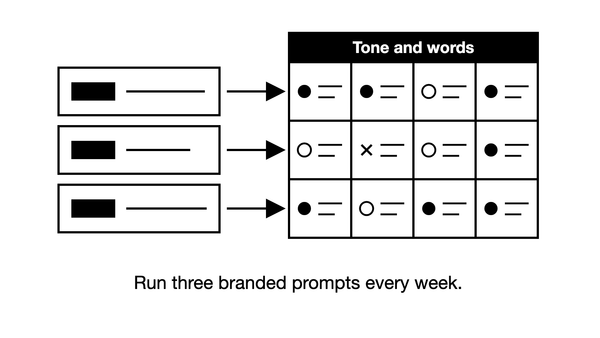
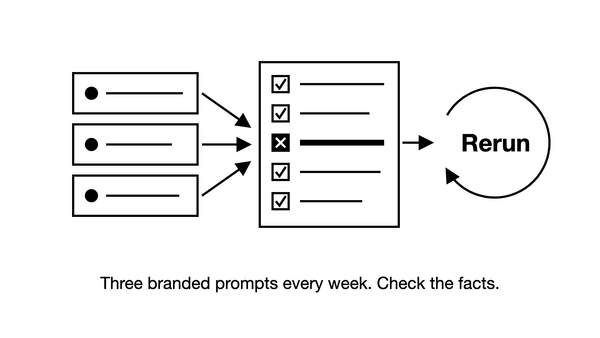
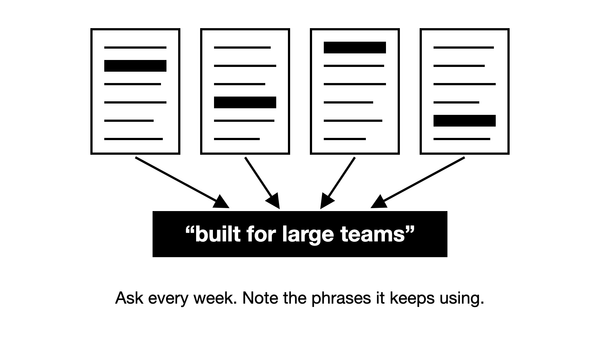
Run three branded prompts every week: "What is [brand]?", "[brand] pros and cons" and "Is [brand] good for [use case]?". Watch the answers for three traps:
- Outdated facts, such as old pricing, old features or an old category.
- A place in the wrong kind of list, such as "cheapest options" for a premium product.
- Wrong words attached to your name.
Once a month, and after any product change, check the answers against a fact list: pricing, features, category, who you are for and company facts. When an answer gets a fact wrong, look at what it cites. If a cited page carries the old fact, that page is the one to get updated. If ChatGPT states the fact with no page cited, it may come from what the model learned in training.
Is ChatGPT a meaningful traffic and lead source yet?
It is a small but real source, and only part of its effect shows up as ChatGPT visits. A buyer who sees your name in an answer does not have to click. They may type your address later or search your brand on Google.
In a case study published in June 2025, Seer Interactive, an agency, looked at one of its B2B software clients from October 2024 to April 2025. Visitors from ChatGPT converted at 15.9%, against 1.76% for Google organic. But AI traffic of all kinds was small: just under 11,000 sessions, against almost 14 million from Google organic. These figures come from one client, so your own numbers may differ.
Seer's later study, published in September 2025, drew on the last 16 months of data from the agency's own clients. Visits from Perplexity converted at 15.9% on average, against 9.77% for organic search. Every AI assistant in the study had a higher conversion rate than organic search.
How do you see ChatGPT visits in GA4?
Google Analytics 4 (GA4) sorts every visit into a channel, such as Organic Search, Direct or Referral, by where it came from. Since 13 May 2026, its default channels include an AI Assistant channel for visits from ChatGPT, Gemini, Copilot and other assistants. A visit goes there only when the site it came from, the referrer, matches Google's own list of assistants, which is not published in full. Visits from Google AI Overviews and AI Mode are not in it: they count as Organic Search.
For a cleaner view, build a custom channel group, which is your own version of GA4's channel list. Add an AI channel to it and place it above Referral, because GA4 checks channels in order. A custom group also applies to your past data.
Google's example for that AI channel names ChatGPT, Gemini, Microsoft Copilot, Claude and Perplexity. The default AI Assistant channel's description does not name Perplexity, so your own channel is the safer way to count it.
We have seen ChatGPT add utm_source=chatgpt.com to the links it cites (February 2026). That tag tells analytics where a click came from, so visits with the source chatgpt.com are clicks from ChatGPT. Their landing pages show which cited pages people opened.
How do you find the leads ChatGPT sends you?
A buyer who saw you in ChatGPT and later typed your address shows up as Direct. One who searched your brand on Google instead shows up as Organic Search, and may tell your sales team they found you on Google. This route, from a ChatGPT answer to a later visit, is growing as more buyers start their research in AI assistants.
Watch branded searches and direct visits for a rise. Treat a rise as a rough signal only, because GA4 cannot show that ChatGPT caused it.
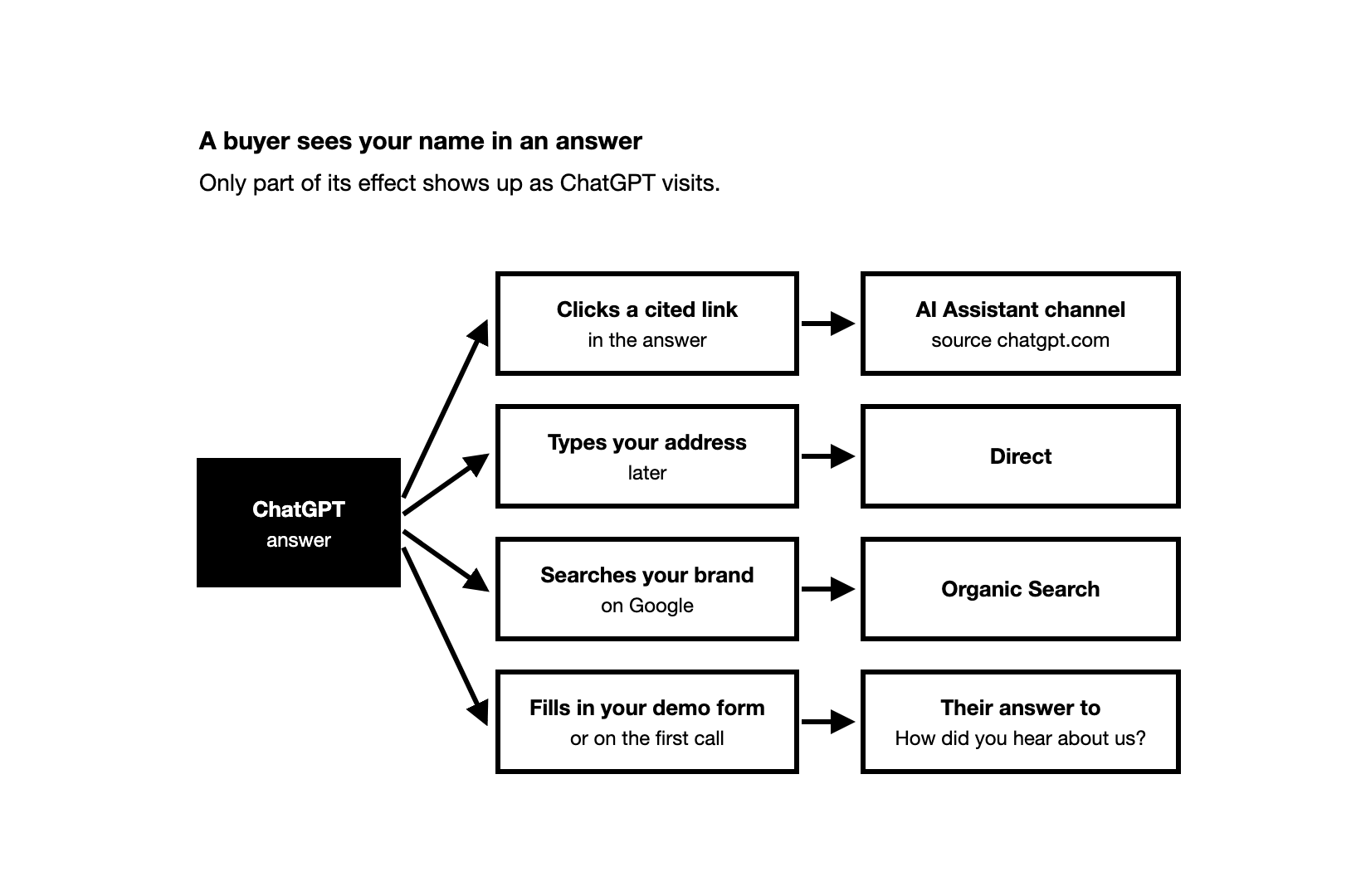
Your main way to link leads to ChatGPT is to ask. This is especially true in B2B, where the sales cycle has more touch points with the buyer, and may apply less in B2C. Add a "How did you hear about us?" field to your demo form, and ask again on the first call. Then watch whether answers naming ChatGPT or another AI assistant rise over the months.
Report both side by side: ChatGPT visibility against your competitors as the early signal, and these lead signals for direction. AI visibility sits between performance and brand marketing. So do not expect a cost per lead for each mention, and do not write it off as unmeasurable.
Frequently asked questions
Does ChatGPT show your buyers the same answer it shows you? No. Your saved memories, your location and plain chance all change ChatGPT's answer, and no tool, ours included, sees the answer a real buyer got. A logged-out run from a VPN in your buyer's country, repeated daily, is the closest stand-in you have.
Can you monitor ChatGPT brand mentions through the OpenAI API? You can automate the checks with OpenAI's API, but API answers differ from what buyers see in the ChatGPT app. In the API, web search is a tool you turn on, and even then the model chooses whether to search. Check a sample of the API answers against logged-out runs in the app.
Does it count as a mention if your brand appears only in a ChatGPT citation? No. A mention is your brand named in the answer's own text. A link to your page with no name in the text is a citation, and it goes in its own column. When ChatGPT writes your name in its sentence as a link to your site, log both.
Can GA4 show which ChatGPT prompt sent a visitor? No. GA4 records the visit and the page it opened, not the question asked or the answer given, and no AI engine shares the prompts people type. The landing page is your best clue, because it is the cited page the visitor clicked.
Can you monitor brand mentions in ChatGPT for free? Yes, by hand: the prompts, settings and log above cost only time. To skip the daily runs, the Zadoosh AEO platform's free trial runs your prompts on ChatGPT, Gemini, Perplexity, Copilot, AI Overviews and AI Mode. It counts how often the answers name your brand and cite your pages. As of November 2026, it covers 25 prompts for 7 days, with no card.