Mentioned, Cited, Retrieved: What Each Means in AI Answers
Mentioned: an AI answer names your brand. Cited: it shows your own page as a source. Retrieved: it read your page. What each means and how to count it.
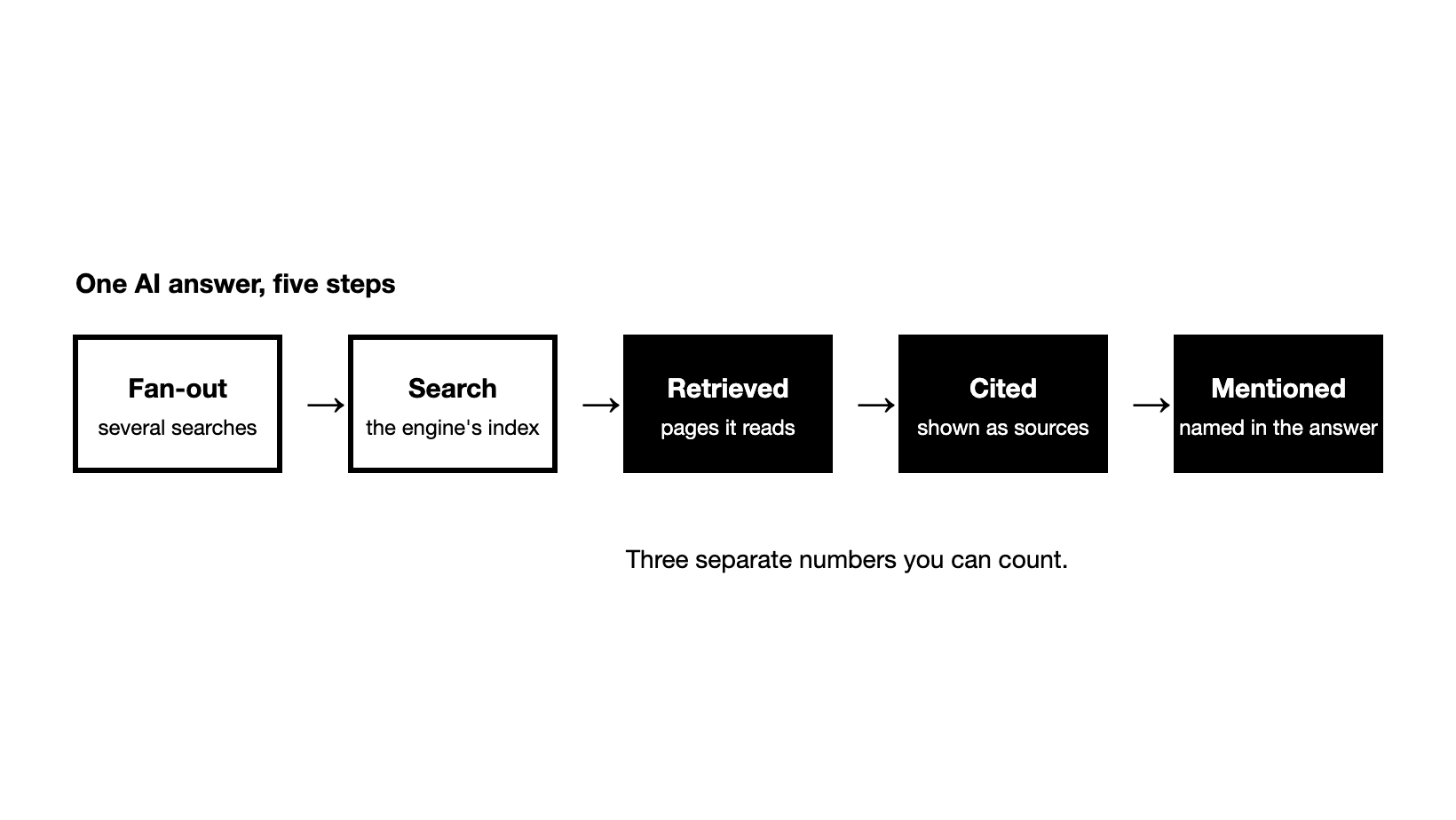
AI visibility comes down to three things you can count: whether an AI answer names your brand (mentioned), shows a page from your own site as a source (cited), or read your page while building the answer (retrieved), and before you trust any number you need to know which of the three it measures.
This is part of our guide to measuring AI visibility.
What does "mentioned" mean in an AI answer?
Your brand is mentioned when the answer names it in its text. Any mention counts as AI visibility, whether the brand comes first or fifth, with a link or without one.
A mention can come from anywhere. The engine may name you because a review site, a listicle or a community thread it read names you, or because of what the model learned in training. So a mention is not a measure of your own site, and your own pages are only one of the ways to earn more of them.
Being recommended is not a separate result: when an answer picks your brand, that is a mention. How the answer describes you (the words it uses, the use case, the kind of list it puts you in) is a different question, about positioning, and worth checking on its own.
What does "cited" mean?
In general, any page an AI answer shows as a source is a citation: your own page, a listicle on someone else's site, a Reddit thread. When you measure your own visibility, the metric narrows to your pages cited: answers that show at least one page from your own domain as a source. A third-party page that names you feeds your mentions, not your citations.
In ChatGPT, the citations are the links inside the answer, and selecting one opens its source. Google's AI Overviews and AI Mode show links to supporting websites.
Citations matter even though buyers rarely click them: engines use the sources they cite to decide which brands to name. That makes citations a route to mentions, not a lesser result.
What does "retrieved" mean?
Before an engine answers, it runs its own searches and gathers a pool of pages to read. ChatGPT, for example, rewrites a question into one or more targeted queries when it searches the web. Every URL in that pool is retrieved (ChatGPT calls them sources).
Cited pages come out of that pool, but not every retrieved page is cited. In ChatGPT, the Sources button lists "cited sources and other relevant links", so a page of yours that is listed there but not linked in the answer was read and passed over. Like cited, retrieved is about your own URLs.
You can count retrieval only where an engine shows its full source list, as ChatGPT does.
Why are they three separate numbers?
Because an AI engine produces them at different steps of building one answer.
- Fan-out. The engine works out the intent of the question and breaks it into several search queries, called query fan-out. ChatGPT, for example, rewrites a question into one or more targeted queries.
- Search. Each query runs against the web index that engine uses. Google's AI Overviews, for example, searches Google's own index.
- Retrieved. From all the pages that come back, the engine picks the ones it judges most useful, say the top 30, and reads them.
- Cited. Of those, it cites only the few that carry enough credible information for the answer, say 7 or 8.
- Mentioned. While writing the answer from those pages, it names the brands it thinks are worth naming.
Each step narrows the one before it, but each answers its own question: does the engine read your pages, does it show them as sources, does it name your brand?
How do you count each one?
Count answers, not links, and use the same set of answers for all three so the numbers sit side by side. Split them by engine when you read them.
| Metric | Formula | What counts |
|---|---|---|
| Mention rate | Answers that name your brand, divided by all answers | Any mention that clearly means your brand |
| Citation rate (your pages cited) | Answers that show at least one of your pages as a source, divided by all answers | Pages on your domain, its subdomains and any other domain you own |
| Retrieval rate | Answers that list your page among their sources, divided by answers that show a full source list | Any of your URLs in the list, cited or not |
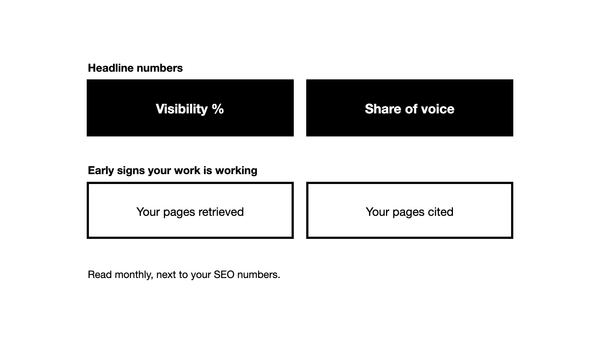
Mention rate is your visibility percentage, the headline number. The other two show how much of it your own site supports.
Four rules keep the numbers honest:
- One answer counts once. An answer that cites three of your pages adds one to your citation rate, not three. Counting links rewards the answers that cite you heavily and hides the ones that ignore you.
- Cited means shown in the answer. If a tool's "cited" list includes pages it found that the answer never showed, the rate runs high. Check how each tool counts before you compare two of them.
- Only mentions that mean you. If your brand name is also a common word or another product's name, count only the mentions that clearly refer to your brand.
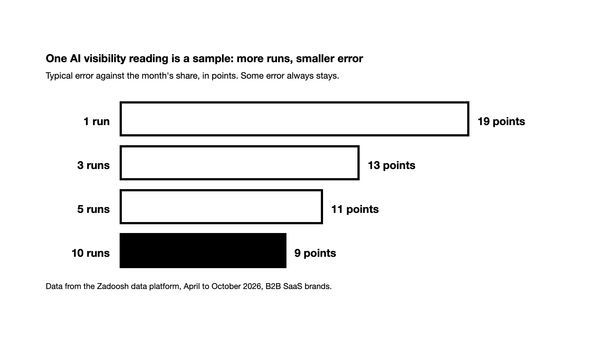
- Enough answers per prompt. The same prompt gets different answers each time, so one answer per prompt proves little. Why ChatGPT gives a different answer each time covers how many runs you need.
To count retrieval by hand in ChatGPT, run the prompt, open Sources, and note whether any of your URLs is listed. Then check whether the same URL is linked in the answer itself: listed and linked is cited, listed only is retrieved and not cited. Most AI visibility tools show this source list too.
Should you track mentions or citations?
Track all three as separate results, and read them for different things. Mentions are the outcome: they are your visibility. Your pages cited and retrieved show what your own site contributes, and they are the numbers your own content work moves first.
Citation count alone is a weak KPI, for an agency or a brand team: your pages can be cited in answers that never name you. Report the mention rate as the headline, with citation and retrieval rates beside it. Rankings are no substitute either: an AI answer has no fixed positions 1 to 10, and where you appear when named is worth tracking only once you are named often.
For a small team, the order of work follows what you control: get your own pages retrieved, then cited. Mentions also depend on community and third-party pages, so they usually move last. That is an order of work, not a chain where one causes the next.
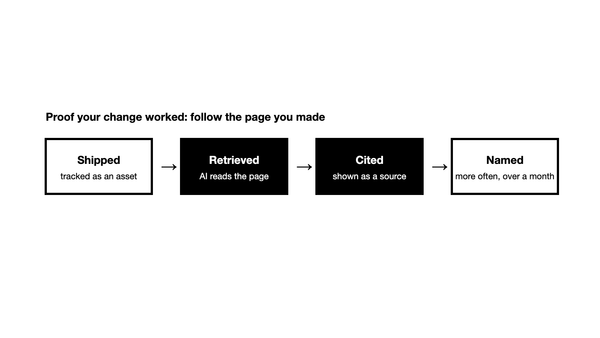
The same three numbers show whether your own work did anything. When you publish or earn a new page, seeing that page retrieved, then cited, then mentions following is clearer proof than overall visibility rising, which can move with engine changes you had no part in.
What can none of the three tell you?
- Why. The numbers say how often; the sources say why. Split the pages each engine cites into your own site, community and third-party publications, as in step 6 of an AI visibility audit.
- What a real buyer saw. No tool sees a buyer's own conversation. Tracking shows what the engines answer your prompts today.
- How Google's AI features differ. AI Overviews and AI Mode need their own reading; see how to measure your brand in AI Overviews and AI Mode.
Frequently asked questions
What is the difference between being mentioned and being cited in AI answers? Mentioned means the answer names your brand in its text. Cited, as a metric, means the answer shows a page from your own site as a source. They come from different steps of the answer: the engine can name your brand from pages that are not yours, and cite your page without naming you.
How are mention rate and citation rate calculated? Mention rate is the answers that name your brand divided by all answers collected for your prompts. Citation rate is the answers that show at least one page from your own domain as a source, divided by the same total. Count each answer once, however many of your pages it cites.
Can AI cite my page without mentioning my brand? Yes. Citing and naming are separate steps: the engine can use your page as a source and still name other brands in the answer. A citation count on its own overstates your visibility.
How can I tell if ChatGPT read my page? Open the Sources list on the answer. Every URL listed there was retrieved; the ones also linked in the answer were cited. If your page is listed but not linked, ChatGPT read it and cited other pages.
Is being cited the same as being recommended? No. When an answer picks your brand, that is a mention; being cited means one of your pages is shown as a source. Count a recommendation as a mention, and check how the answer describes you as a separate positioning question.