Brand AI Search Score: The One Number Leaders Should Watch
Watch one number, the share of AI answers that mention your brand, and check it rises over about a month against your top three competitors.
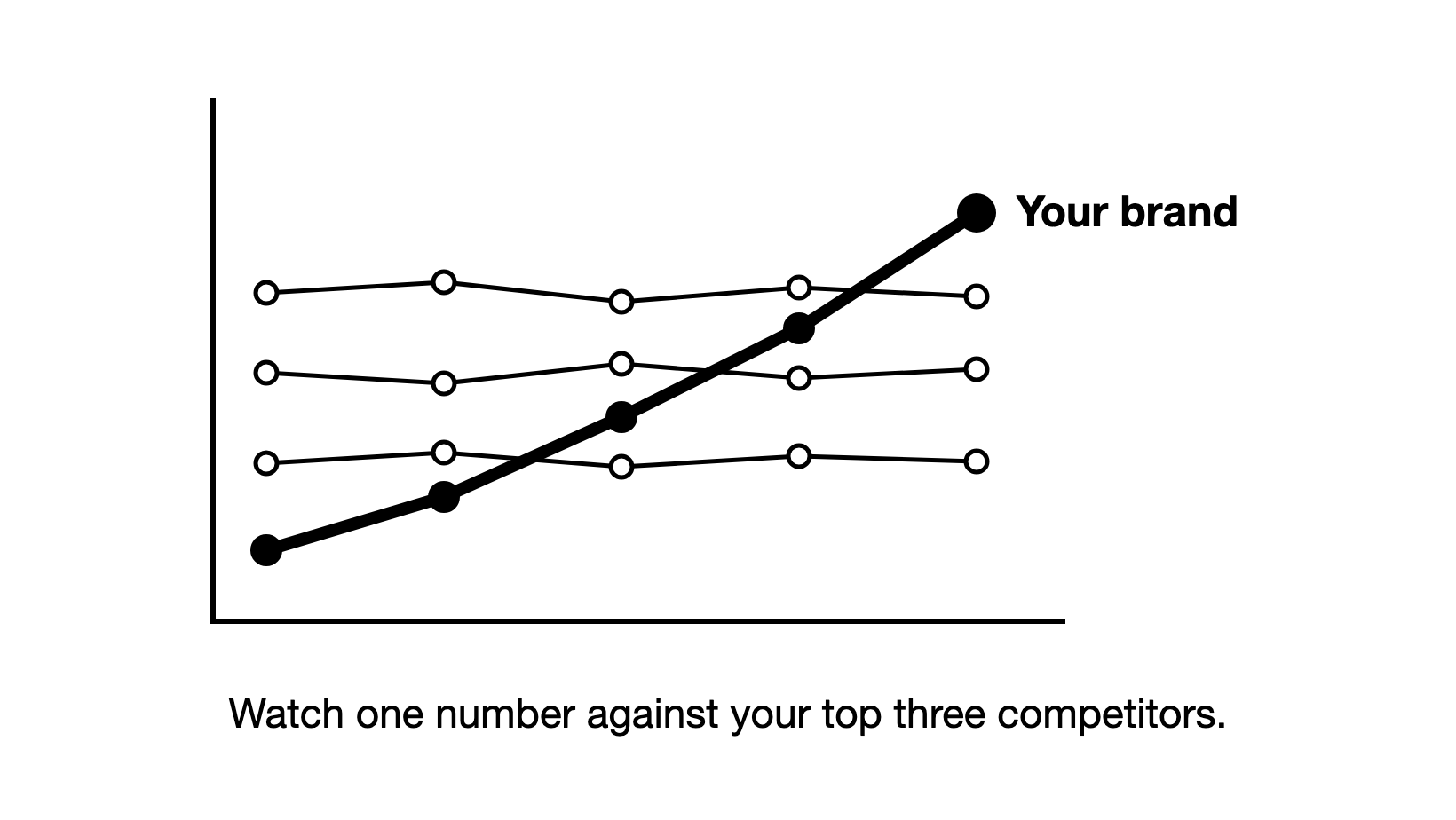
Your brand AI search score is the share of AI answers that mention you: watch it, and check that it rises over about a month against your top three competitors.
AI visibility is how often AI engines such as ChatGPT, Gemini and Google AI Overviews name your brand when buyers ask the questions you care about. Tools give its headline number different names: AI visibility score, visibility %, mention rate. There is no standard definition, and some tools divide by all the brand mentions in the answers instead of by the answers. Check which one your report uses, because the two answer different questions.
What is a brand AI search score, and which numbers should a leader watch?
The score is visibility %, counted only on answers to visibility prompts: buyer questions that name no brand, such as "best CRM for a 20-person B2B sales team". Your brand is mentioned when an AI answer names it in its text, first or fifth, with a link or without one.
Say your brand is named in 3 of 5 answers to one prompt. That prompt's visibility is 60%. Your overall score counts every prompt, engine and country together: all the answers that name you, divided by all the answers collected.
It is the one number to watch because it answers a leader's first question: when buyers ask AI for a solution, do they hear your name? Most teams need that answer before they worry about how AI describes them.
A few supporting numbers sit next to the score, and one of them counts citations. A citation is a page an AI answer shows as a source for what it says. It can be your own page, a third-party page (a competitor's page, a listicle, etc.) or a community page (a Reddit thread, a forum post, etc.). Engines use the cited pages to decide which brands to name.
| Number | What it counts | What it tells a leader |
|---|---|---|
| Share of voice | Your mentions as a share of all brand mentions in the same answers | How big your slice is next to your competitors' |
| Your pages cited | Answers that show one of your own pages as a citation | Whether the engines use the pages your team made |
| Recommended | Answers that name you as the best fit for the buyer's need, not just one name in a list | Whether answers favour you or only list you |
| Position | The order in which the brands you track are first named in an answer | Where you sit inside an answer |
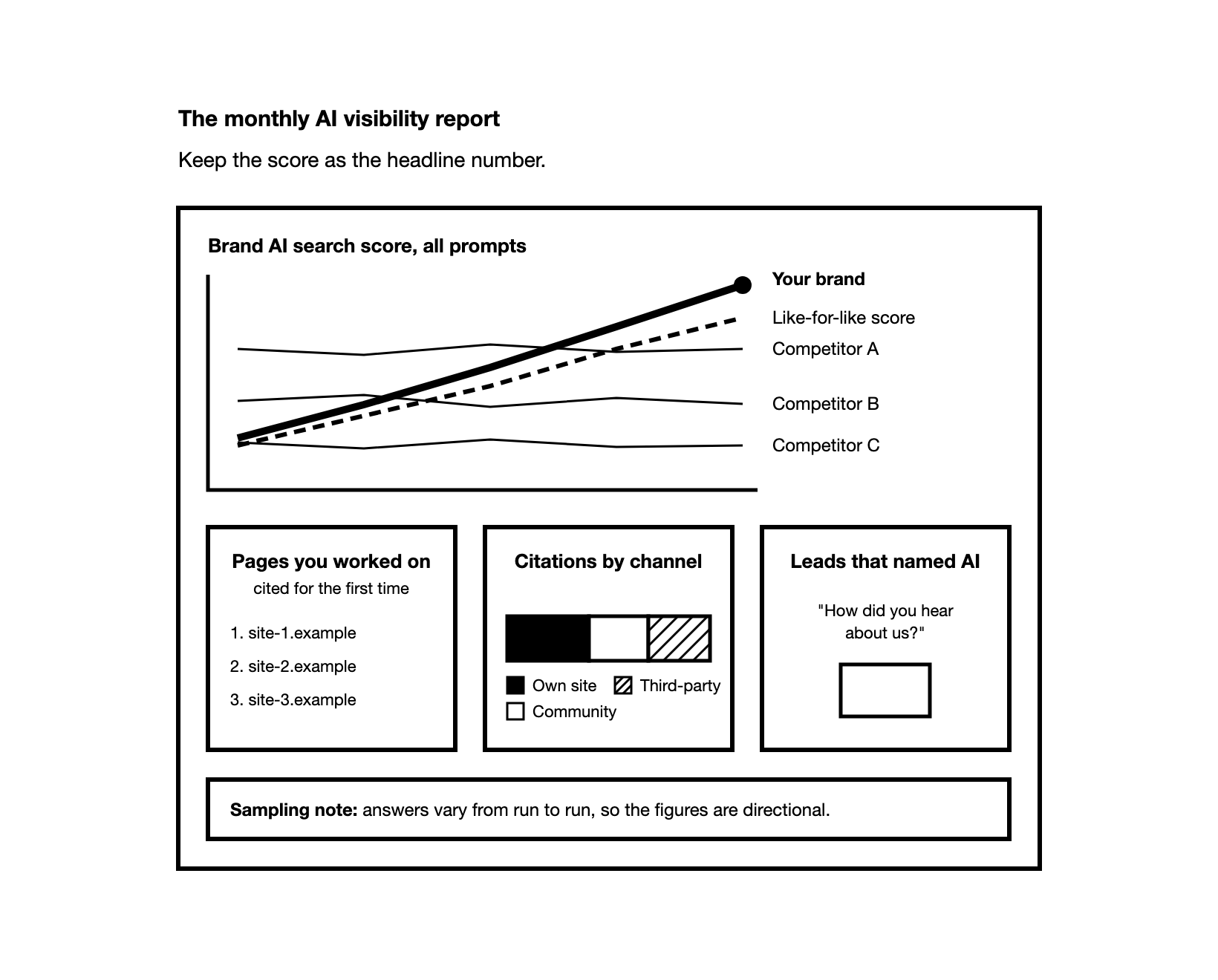
Keep the score as the headline number. Share of voice can rise while buyers see you less, if your rivals drop out of answers faster than you do. Position means little until you are named often. Which AI visibility metrics matter shows how to calculate visibility % and share of voice.
How do you compare your brand AI search score with your top three competitors?
No score is good or bad on its own: the same percentage can lead one category and trail in another. So put your score next to the scores of your top three competitors, on the same prompts, engines and months. Pick the three from the brands the answers name, not the rivals you expected. How to monitor brand mentions in AI search covers how to choose them.
How to measure AI search visibility shows how to measure share of voice against competitors.
How do you track AI visibility over time when the answers keep changing?
OpenAI says the same question may yield different answers in ChatGPT. Ask it one buyer question twice in a morning, and some of the brands named and many of the pages cited will differ. How to monitor brand mentions in AI search covers the tracking method itself.
We looked at data from the Zadoosh data platform, April to October 2026, B2B brands across software and other fields. Take two runs of the same prompt on the same day. In ChatGPT they shared 53% of the brands named but only 22% of the cited pages. In Gemini (June to October 2026), they shared 59% of the brands named and 20% of the cited pages.
Brands stayed steadier than cited pages, but both move a lot. So read both as rates over many runs. Your trend line is the brand rate: the share of answers that name you. Read your cited pages as a second rate: how often each one was cited across the month.
How often should you collect answers for your brand AI search score?
Collect as often as you can: one run a day for each prompt, on each engine, in each market. A weekly check gives each prompt only a handful of answers a month, too few to show a trend. How many prompts should you track explains why runs per prompt matter more than the number of prompts.
No tool sees the answer a real buyer got, so "real-time" tracking can only mean running your own prompts often. Running them once a day is enough to read a trend.
Daily runs across several engines are a job for a tool, not a spreadsheet. As of November 2026, the Zadoosh AEO platform's free trial runs 25 prompts for 7 days, no card. That shows where your score starts, but a week is too short to show a trend.
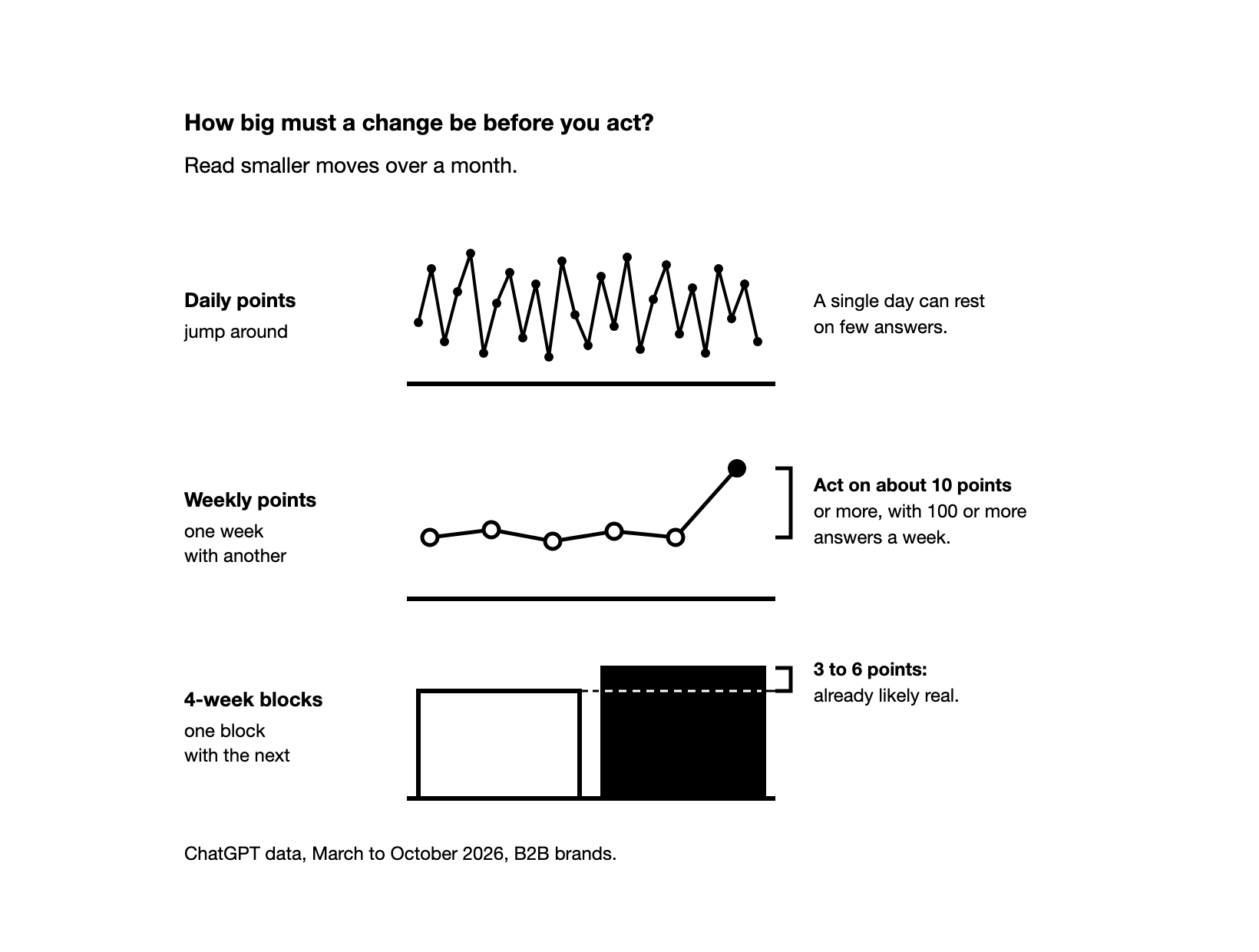
On a chart, use daily points only for a view shorter than two weeks, weekly points up to six months, and monthly points beyond that. Daily points jump around because a single day can rest on few answers. Check how many answers sit behind each point: a week with far fewer answers than usual gives a shakier point.
How big must a weekly change in your brand AI search score be before you act?
Say your score rises 3 points this week. That is about the size of a normal weekly move, so it tells you little yet. We looked at ChatGPT answers in our data from March to October 2026, for B2B brands across software and other fields. Most week-to-week moves in a prompt set's visibility were noise: the median move was about 3 points.
A weekly change was at least 80% likely to be real from about 11 points across all prompt sets. On sets with 100 to 299 answers a week, that bar fell to about 7 points. Under 100 answers a week, no weekly change could be told from noise.
So act on a weekly change of about 10 points or more when your set has 100 or more answers a week, and read smaller moves over a month. To count your answers, each prompt run once a day on one engine adds 7 a week. A single engine's line rests on fewer answers, so it needs a bigger move before you act.
How can you tell if AI visibility is truly improving before you report it?
Is the rise bigger than noise? For a small rise, compare one 4-week block with the next, not one week with another. A steady rise of 3 to 5 points a month is a good sign.
The same ChatGPT data (March to October 2026, B2B brands across software and other fields) backs this. Changes of 3 to 6 points between one 4-week block and the next were already likely real.
Did the prompts, engines or markets change? Adding prompts changes what the score measures. New prompts start at whatever your visibility is for them, so they can pull the score up or down. When that happens, report two numbers: the score on all prompts, and a like-for-like score on the prompts you tracked before. Treat a month that added or dropped an engine or a country as not directly comparable with the last.
Did your competitors rise too? A prompt's results drift over time. We saw this in our data (April to October 2026, B2B brands across software and other fields). From a prompt's first 28 days to its last 28 days, the share of ChatGPT answers naming the brand moved by a median 13 points. Noise alone gave about 4 points.
The data does not show why. Your own work, a competitor's work or an engine change can each move that share. So check your top three: if they rose as much as you did, your standing did not change.
Did the pages you worked on start being cited? That is the clearest sign that a rise came from your work. Which AI visibility metrics matter covers the general method for proving a change is real.
How do you know AI visibility work is paying off without rankings or clicks?
An AI answer has no positions 1 to 10 to climb, and few buyers click through to the pages it cites.
AEO (answer engine optimization) is the work of getting a brand into the answers AI engines write, rather than into a list of blue links. It covers your own site, community and third-party publications. Judge it as something between performance marketing and brand marketing.
That rules out two mistakes. One is expecting an exact dollar value per mention, as with paid ads. The other is calling it unmeasurable, the way brand marketing is often treated. AI visibility is narrower than brand marketing, so a jump in revenue can still be attributed to it.
Instead, look for three signals, in the order they usually appear. The first is about your pages, not your brand. An engine has retrieved your page when the page is among those it gathers from its searches for an answer.
| Signal | What it shows | When it appears |
|---|---|---|
| The pages you worked on are retrieved, then cited | The engines now use what your team made | First: the early win |
| Your score rises against your top three competitors | Buyers meet your brand in more answers, before leads show it | Next: read it every month |
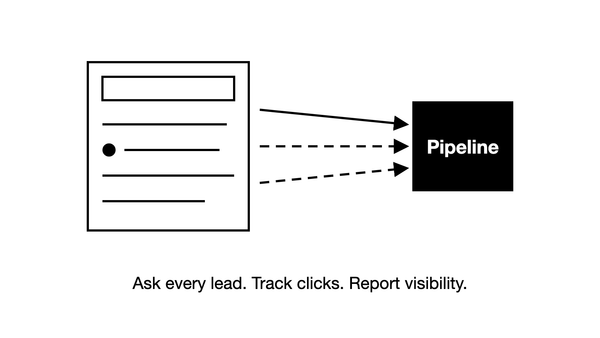
| Leads say an AI engine sent them | The work is reaching your pipeline | Last, and only in part |
The pages you worked on can be your own. They can also be third-party pages (a listicle, a comparison article, etc.) or community pages (a Reddit thread, a forum post, etc.). If nothing you made is retrieved or cited, a rise in your score came from somewhere else.
To see whether ChatGPT retrieved or cited the pages you worked on, open the Sources panel of an answer. It lists cited sources and other relevant links: the pages ChatGPT retrieved for that answer. The links inside the answer text are the ones it cited. Most engines show something similar, and most tracking tools show both lists.
For the third signal, add a "How did you hear about us?" field to your forms, and ask the same question on every demo call. Then watch whether the number of buyers who name an AI engine rises. Expect an undercount: some buyers who found you in an AI answer say they found you on Google.
Set targets as a direction, never a fixed percentage. A good quarter shows a rising score and a smaller gap to your top three competitors.
What should the monthly AI visibility report and the quarterly CFO summary show?
Give AI visibility its own section and KPI in the monthly marketing report, next to the SEO numbers: rankings, organic traffic, Search Console impressions and branded search. How to measure AI search visibility covers the full measurement plan behind the report.
| Line in the monthly report | What it shows |
|---|---|
| Brand AI search score, all prompts | The share of answers that named you this month, the change from last month, and how many answers sit behind it |
| Like-for-like score | The same score on the prompts you tracked before you added new ones |
| Gap to your top three competitors | Their scores next to yours, or your share of voice |
| Score by engine | Where you are named and where you are missing, with AI Overviews and AI Mode on separate lines |
| Pages you worked on | Which ones the engines retrieved or cited for the first time |
| Citations by channel | The share of cited pages from your own site, from community pages and from third-party pages |
| Leads that named AI | "How did you hear about us?" answers that mention an AI engine |
| Sampling note | The same short line every month on how to read the figures |
Citations by channel show which kind of page drove a change. Say your score rose, and third-party pages grew their share of the cited pages while your own pages' share stayed flat. Then your third-party work is the likely cause.
When you split citations by channel, split review sites by page. User reviews count as community, and editorial pages, such as a review site's listicles, count as third-party.
Leave out two things that mislead: a screenshot of one answer, and raw counts of citations. One answer is a sample of one, and raw counts rise and fall with how many answers were collected.
End every report with the same sampling note. Answers vary from run to run, so the figures are directional. Most week-to-week moves are noise, and the trend over several weeks is the signal. The list of cited pages is a floor, because it only covers the prompts you track.
The quarterly summary for the CFO is shorter. It shows the score's direction over the quarter against the top three, the pages the engines started to cite, and the leads that named AI. Add one line on how to judge it: AI visibility sits between performance and brand marketing.
How do you explain AI visibility results to leadership without inventing rankings?
Leaders used to SEO reports will still ask where you rank. The nearest thing an AI answer has is position, and it only compares you with the brands you track.
So "#3" means third among those brands, not third in the market. If you show position at all, label it "order among tracked brands".
They will also ask why analytics shows so little AI traffic. A buyer who saw you in an answer but did not click leaves no trace there. That buyer may come back later as a direct visit or a branded search.
Even the visits that do come by a click are split. In Google Analytics 4 (GA4), the AI Assistant channel counts visits that click through from engines such as ChatGPT, Gemini and Copilot. Visits from AI Overviews and AI Mode count as Organic Search. How to measure AI search visibility covers AI traffic in GA4, Search Console and Bing.
Frequently asked questions
Should the brand AI search score combine every AI engine into one number? Yes for the headline, with a line for each engine under it. An engine you collect many more answers from moves the combined score most, so a rise in one engine can hide a fall in another.
Should a brand with several products track one brand AI search score or several? Track one score for each product line or buyer group, as well as the overall score. A pooled score can rise on your strongest product while a weaker one loses ground. Tag your prompts by product line, then read each group on its own against the rivals the answers name for it.
Why did our brand AI search score drop when nothing changed on our site? First check that the drop is bigger than normal weekly noise. If it is, look at the pages AI cites, not at your own site. Find the cited pages that used to bring your brand into the answers, and check whether they dropped out. Then see which pages the engines cite now, and how many of them name you.
When does a brand AI search score become a vanity metric? When it counts answers that tell you nothing about buyers. A branded prompt such as "What is [brand]?" puts your name in the question, so the answer names you too: keep such prompts out of the score. A mention that describes you wrongly is vanity as well, because it brings visitors who expect something else. How to choose which prompts to track covers which prompts belong in it.
Why do two tools give the same brand a different AI search score? Each tool runs its own prompts, engines, countries and number of runs, and counts a mention its own way. Pick one tool and read its trend. Then spot-check a few of its prompts by hand, logged out, against what it recorded. How AI visibility tools work covers how to check a tool's numbers.