How Many Prompts Should You Track for AI Visibility?
Start with 20 to 30 buyer prompts and grow the set, because trustworthy numbers come from running each prompt daily, not from a longer list.
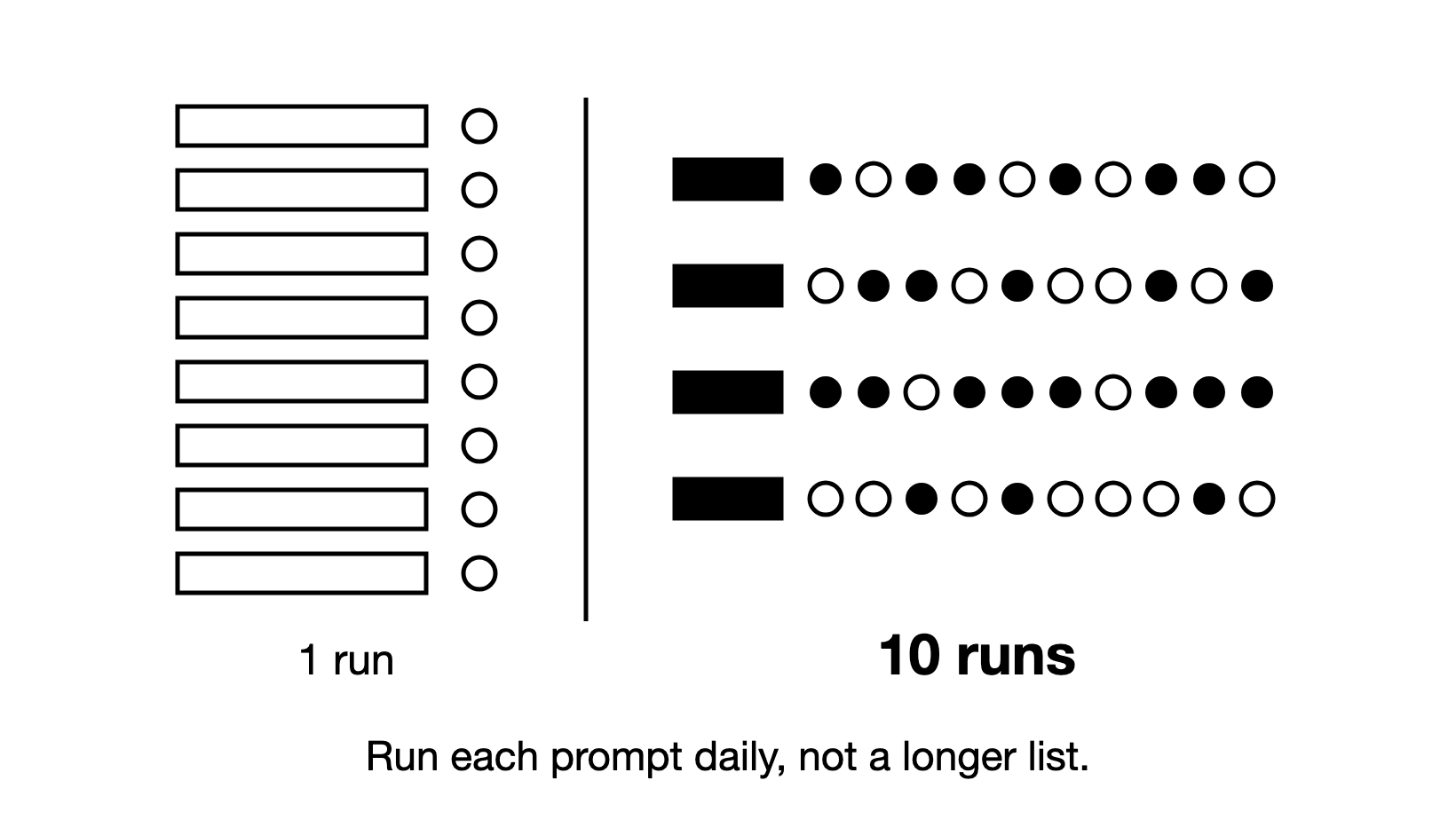
Start with 20 to 30 buyer prompts and grow the set as you find more, because trustworthy numbers come from running each prompt daily, about 10 or more times, not from a longer list.
AI visibility is how often AI engines such as ChatGPT, Gemini and Google AI Overviews name your brand when buyers ask the questions you care about. You measure it as the share of answers that mention you. Tracked prompts are the questions you ask the engines again and again, recording each time whether the answer names you.
How many prompts should you track?
Use one set of prompts for every engine and market you track. These are visibility prompts: questions that name no brand, such as "best CRM for a 20-person B2B sales team".
How many you need depends on your business. A single product sold in one country needs fewer prompts. A company with several products, segments or types of buyer needs more.
Do not stop at the first list. Add a relevant prompt whenever you find one, for example a new question from a sales call. Remove a prompt only when you realise it was tracking the wrong thing. A new prompt starts at whatever your visibility is for it, so adding prompts does not by itself pull your number down.
A longer list covers more questions, but it does not make any single number more accurate. Accuracy comes from how many answers you collect for each prompt.
On a tight budget, cut in this order:
- Track fewer engines. Keep the ones your buyers really use.
- Then keep fewer prompts, still run every day. Ten prompts run daily tell you more than many prompts run once a month.
Why do runs per prompt matter more than the number of prompts?
Every AI answer is just one sample. Say your brand is named in 40% of answers this month. One run shows you 0% or 100%.
We looked at data from the Zadoosh data platform, April to October 2026, B2B brands across software and other fields. Two same-day ChatGPT runs of a prompt named only 53% of the same brands. The pages they cited as sources overlapped even less: 22%.
That is why the most common mistake is one check followed by a big conclusion. Someone asks ChatGPT once, often while logged in, and treats the answer as the truth. A one-off test of 20 prompts has the same problem. It gives one answer per prompt and no trend, so you cannot tell a real result from a lucky or unlucky run.
Most prompts are not all or nothing. On the same data, for 72% of prompts in a given month, ChatGPT named the brand in some answers but not in others. Call the share of that month's answers naming the brand its 30-day share.
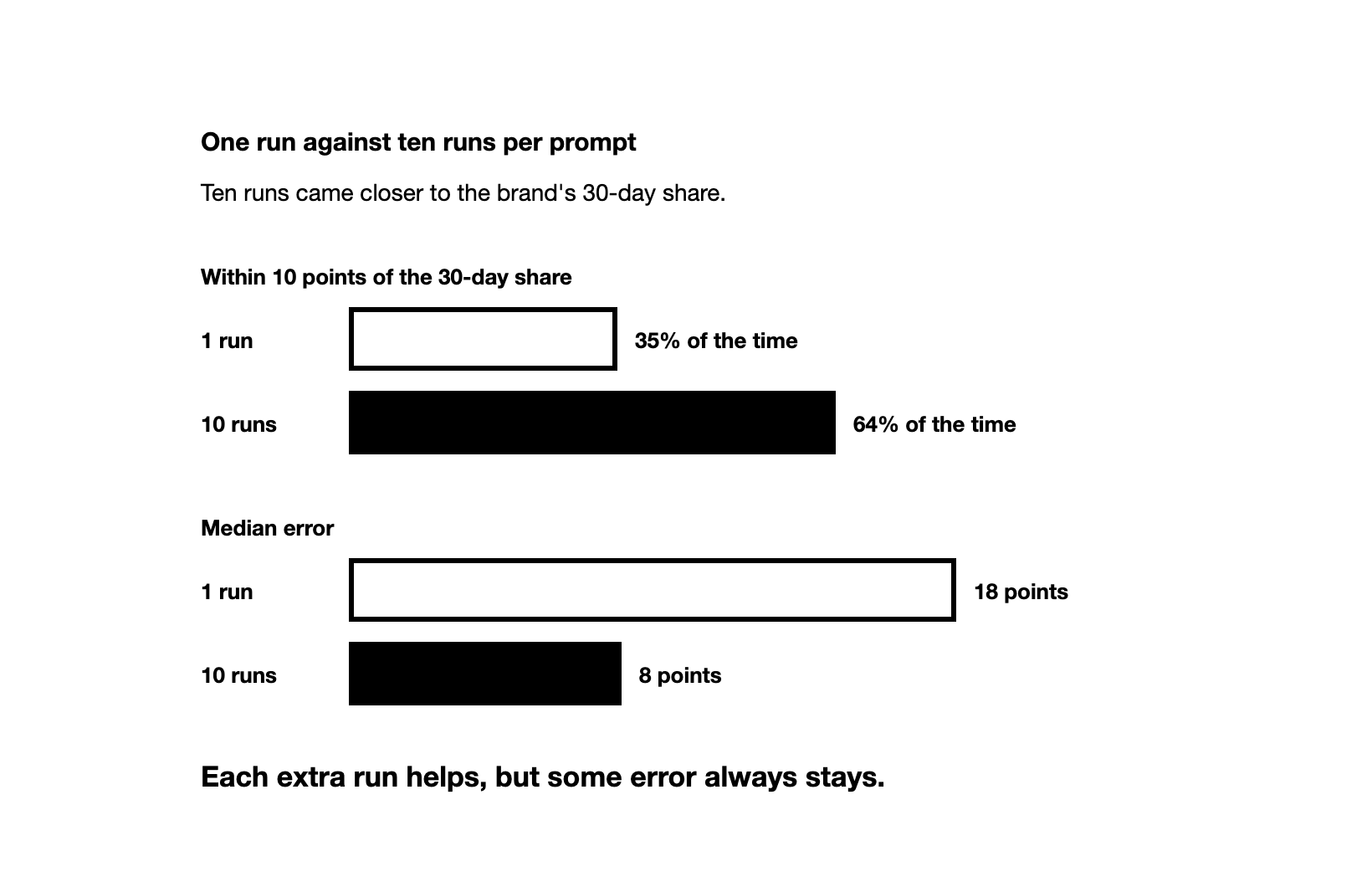
For those prompts, one run came within 10 points of the 30-day share only 35% of the time. Ten runs did so 64% of the time. The typical (median) error fell from 18 points to 8. Each extra run helps, but some error always stays.
So for ongoing tracking, collect about 10 or more answers per prompt, engine and market. In practice that means one run a day per prompt, read as a trend over the month. For a first audit snapshot, 4 to 5 answers per prompt, engine and market give a usable starting read.
How big does a visibility change need to be before you act?
Say your visibility rises by a few points this week. That is a normal weekly move, and it is mostly noise. We looked at data from the Zadoosh data platform, March to October 2026, B2B brands across software and other fields. The typical (median) weekly move in ChatGPT visibility was about 3 points.
A weekly change was likely real (about 80% likely) from about 11 points. If your prompts collect 100 to 299 answers a week, 7 points was enough. Over a month, even a change of 3 to 6 points was likely real.
So act on a weekly change of about 10 points or more, when your set collects 100 or more answers a week. Read smaller changes as a trend over about a month. Twenty prompts run once a day on one engine give you 140 answers a week, enough to read a weekly change.
Does an AI visibility baseline stay trustworthy?
A baseline is your starting numbers, recorded over a few weeks before you change anything. It does not stay fixed for long. We looked at data from the Zadoosh data platform, April to October 2026, B2B brands across software and other fields.
Take one prompt and the share of its ChatGPT answers that name your brand. From its first four weeks to its last four, that share moved by a typical (median) 13 points. Noise alone would explain only about 4 points.
Engines change how they answer, and the market changes the right answer. So keep running the prompts every day instead of trusting a number from two months ago.
When you add prompts, report a like-for-like number on your original set next to the all-prompts number. Then a change in the mix of prompts is not read as a change in performance.
Should you count prompts per category or as one list?
Count them per category you plan to report on. If you will report visibility for each buyer role, each buying stage or each market, each category needs enough prompts and answers to be read on its own. Split your prompts evenly across the stages and roles you serve, so no category rests on two or three prompts.
The Zadoosh AEO platform lets you group tracked prompts by category and read each group on its own.
Which prompts should stay out of the count?
Informational prompts such as "What is employee engagement?" get a definition and rarely name any brand. Keep them, if at all, as a separate watch list for citations only (your pages linked as sources).
Prompts that name your brand, and "[your brand] vs [competitor]" prompts, force you into the answer. They show how AI describes you, so track them as positioning prompts, never in visibility %.
Frequently asked questions
How do I set up prompts quickly when my tool gives no industry templates? Start from your own website, with each product page and use case rewritten as a question in buyer words, or start from the free Zadoosh Prompt Builder. Prompts built from your own positioning tend to find the niche where you already win, so move over time to buyer language from sales calls, research and communities. Add a short "do not drift into" list of neighbouring categories, so your prompts stay in your own market. Our guide to choosing prompts to track covers the full method.
Does every prompt need to run every day? Prompts that ask for recommendations, "best" lists or comparisons do, because their answers keep changing. A prompt with one fixed answer, such as the year your company was founded, needs only a second run to catch a wrong answer.
How many engines should I track? The ones your buyers really use. For another market, run the same prompts in that market's language, with that country set.
Why does ChatGPT give different answers to the same question? Each answer is generated fresh, so the brands named and the pages cited change from run to run. That is why you read visibility as a rate over many answers, never from one answer.