How to Track Brand Sentiment in AI Answers
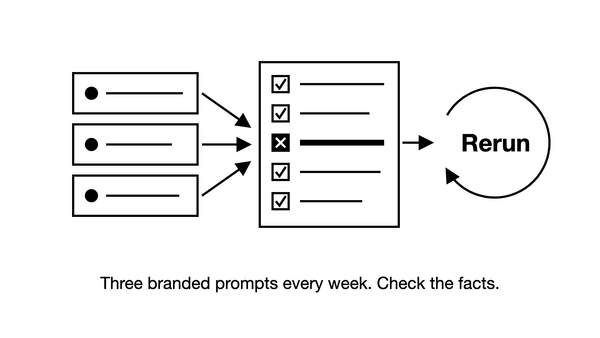
Run three branded prompts every week, such as "What is [brand]?" and "[brand] pros and cons", and record the tone and the words each AI answer uses.
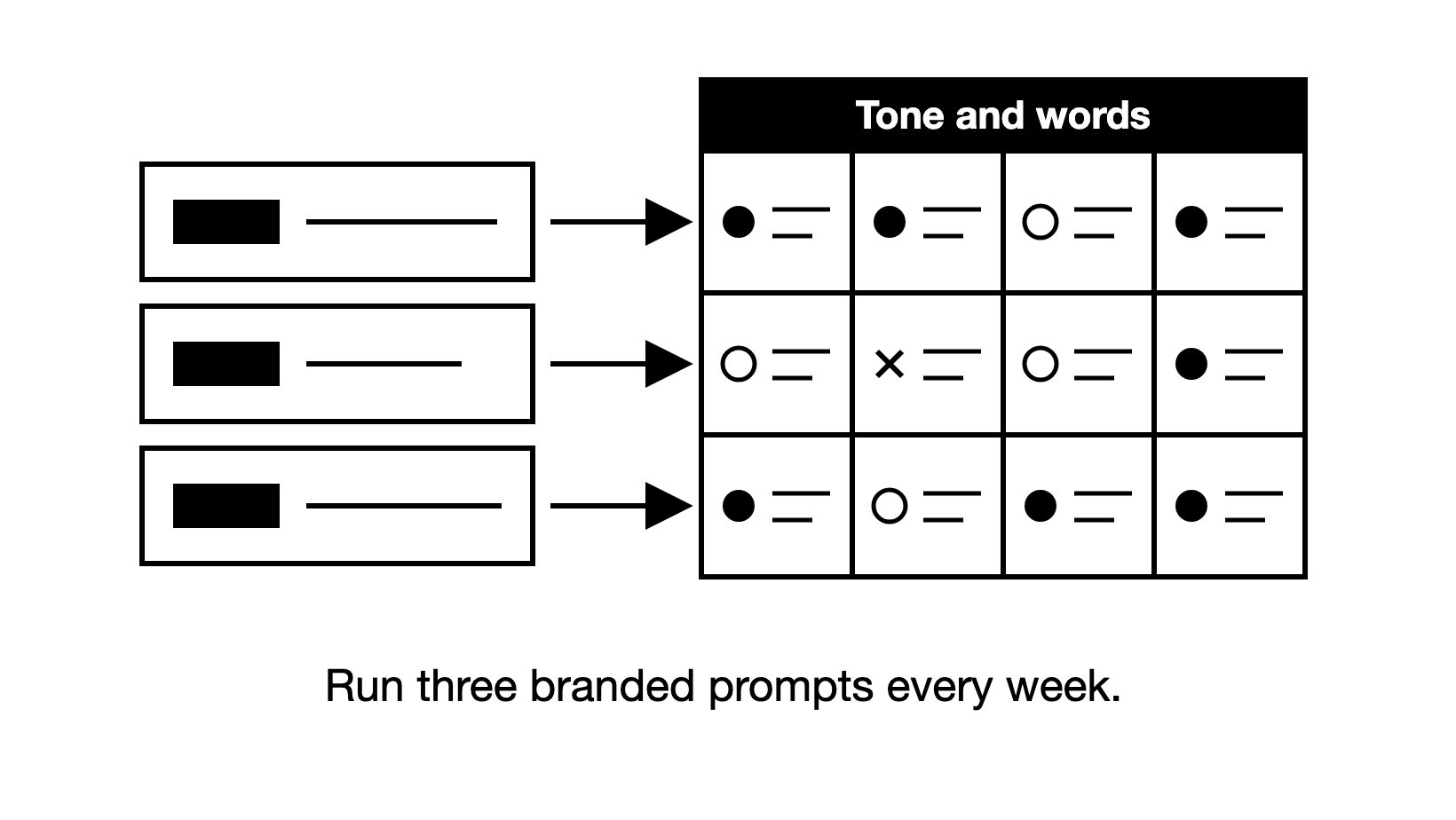
To track brand sentiment in AI answers, run three branded prompts every week ("What is [brand]?", "[brand] pros and cons" and "Is [brand] good for [use case]?") and record the tone and words each answer uses.
What is brand sentiment in AI answers, and why does it matter?
Sentiment is whether AI answers describe your brand positively, neutrally or negatively. It is a positioning check (what AI says about you), tracked weekly next to visibility. Beyond the label, the words the answers attach to you, such as expensive or easy to set up, are what you act on. Because the engines run on large language models (LLMs), it is also called LLM brand sentiment.
Keep it apart from AI visibility. AI visibility is how often AI engines such as ChatGPT, Gemini and Google AI Overviews name your brand when buyers ask the questions you care about. It is measured as visibility %: the share of answers to your visibility prompts that mention you.
Visibility prompts name no brand, for example "best CRM software". Your brand is mentioned when an AI answer names it in its text, first or fifth, with a link or without one. Sentiment checks use branded prompts instead: prompts that name your brand on purpose, to see what AI says when asked about you directly.
Most teams first make sure they show up in AI answers. How AI describes them comes next, and it matters most late in a purchase. A buyer with you on a shortlist may ask an engine about you by name before contacting sales.
You do not see the answer that buyer got unless they share it, and no tool sees it either. Running the same branded prompts yourself shows what the engines say about you today.
How do AI brand sentiment, brand reputation and social listening differ?
The pages an AI engine cites when it answers fall into three groups. They are your own pages, third-party pages (a listicle, an editorial review page, etc.) and community pages (a Reddit thread, user reviews, etc.). Social listening covers the community group. A sentiment check reads the answer the engine writes from all three.
Tracking your brand reputation on AI search engines means tracking what the answers say about you. So it uses the same method as sentiment: the three branded prompts in the next section.
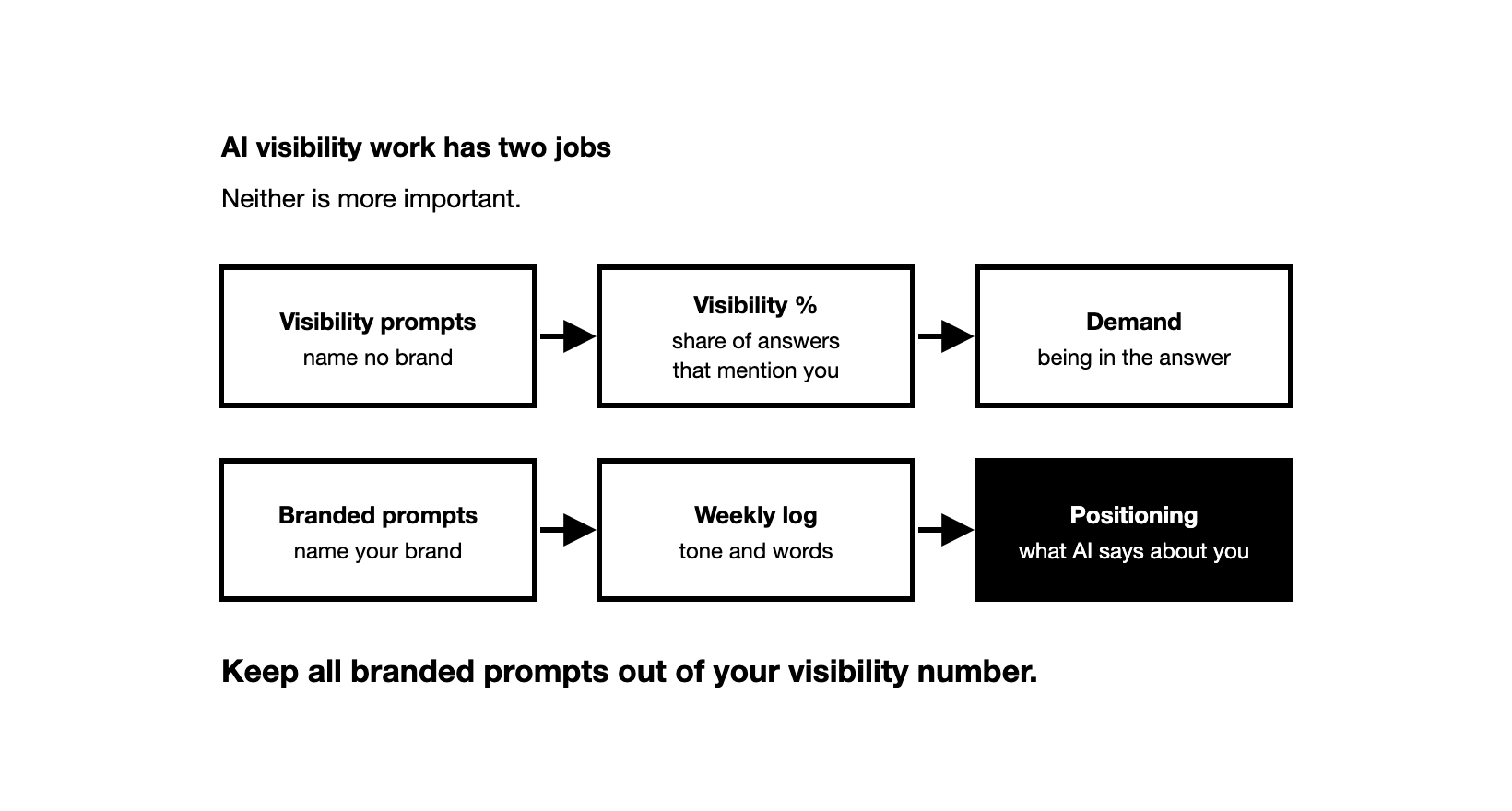
AI visibility work has two jobs, and neither is more important. Demand is being in the answer when a buyer looks for a solution, and your visibility % measures it. Positioning is what AI says about you, read across answers for patterns and repeated words, then fixed where it does not match how you want to be known.
| Question | Social listening | Brand sentiment in AI answers | AI visibility |
|---|---|---|---|
| What do you read? | People's posts, threads and reviews | Answers to branded prompts | Answers to visibility prompts |
| Which job does it serve? | Reputation with people | Positioning: your reputation in AI answers | Demand |
The two jobs are linked. A mention with the wrong words counts in your visibility % but drives no demand, because the visitor arrives expecting something else. Say AI answers keep calling a premium product a budget option. Buyers who want a budget option click through, see the pricing and leave.
The checks also differ in what you can do next. You can reply to a post or a review, but not to an AI answer. You change an AI answer by changing the pages the engine cites, as the tracing step below shows.
Which prompts should you run to track brand sentiment in AI answers?
| Prompt | What it shows | What to read in the answer |
|---|---|---|
| What is [brand]? | Whether the engine knows who you are | The category it puts you in, who it says you are for, any mix-up with another company |
| [brand] pros and cons | The words AI attaches to you | The pros and cons that come back each week, and any that are out of date |
| Is [brand] good for [use case]? | Whether AI sees you as a fit for your best buyers | A clear yes or no, and the kind of buyer it says you suit |
Fill [use case] with the job your best-fit buyers hire you for, in their words. For a CRM, that could be "Is [brand] good for a 20-person B2B sales team?". If you sell to two clearly different kinds of buyer, run the third prompt once for each.
How does "What is [brand]?" show whether AI knows who your company is?
Run "What is [brand]?" first. It is an identity check: before you read the tone of an answer, make sure the engine is describing the right company.
When ChatGPT searches the web, it typically rewrites the question into one or more targeted searches, a step known as query fan-out. Our guide to query fan-out shows how to see those searches for your own prompts. For "What is [brand]?", check that those searches look for your company, not a different company.
Pick one descriptor: a short line that tells your company apart from anything else with your name. Use it word for word on your site and off it: your homepage, your About page and your profiles on review sites and directories. Then check that the "What is" answer repeats it. If the answer puts you in the wrong category, fix that first.
If your name is also a common word or another product's name, add your category to all three prompts, for example "What is [brand], the [category] software?". Then count only the mentions that clearly mean you.
Why do brand sentiment checks stay fixed and out of your visibility number?
Keep the wording of all three prompts the same every week, so each week compares with the last. Three prompts are enough for a weekly check. You do not need a separate prompt for each theme buyers weigh, such as pricing or support. The "pros and cons" answer brings those themes out, and you tag each recurring word with its theme when you log it.
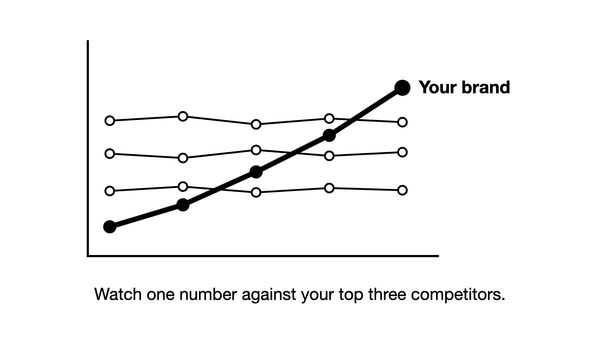
A "[brand] vs [competitor]" prompt is a separate positioning check. It shows how AI sets you against one rival, not how it describes you on your own. To compare the words AI uses about your rivals, run the same three prompts for each of your top three competitors.
Keep all branded prompts out of your visibility number. Your prompt set is the list of buyer questions you run on AI engines again and again to measure visibility.
A branded prompt forces your name into the answer. Counted in the set, it would push your visibility up without showing whether buyers find you. Put the three checks in a group of their own and read them apart.
Where and how should you run brand sentiment prompts?
Run the three prompts on every engine your buyers use, each time in a fresh chat and logged out. ChatGPT may use saved memories when it rewrites a search, so a logged-in check about your own brand can be shaped by your own history.
Run each prompt more than once a week on each engine, and save the full answer text, the date, the engine and the cited pages. The same question can get a different answer each time.
How to choose which prompts to track covers which engines to track and how many runs each prompt needs. If you sell in other countries, tracking AI visibility by location and language shows how to run the prompts from each one.
How do you score the tone of every AI answer the same way?
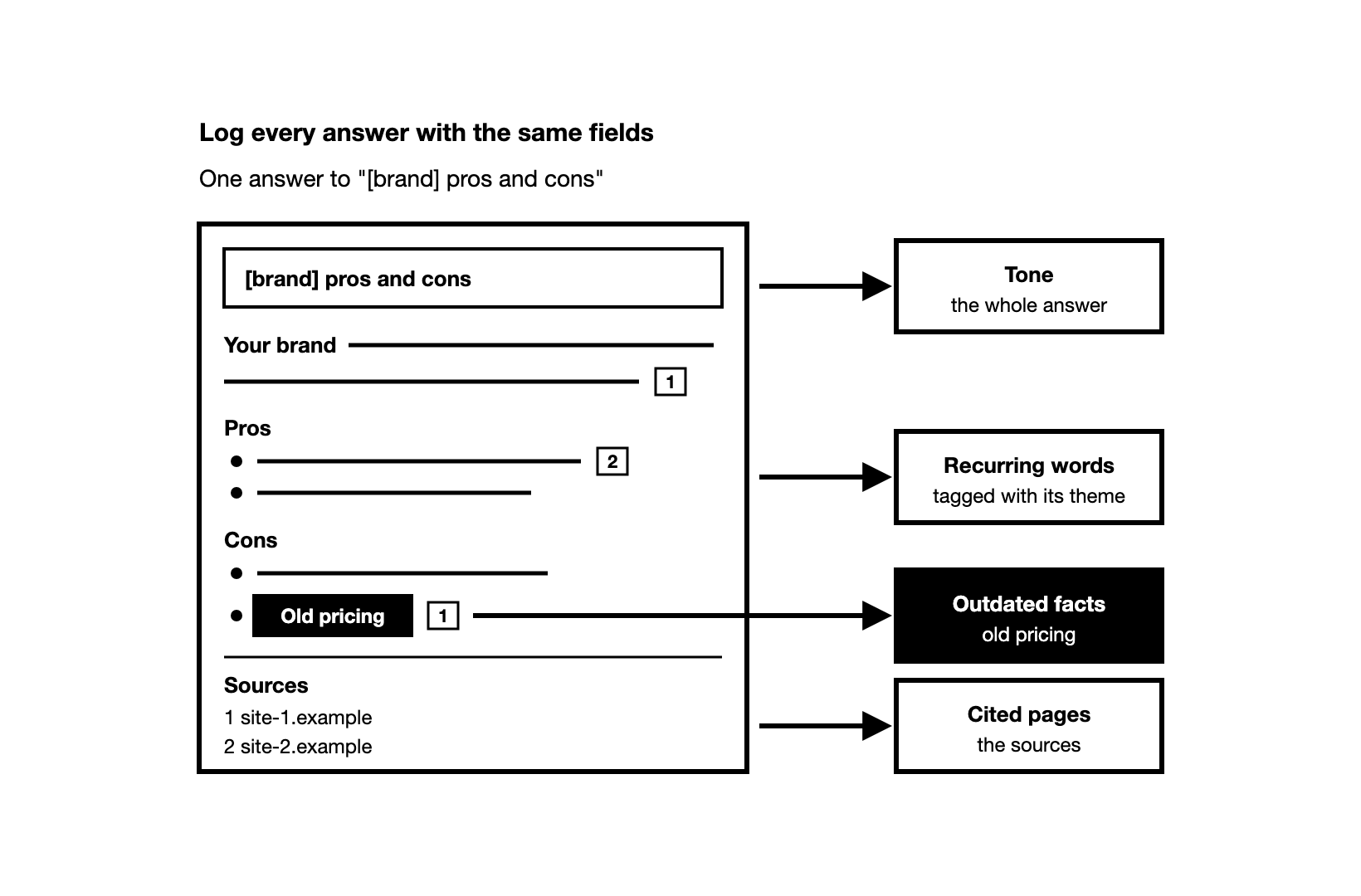
Log every answer with the same fields, in a sheet or a tool:
| Field | What to record |
|---|---|
| Tone | One label for the whole answer: positive, neutral or negative |
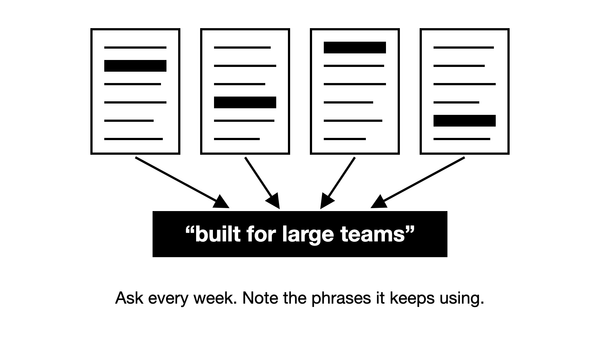
| Recurring words | The words used about you, each tagged with its theme (pricing, support, setup, etc.) |
| Use case verdict | For "Is [brand] good for [use case]?": yes, yes with reservations, or no |
| Outdated facts | Old pricing, old features or a category you have left |
| Wrong list | Being named among options you do not belong with, such as "cheapest options" for a premium product |
| Cited pages | The pages the answer shows as its citations |
Two numbers come out of the log. The first is the share of answers that are positive, neutral and negative, per prompt and per engine. The second is how often each recurring word comes back.
Do not skip neutral answers. A neutral answer can still state an outdated fact, put you in the wrong list or use the wrong words about you.
How do you trace brand sentiment back to the pages an AI answer cites?
When a word or a fact keeps coming back, open the pages behind it. In ChatGPT, select Sources, when available, to see the cited sources and other relevant links. The Gemini app shows a Sources button under the response or inside it when the answer has sources. Perplexity numbers its citations, each linked to its source.
Find the page that carries the word, and note which group it belongs to: your own pages, third-party pages or community pages.
Most of the pages AI answers cite are not the brand's own. We looked at data from the Zadoosh data platform, all engines, April to October 2026, B2B brands across software and other fields. The data covers answers to every prompt tracked, not branded prompts alone.
Third-party pages were 80% to 86% of the pages AI answers cited, depending on whether review sites count as third-party or community. Community pages were 8% to 15%, and the brand's own pages about 6% (April to October 2026).
Fix your own pages first, because you control them. Then ask the owners of third-party pages with old facts to update them. If community threads keep raising the same complaint, check whether it is true. If it is, take it to your product or support team.
An answer that cites no page may draw on what the model learned in training, so not every negative phrase has a page behind it.
Why does the same brand get different sentiment in ChatGPT, Perplexity and other AI engines?
Each engine runs its own searches and cites its own pages. Google says AI Overviews and AI Mode may use query fan-out, issuing more than one related search to build one answer. Different searches return different pages, so one engine can describe you warmly while another repeats an old complaint.
The share of brands' own pages also differs by engine. In the same data, for B2B brands across software and other fields, the brand's own pages were about 14% of the pages Perplexity cited (June to October 2026). In ChatGPT they were about 4% (April to October 2026).
Read each engine on its own line. If you average the engines into one score, a problem in one of them can get lost in the average. When one engine stands out, compare the pages it cites with the pages the others cite, and start with the pages only that engine cites.
How far can you trust automated brand sentiment scores?
Trust a sentiment score as far as you can check what is under it: how many answers it rests on, where they were captured and how they were labelled.
Start with the number of answers. Say ChatGPT calls you expensive in about half its answers to "[brand] pros and cons". A single run either shows the word or does not, so a score built on one run can move from week to week by chance.
We looked at ChatGPT data from the Zadoosh data platform, April to October 2026, B2B brands across software and other fields. The 30-day share is the share of a month's answers that named the brand. For prompts where the brand is named in some answers but not all, one random run came within 10 points of the 30-day share 35% of the time. With 10 runs, the result came that close 64% of the time (April to October 2026).
That figure is about whether the brand is named, not about tone. A tone score built on one answer per prompt is a thin sample in the same way. Ask a tool how many runs sit behind each score, and read each week against the weeks before it.
Next, make sure you can open the answer behind every score, so you can check the label against the words.
Prefer answers captured from the engine's app or website, because they are closer to what buyers see. Answers pulled through an engine's API, the direct route software uses, may not match them. Perplexity, for one, says its API and web results can differ. How AI visibility tools work explains why.
Then calibrate once a month. Take a handful of scored answers and label them yourself before you look at the tool's labels. Where your label and the tool's differ, read the answer to see why, and keep that in mind when you read the tool's trend.
When two tools disagree, compare what each does differently: the prompts, engines, country, runs and how it scores a neutral answer. Pick one, read its trend, and spot-check a few prompts by hand.
How often should you recheck brand sentiment in AI answers?
Run the three branded checks every week. Even many runs this week cannot tell you what an engine will say about you next month. Engines change how they search and choose pages, and the pages they cite change too.
Once a month, and after any change you make, such as a new price or plan, run a fact checklist. Check what the answers say about your pricing, features, category, who you are for and your company facts. Any fact that is out of date goes through the tracing step above.
After a fix, do not judge it by the next answer you get. One answer is one check, and drawing a conclusion from one check is the most common mistake we see. Compare the weeks after the fix with the weeks before in your log, for each recurring word and on each engine.
Frequently asked questions
Can ChatGPT do sentiment analysis on AI answers about your brand? Yes. You can paste a batch of answers into ChatGPT and ask it to label each one positive, neutral or negative, and to list the words used about your brand. Keep the instruction the same each week, and check a few of its labels by hand each month.
What do positive, neutral and negative brand sentiment look like in an AI answer? Take the prompt "Is [brand] good for a 20-person B2B sales team?". A positive answer says yes and gives a reason that fits, such as fast setup. A neutral answer lists your features without a view. A negative answer says you suit larger teams and points the buyer to other tools.
Can you track brand sentiment in AI answers for free? Yes, by hand. Open each engine logged out, run the three branded prompts and log the answer text, tone and cited pages in a sheet. A hand check gives you a sense, not a verdict, because answers change from run to run. For more runs than you can do by hand, the Zadoosh AEO platform's free trial runs the prompts for you. As of November 2026, it tracks 25 prompts for 7 days on ChatGPT, Gemini, Perplexity, Copilot, AI Overviews and AI Mode, with no card. In the platform, give the three branded prompts their own prompt category and read that category on its own.
Does positive brand sentiment in AI answers mean AI recommends your brand? No. An answer to a branded prompt names you because the prompt asks about you. So a warm tone in that answer says nothing about whether AI picks you when a buyer asks for options. Being recommended means an answer names you as the best fit, not just one option in a list. It is its own measure, read in answers to visibility prompts, which name no brand. Which AI visibility metrics matter covers how to measure each one.