How to Analyse AI Citation Gaps Against Competitors
Find the answers to your buyer prompts that name a rival but not you, then compare the pages cited there with yours, page type to page type.
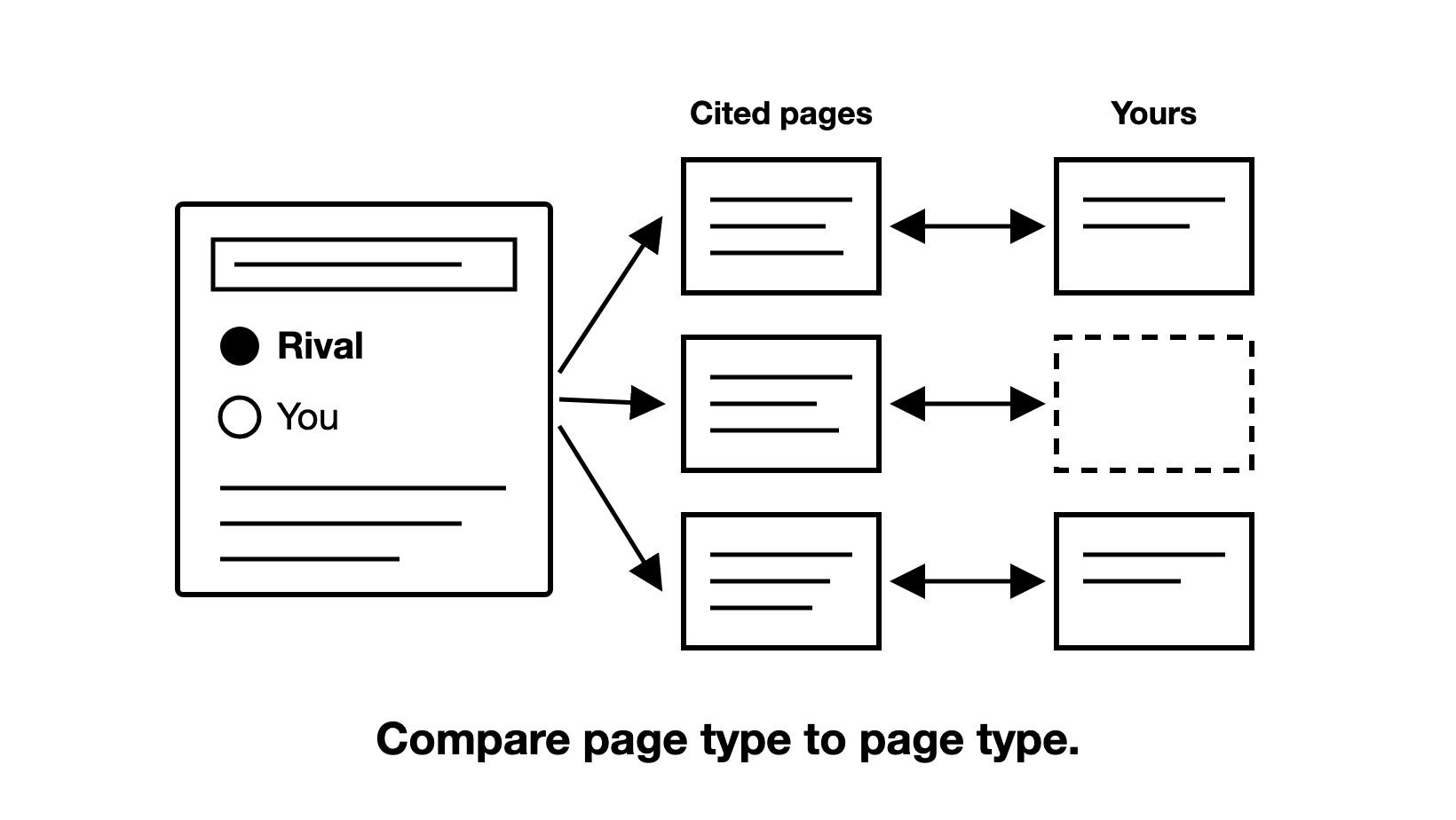
To analyse citation gaps against competitors, find the answers to your buyer prompts that name a rival but not you, then compare the pages cited there with yours, page type to page type.
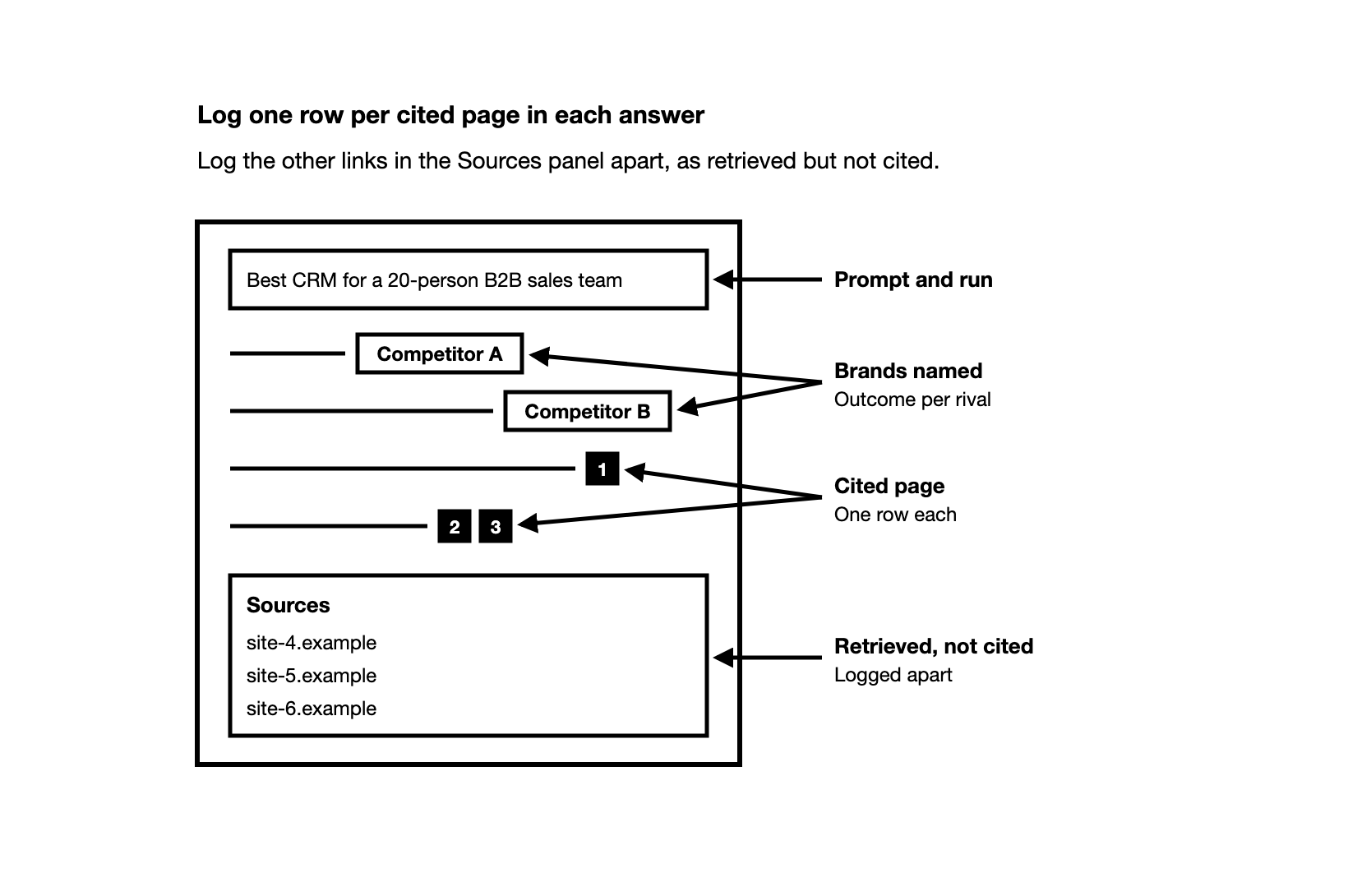
Say a buyer asks ChatGPT for the best CRM for a 20-person B2B sales team. That question is one of your buyer prompts. The answer names two of your rivals but not you, and it cites three pages: a "best CRM" listicle (a list article), a review page and one rival's comparison page. That answer is a loss, and those three pages are your evidence of why the engine named your rivals.
Collect enough losses across prompts, runs and engines, and a pattern appears. You see which pages the engines rely on when they name a rival instead of you, and which of those pages you can do something about.
What is an AI citation gap analysis?
An AI citation gap analysis is a focused part of measuring AI visibility. It studies the pages AI answers cite when they name a competitor and not you. The wider question of why your brand is missing from AI answers is covered in AI search visibility gap analysis.
A citation is a page an answer shows as a source for what it says. It can be your own page, a third-party page (a competitor's page, a listicle, etc.) or a community page (a Reddit thread, a forum post, etc.). Buyers rarely click citations, but engines use the cited pages to decide which brands to name.
Being named and being cited are different signals. Your brand is named (mentioned) when it appears in the answer's text, whether or not any page of yours is cited. The names tell you which answers to study. The pages those answers cite are what you study.
Score every answer against one rival at a time. The same answer can be shared with one rival and won against another. Against each rival, every answer has one of four outcomes:
| Outcome | What the answer names | Do its cited pages count as evidence? |
|---|---|---|
| Lost | The rival, not you | Yes. These pages are your gap |
| Shared | You and the rival | No. The same pages served you both |
| Won | You, not the rival | No. This answer is the rival's loss |
| Nobody | Neither of you | No. The engine made no choice between you |
Count the shared and nobody answers as well, so you know how often each outcome happens. Keep their cited pages out of the evidence, though. Mixed in, they fill your list with pages that never cost you an answer.
A citation gap is a topic where the engines cite a rival's pages and never cite yours. It is not the same as an SEO content gap, which lists topics you have no page for. A citation gap can also sit on a topic you already cover, with a page the engines never cite.
So compare page type to page type: the rival's comparison page against yours, its docs (help and documentation pages) against your docs. Each page type answers a different kind of question, so a strong guide of yours does not make up for a missing comparison page. Each gap then reads one of two ways. "Page exists, never cited" means you fix the page you have, and "no page covers it" means you write one.
Why do AI answers name your competitors instead of you when your Google rankings look fine?
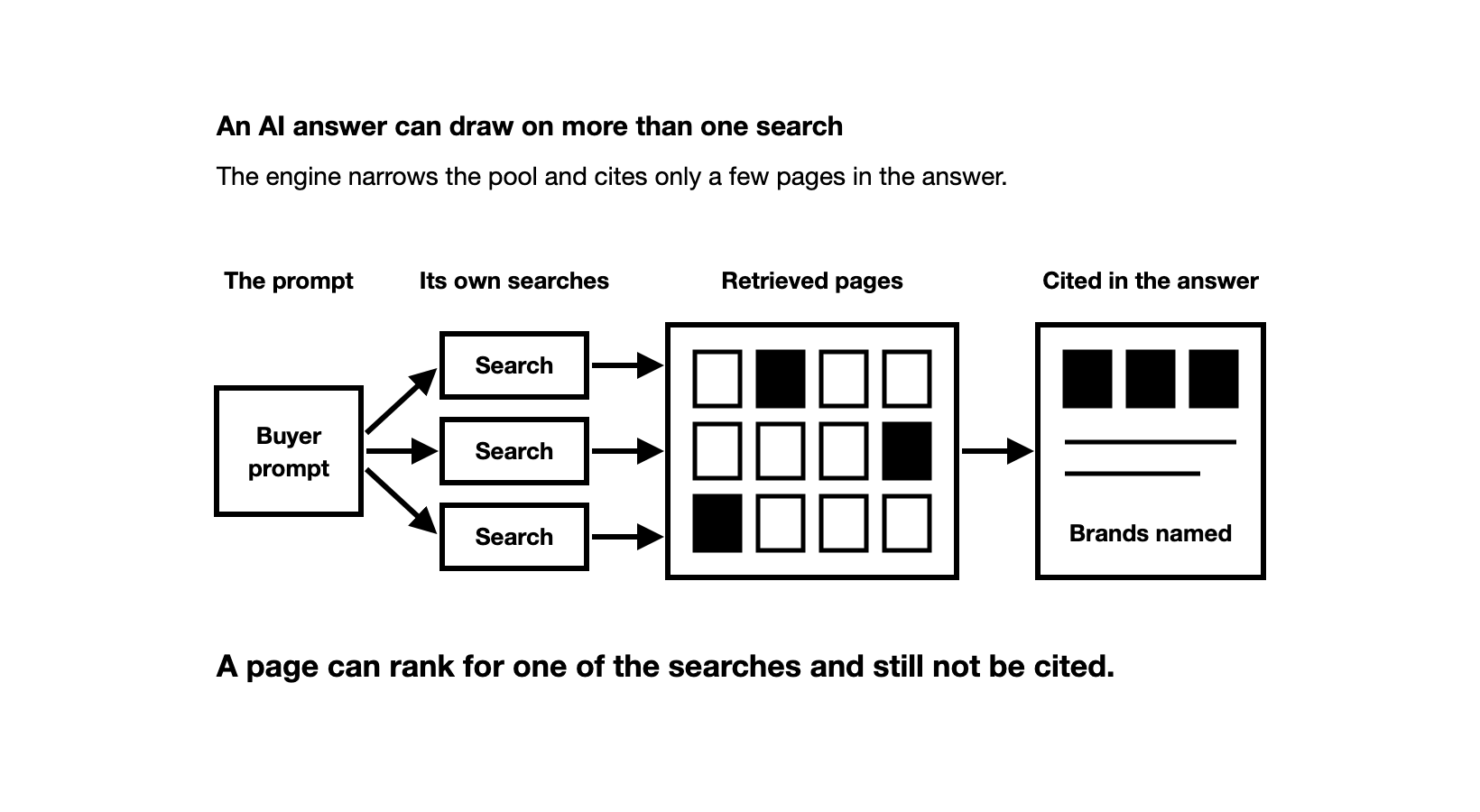
A Google ranking is a position on one results page, for one search. An AI answer can draw on more than one search. OpenAI says ChatGPT search "typically rewrites your query into one or more targeted queries".
The engine works out what the buyer wants and turns the prompt into its own searches, a step called query fan-out. Google says AI Overviews and AI Mode may use query fan-out to build a response.
We looked at data from the Zadoosh data platform, October 2026, B2B brands across software and other fields. ChatGPT ran a median of 2 web searches per answer (mean 2.8), and 7% of answers ran 6 or more. Only ChatGPT's searches are recorded in our data. A page that ranks for your main keyword may not show up for the other searches.
From what those searches return, the engine pulls in a pool of pages. These pages are retrieved. The engine then narrows the pool and cites only a few pages in the answer. So a page can rank for one of the searches and still not be cited.
Your SEO work still counts for AI Overviews and AI Mode. Google says a page must be indexed and eligible to be shown with a snippet in Google Search before either can show it as a supporting link. But an eligible page is not always cited.
Most of what gets cited also sits on other people's sites. In our data (April to October 2026, all engines, B2B brands across software and other fields), third-party pages were 80% to 86% of the pages AI answers cited. Community pages were 8% to 15%, and the brand's own pages about 6%. The range depends on how review sites are counted: 86% when they count as third-party, 80% when they count as community.
In the same data, the brand's own share of cited pages differed by engine:
| Engine | Brand's own pages, as a share of cited pages | Months of data (2026) |
|---|---|---|
| Perplexity | About 14% | June to October |
| Copilot | About 13% | June to October |
| AI Overviews | About 8% | June to October |
| Gemini | About 7% | June to October |
| AI Mode | About 7% | June to October |
| ChatGPT | About 4% | April to October |
A brand that is strong only on its own site covers a small part of what the engines cite. A rival named in the listicles, review pages and threads the engine's searches return gets many more chances to be named. A rank tracker shows none of this, which is why a citation gap analysis starts from the AI answers themselves.
Which buyer prompts and competitors belong in a citation gap analysis?
Use buyer prompts that never name your brand. The general method for choosing them is in how to choose which prompts to track, and how many prompts to track covers the size of the set. For a gap analysis, one more test matters: can the prompt produce a loss at all?
| Prompt type | Example | Use it for a gap analysis? |
|---|---|---|
| Category | "Best CRM software" | Yes |
| Category plus context | "Best CRM for a 20-person B2B sales team" | Yes |
| Alternatives | "Best alternative to [competitor] for [need]" | Yes, scored against your other rivals |
| Buyer intent | A full buyer situation: role, company, need and constraints | Yes |
| Branded | "What is [your brand]?" | No. It forces you into the answer |
| You vs a competitor | "[Your brand] vs [rival]" | No. It forces both of you in |
| Competitor vs competitor | "[Rival A] vs [Rival B]" | No. It names two rivals, so the answer is built around them |
| Informational | "What is employee engagement?" | No. It rarely names any brand |
The first four types are visibility prompts. They never name your brand, so the engine chooses freely, and they are the prompts behind your visibility (the share of answers that name you). An alternatives prompt names one rival itself, so that rival showing up in the answer tells you nothing.
Leave out prompts for things you do not sell, too: they create a gap you could never close. To draft buyer intent prompts, the free Prompt Builder works from your segment, personas and buying stage.
Your competitors here are the brands the engines name for your prompts. They are not always the brands you assume you compete with. Run the prompt set for a few days, list every brand the answers name, and start with the three that come up most often. If a rival you expected never appears, your prompts may be too generic.
Then write down every domain each rival owns: its main site, blog, help centre, docs and any product subdomains. In this analysis, each rival's own site is a channel of its own. Without the domain list, its pages are counted as third-party pages, and its strength on its own site disappears into that count.
How do you run the prompts across AI engines and log every cited page?
Run the same prompts on each engine your buyers use, from the country you sell in. For B2B buyers, that means ChatGPT, Gemini, Perplexity, Copilot, AI Overviews and AI Mode, plus Claude if your buyers work in tech. On a small budget, cut engines before you cut prompts or runs.
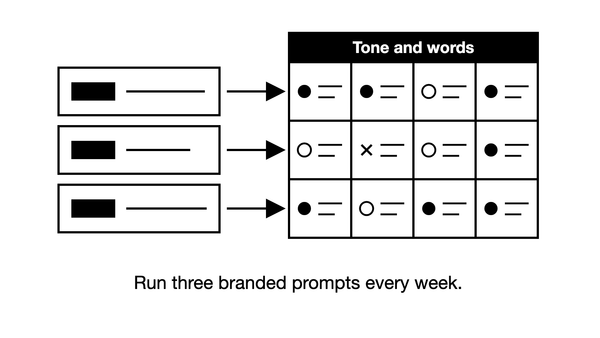
Run each prompt 4 to 5 times per engine and country for a first analysis, as you would in a first AI visibility audit. Once you track it, run each prompt about 10 or more times, one run a day. Two or three runs give only a sense. Why answers change between runs is covered in can AI visibility be measured.
Cited pages change between runs more than brand names do. In our data (April to October 2026, B2B brands across software and other fields), two same-day runs of one ChatGPT prompt shared 53% of the brands named. They shared only 31% of the cited sites and 22% of the cited pages.
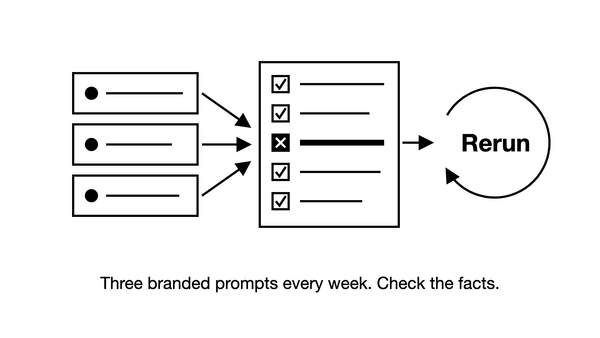
So never build a gap list from one run. Count how many runs cite each page, and treat a page cited only once as a weak lead.
Run the prompts in a clean session: a fresh chat, logged out or with memory off. OpenAI says saved memories can shape the searches ChatGPT runs, and that a VPN changes the location it infers from your IP address. Country and language settings are covered in tracking AI visibility by location and language.
Each engine shows its cited pages in its own way:
| Engine | Where to find the cited pages |
|---|---|
| ChatGPT | Links inside the answer. The Sources panel shows "cited sources and other relevant links", in OpenAI's words |
| Perplexity | Numbered citations that link to the original sources |
| Gemini | A Sources button at the bottom of the response or in the text. Not every response has one |
| AI Overviews and AI Mode | The supporting links shown with the answer |
In ChatGPT, log the links inside the answer as cited. Log the other links in the Sources panel apart, as retrieved but not cited, so the two never mix. For the other engines, log the links each answer shows as its citations.
Then log one row per cited page in each answer:
| Column | What to record |
|---|---|
| Date, engine and country | When and where the answer ran |
| Prompt and run | Which prompt, and which of its runs |
| Brands named | You and each tracked rival: named or not |
| Outcome per rival | Lost, shared, won or nobody |
| Cited page | The full address of the page |
| Owner | Your site, a rival's site, community or third-party |
| Page type | Listicle, comparison, review, guide, docs, pricing page, landing page, etc. |
| Brands on the page | Which tracked brands the page itself mentions (check this for lost answers only) |
Clean the URLs before you count them: use https, drop "www" and trailing slashes, and strip tracking tags such as utm_source. Otherwise one page counts as two.
How do you benchmark your AI citations against a competitor, topic by topic?
How do you measure citation share against a rival?
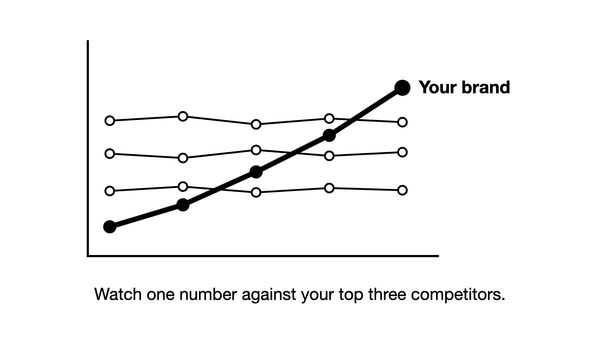
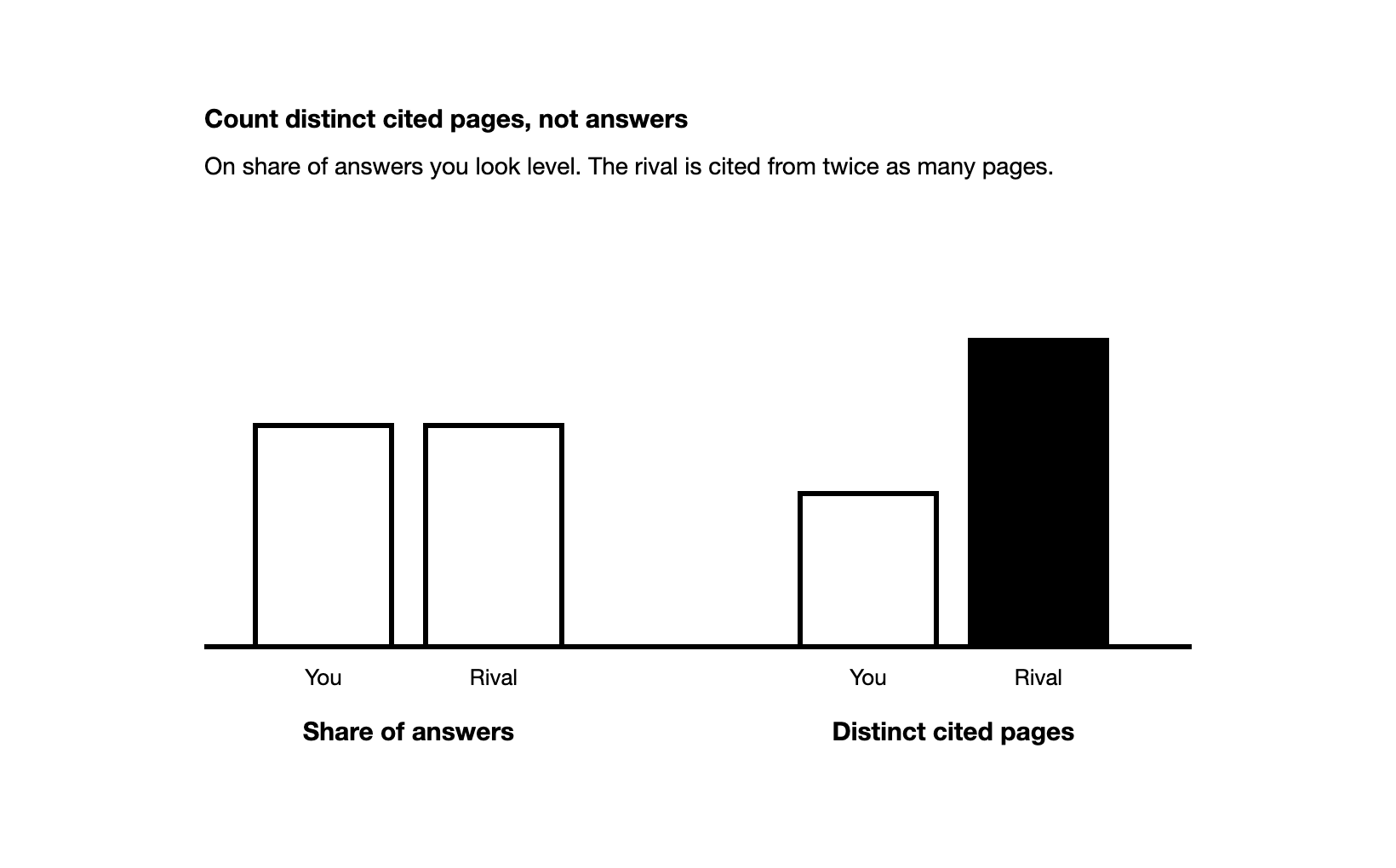
Citation share is the share of the pages cited for your prompts that come from a given source. Count distinct cited pages, not answers. Make the same count for each rival, over the same prompts, engines and dates.
Share of answers is a different measure: the share of answers that cite at least one of your pages. It cannot tell one page cited in every answer from many pages cited once each.
Say you and a rival each have a page cited in the same share of answers, so on that measure you look level. Now count distinct pages: the rival's citations may come from twice as many pages as yours. The rival has far more pages that can come up in the engine's searches, and share of answers does not show it.
Split the count by channel: your own site, the rival's own site, community and third-party. Review sites mix kinds of pages. Their user reviews count as community, and their editorial pages, such as category and comparison pages, count as third-party. Class them the same way for you and for every rival.
Then read each channel against the rival:
| Channel | What to compare | A gap here points to |
|---|---|---|
| Own site | Your distinct cited pages against the rival's distinct cited pages | Your own pages, page type by page type |
| Community | Cited threads and posts that name the rival against those that name you | Threads you could take part in |
| Third-party | Cited listicles, reviews and articles that name the rival against those that name you | Publications that do not mention you yet |
How do you compare page types, topic by topic?
Group your prompts into topics by the need behind them, such as pricing, integrations or one use case. Then list the page types cited in your losses for each topic. A brand can lead across all its prompts and still lose on one topic, and the overall number hides that.
Compare topics by their loss rate: the share of each topic's answers you lose to the rival, per engine. Raw counts mislead, because a topic with more prompts or runs produces more losses without being a bigger gap.
The cited page types tend to follow the kind of prompt. Narrow buyer prompts get vendors' pricing pages, homepages and docs cited. Category prompts get listicles cited. So read each topic's page types next to the prompt types behind it.
Judge each page's type by opening it, not from its URL. Treat a page on a help centre or docs site as docs, even when it reads like a guide, because the two serve different intents.
For example, a topic view might read like this:
| Topic | Page type cited in your losses | What you have | Reading |
|---|---|---|---|
| Pricing for small teams | The rival's pricing page | A pricing page, never cited | Page exists, never cited: fix your page |
| Integrations | The rival's integration docs | No integration docs | No page covers it: write one |
| Best tools in the category | Third-party listicles | You are not named on them | Off-site gap: check which cited pages you can act on |
For a third-party gap, you can get named on the listicles and reviews already cited, or publish your own page of the cited type. For a community gap, you take part in the cited threads. Work on all three channels, not only your own site.
Which cited domains and pages are worth acting on?
Start with a domain view of your losses, which shows the publishers that keep coming up. Then work page by page. One domain can hold a listicle that names your rival and another page that names you, and only the first is part of the gap.
Not every domain cited instead of you belongs on your list. Sort every cited page in your losses before you plan any work:
| Cited page | Act on it? | Why |
|---|---|---|
| Your own pages | Yes | You control them |
| Community threads and posts | Yes | You can take part in them |
| Third-party listicles, comparisons, alternatives lists, reviews, guides, blog posts and news articles | Yes | The writer or editor can add you |
| A rival's or another vendor's own listicles, guides, blog posts and news | Yes | They can name other products |
| A rival's or another vendor's own "X vs Y" and alternatives pages | No | They exist to sell that vendor |
| Other companies' landing pages, pricing pages, docs, press releases, case studies and research reports | No | They cover one company or one study and will not add you |
A page you cannot act on still shows you the page type the engine wants. If a rival's pricing page is cited in your losses on a narrow buyer prompt, your own pricing page is the one to compare.
For community threads, take part only in threads an engine already cites for one of your prompts, and only if the thread still accepts replies. The rival does not need to be named in it. A cited thread that names no vendor yet is the cheapest to join, because your reply faces no competition there. Start with the threads the engines began citing most recently, and among those, the ones with fewer comments.
For the third-party and community pages you can act on, open each one and check whether it names you. Of the cited pages, the share that mention your brand is your density there: if 4 of 10 cited pages name you, your density is 4 in 10. Run the same count for each rival. The pages that name the rival and not you are the core of your off-site list.
If most of the cited pages already name you and you still lose, read how they describe you. You may sit low in their lists, or be named for a different use than the one the prompt asks about.
Getting onto those pages is its own work. This analysis tells you which pages the engines already rely on, so that work starts where it can change an answer.
How do you find out why a citation gap exists?
First, check that the prompt measures the right race. A prompt can drift into a neighbouring category, where the engine names brands from another market. If the brands in your losses sell something else, the problem is the prompt, not your pages. Rewrite it with what you sell and the neighbouring categories to leave out, then run it again.
Then work through three checks, in this order:
- Who is cited instead of you. Look at the owners of the pages cited in your losses: the rival's own site, community or third-party. This tells you whether the fix sits on your site or off it.
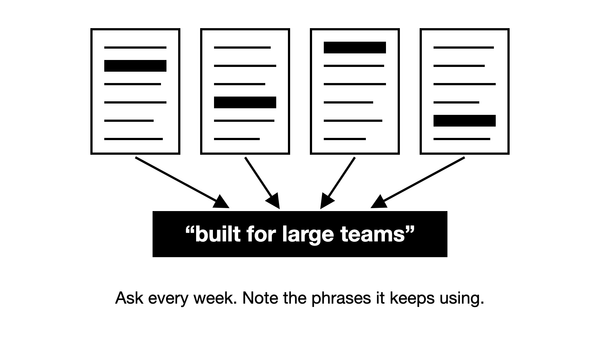
- Whether you have the page type the engines cite. The topic view above shows the type. If you have none, that is the gap. If you have one and it is never cited, set your page next to the cited one. Note what yours lacks: a direct answer near the top, the facts the buyer asked for, a comparison, real data.
- Whether engines can reach your pages. Check this only if no page of yours ever shows up in an answer's citations or in ChatGPT's Sources panel. Make sure your robots.txt (the file that tells crawlers what they may visit) and your bot protection do not block AI crawlers. For ChatGPT search, allow OAI-SearchBot, OpenAI's search crawler. OpenAI says sites that block it are not shown in ChatGPT search answers. For AI Overviews and AI Mode, also check Google's eligibility rule: the page must be indexed and able to show in Google Search with a snippet.
One case needs its own look: your own page cited inside a loss. The engine retrieved and cited your page, then named the rival anyway. Check whether that page names your product and says plainly what it does for the buyer in the prompt.
Run the same checks when an answer names you but recommends the rival, that is, names it as the best fit. Keep those answers as their own group, apart from your losses, and compare what the cited pages say about each of you.
Which citation gaps should you close first, and how often should you re-test?
Start with the cheapest fixes: topics where a page of yours already exists and is close to what the engines cite. Fixing a page you have costs less than writing a new one.
Then work outward: your own site first, then community and third-party pages. Within each channel, put first the gaps that show up across several prompts and engines, because one fix can close many losses at once. Give extra weight to losses on buyer intent prompts, which describe your exact buyer.
Measure each fix on the prompts where the gap was. The first sign is your page being retrieved and then cited in those answers, and being named tends to follow later. Track your rivals over the same weeks too, so a shift across the whole market is not mistaken for your win. A change can take from 2 to 12 weeks to show up in the answers.
Keep collecting daily on the same prompts, and redo the gap list each month. Add prompts when you find new ones, and remove one only if it was tracking the wrong thing.
Then read each change against normal week-to-week noise. In our ChatGPT data (March to October 2026, B2B brands across software and other fields), the median weekly move in a prompt set's visibility was about 3 points. So act on a weekly change of about 10 points or more when the set has 100 or more answers a week, and read smaller moves over a month.
One topic is a much smaller set than all your prompts. In the same ChatGPT data, no weekly change could be told from noise on sets with under 100 answers a week. So if a topic gets fewer than 100 answers a week, compare its losses month against month. Which AI visibility metrics matter covers how to prove a change is real.
When you report the gap to leadership, keep it to three things each month. Show the share of answers you lose to each main rival and whether it is shrinking over the quarter. Show the topics where the gap sits, with whether the fix is on your site or off it. Then show the early wins: pages you fixed or earned that the engines now retrieve and cite.
Should you analyse AI citation gaps by hand or with a tool?
By hand works for a first look at a few prompts, and it gives you a sense of the gap, not a verdict. At 4 to 5 runs per prompt, engine and country, even a small prompt set means hundreds of rows. And you repeat that work at every re-test.
A tool runs the prompts every day and keeps the log for you. For a citation gap analysis, check that it does five things:
- It shows the raw answer text and the cited pages behind every number.
- It lets you enter each rival's domains.
- It counts distinct cited pages per channel, not only share of answers.
- It splits results by engine, country and prompt.
- It collects answers the way the engine's app shows them to people.
The last point matters because an engine's API (the version built for software) can answer differently from its app. Perplexity's own FAQ says results from its API and its web interface can differ, because their tools, configuration and models differ. How tools collect their answers is covered in how AI visibility tools work.
Whatever you use, spot-check a few prompts by hand, logged out, against what the tool recorded. If a tool will not show you the raw answers, do not build a gap list on its numbers.
Where does citation gap data mislead?
No tool sees the answer a real buyer got. Your analysis shows what the engines answer to your prompts today, from a clean session in the countries you chose.
The engines' own tools cannot run this analysis either. Search Console's generative AI performance report shows impressions of your own pages in AI Overviews and AI Mode, with no queries. Bing Webmaster Tools' AI Performance report shows how often your content is cited in Copilot and AI summaries in Bing, with a sample of the searches. Neither shows which brand an answer named instead of you.
Two tools can also split the same citations differently, for example by how they class review sites. Compare channel numbers only within one tool, and when two tools disagree, check what each counts before you trust either.
Engines change how they search and cite, so date every gap list. They can also keep citing a page for a while after it is gone. Check that a cited page still exists before you plan work around it.
Frequently asked questions
Is an AI citation gap analysis the same as a backlink gap analysis? No. A backlink gap analysis lists sites that link to your rivals and not to you. An AI citation gap analysis lists the pages AI answers cite when they name a rival and not you.
Can ChatGPT run a citation gap analysis for you? Only a small part of one. Asking ChatGPT your prompts gives you one run of one engine, and it cannot see the answers other people got. A chatbot can help you sort a long list of cited pages into topics and page types. Do the counting in a spreadsheet, though: a model asked for a number will write one, whether or not it counted.
What do answers that name neither you nor a rival tell you in a citation gap analysis? They are nobody answers: count them, but keep their cited pages out of the evidence. If they name no vendor at all, the prompt may be informational, and such prompts rarely lead to brand names. If they name vendors you do not track, those vendors may be your real rivals for that prompt, so add them.
Should you use a list of the most cited domains in AI answers for your citation gap analysis? No. Build your list from the pages cited in your own lost answers, because the domains that matter depend on your category and your prompts. General lists also go out of date fast. In our ChatGPT data (May to October 2026, B2B brands across software and other fields), Reddit was 8.6% of cited pages in July 2026. It then fell in one step on 14 August 2026 to 0.1 to 0.2% in September and October.
Can you run an AI citation gap analysis for free? Yes, by hand for a few prompts, with a spreadsheet and a clean session in each engine. For more prompts and daily runs, a tool can collect the answers and their cited pages for you. As of November 2026, the Zadoosh AEO platform's free trial runs 25 prompts for 7 days, no card. It covers ChatGPT, Gemini, Perplexity, Copilot, AI Overviews and AI Mode, in the countries you choose. Start the free trial to run your own buyer prompts.