AI Search Visibility Gap Analysis: How to Find Your Gaps
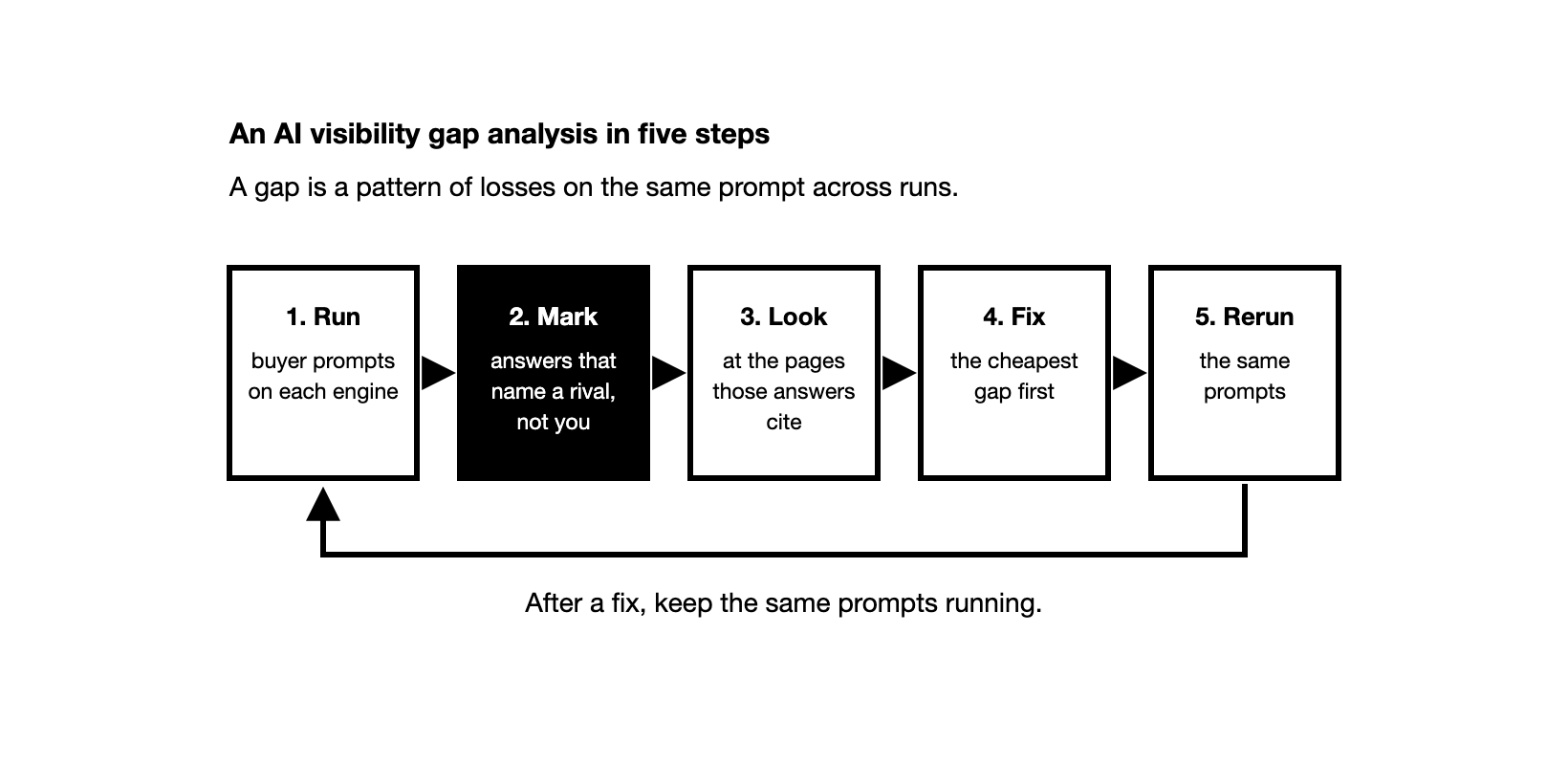
Run your buyer prompts several times on each engine, note answers that name a rival but not you, and read which sources they cite to see why.
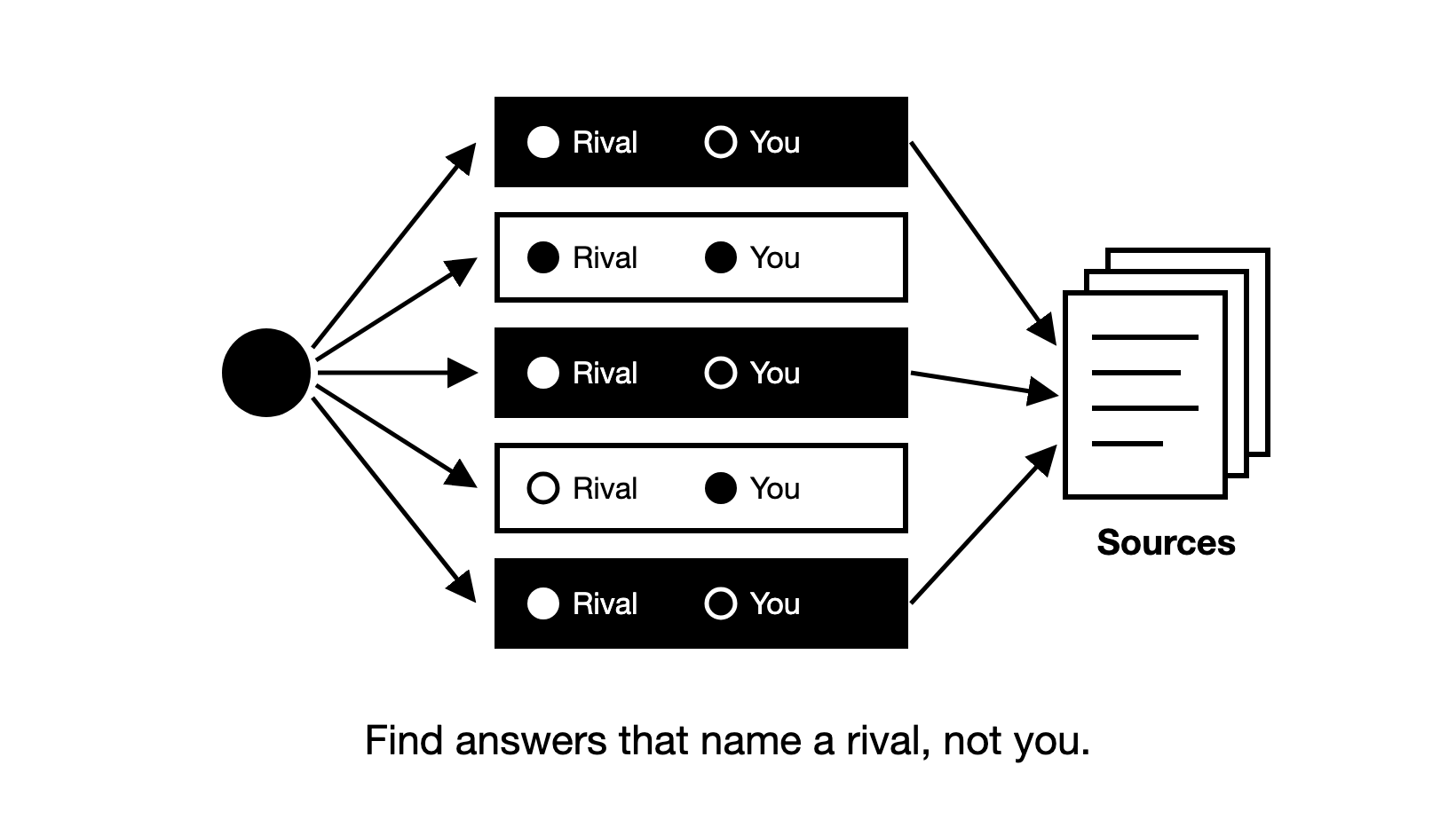
To find your AI visibility gaps, run your buyer prompts several times on each engine, note the answers that name a rival but not you, and read which sources those answers cite to see why.
AI visibility is how often AI engines such as ChatGPT, Gemini and Google AI Overviews name your brand when buyers ask the questions you care about. It is measured as visibility %: the share of answers to your visibility prompts (buyer questions that name no brand) that mention you. If you do not have that number yet, start with how to measure AI search visibility.
What is an AI visibility gap?
An AI visibility gap is a buyer prompt where AI answers name one or more of your competitors and leave you out. Say a buyer asks ChatGPT for the best software for their team. In five runs, the answers name three of your rivals and never name you. On ChatGPT, that prompt is a gap.
Each answer like that is a loss. A gap is a pattern of losses on the same prompt across runs, not one bad answer.
A gap can sit at one of four layers. Your brand is mentioned when an answer names it in its text, with a link or without one. It is recommended when the answer names it as the best fit, not only in a list. A page is cited when the answer shows it as a source.
A cited page can be your own page, a third-party page (a listicle, an editorial review, etc.) or a community page (a Reddit thread, a forum post, etc.). A listicle is a "best tools" list article. A page is retrieved when the engine pulls it into the pool of pages it gathers for the answer. Mentioned, cited and retrieved covers each one in full.
| Layer | What a gap looks like | What it points to |
|---|---|---|
| Retrieved | None of your pages is in the pool for the prompt | The engine's searches do not find your pages, or the engine cannot reach them |
| Cited | Your page is retrieved, but other pages are cited | A content gap: your page loses at the citing step, so compare it with the cited pages of the same type |
| Mentioned | Rivals are named and you are not | The pages the engine cited, or what it learned in training, name rivals and not you |
| Recommended | You are named, but a rival is named as the best fit | What the cited pages say about you and about the rival |

How do mentions and citations differ in an AI visibility gap analysis?
A mention can come from any page the engine used, or from what the model learned in training. A citation counts for you only when the cited page is one of your own. So an answer can name you without citing any of your pages, or cite one of your pages without naming you.
We looked at answers that showed sources, in data from the Zadoosh data platform for B2B brands across software and other fields. In ChatGPT, 8.1% of answers named the brand without citing one of its pages, and 5.2% cited one of its pages without naming it (April to October 2026). AI Mode went the other way round: 5.8% and 17.5% (June to October 2026).
When you are named but not cited, your own pages go unused. Work on getting them retrieved and cited.
If an answer cites your page but names a rival, you are not worse off than if it left you out. Being cited is usually the way in. If your pages are cited and you are still not named, aim to be named next, and then recommended.
What types of AI visibility gaps are there?
The four layers, in the table above, tell you what kind of gap you have. To see where your gaps are, read them by engine, by country and by product category:
- Engine. You are named far less on one engine than on the others. First check that every engine ran the same prompts, then read that engine's lost answers apart from the rest.
- Country. You are named far less in one market than in the others. First check that its prompts ran with that country set and in its language.
- Product category. You are named for one product you sell and missing for another.
Say you sell two products, and answers name you for the first in most runs and for the second in none. Your overall visibility looks fine, but buyers of the second product never see you. The cause is often one of these:
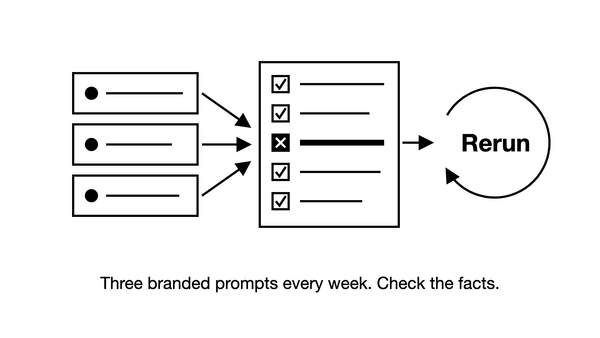
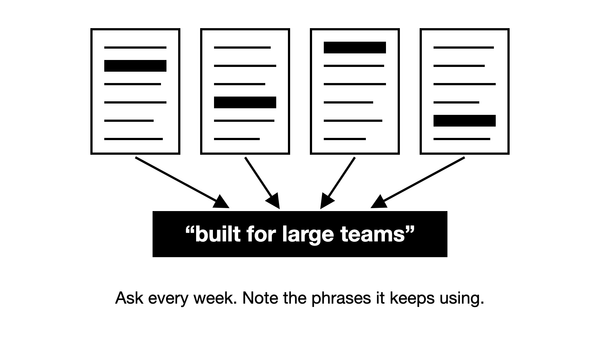
- Positioning: AI files you under one category. It describes you as a tool for one job, so it names you there and nowhere else. Check this with a few branded prompts, such as "What is [brand]?" and "Is [brand] good for [use case]?", and read the words AI uses about you. These prompts check your positioning, not your visibility.
- Prompt drift: the prompt pulls in the category next door. In October 2026, we saw prompts about help desk software come back with tools from neighbouring categories. A zero on those prompts meant the prompt measured the wrong market, not that the brand was invisible. Write the boundary into the prompt: what you sell, who it is for, and what you do not sell.
How do you find where your brand is missing from AI answers, and which pages get cited?
Start with your prompt set: the list of buyer questions you run on AI engines again and again. Every visibility number is a share of answers to that set, so the set decides what a gap means. Begin with 20 to 30 buyer prompts and add more as you find them. Choosing which prompts to track and how many prompts to track cover both in detail.
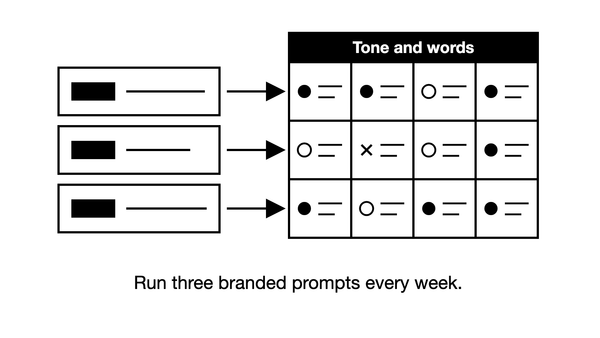
Run the prompts on the engines your buyers use, from the countries you sell in. Tracking by location and language covers the country setup. A first gap check needs 4 to 5 runs per prompt, per engine and per country, over a few days.
One run tells you little, because answers change from run to run. Keep the runs going for a few weeks and they become your baseline: your starting numbers before you change anything. The baseline is what makes a later change mean something.
Read each prompt as a share of runs, per engine and per country. If none of five ChatGPT runs name you, you are absent on that prompt in ChatGPT. If two of five do, you are partly absent. Absence becomes a gap only when those answers name a rival.
Then sort your prompts into three groups: never named, sometimes named and always named. The never-named group is where to look first.
Before you log a zero as a gap, read two or three of its answers. If they list tools from another category, the prompt has drifted, so fix the prompt first.
How do you see which of your pages AI engines cite?
Log your own pages in the same runs (the full check is in how to find AI citations for your website). In ChatGPT, open Sources under the answer: OpenAI says it shows "cited sources and other relevant links". The links inside the answer are the cited pages, and the other links in Sources are pages the engine retrieved and did not cite. Perplexity and the Gemini app show their sources too, Perplexity as numbered citations in each answer and Gemini behind a Sources button when it has sources.
Count a page as yours when its address is on your domain or a subdomain. A page on blog.yourbrand.com counts, but a review of you on a review site does not. Then score each of your pages on three things:
| Score | What it measures |
|---|---|
| Reach | The share of answers that cite the page |
| Engines | How many engines cite it |
| Persistence | On how many days it was cited |
The scores show which of your pages are already cited, and which ones you expected to be cited but are not. A page cited often, on several engines, day after day, is the one to protect when you change your site.
How do you see where competitors appear in AI answers and you do not?
You do not need separate runs to benchmark competitors. The answers you already collected name them, so record every brand each answer names, not only yours.
Benchmark against the brands AI actually names, not the rivals you assume. With the right prompts, the two lists should mostly match. If the rivals you expected never show up, check whether your prompts are too generic. If they never show up while you are named near the front, you are ahead on those prompts.
Third-party pages (listicles, editorial reviews, etc.) and community pages (forum threads, user reviews, etc.) are not competitors in this list. The engines cite them, and you study them through the lost answers below.
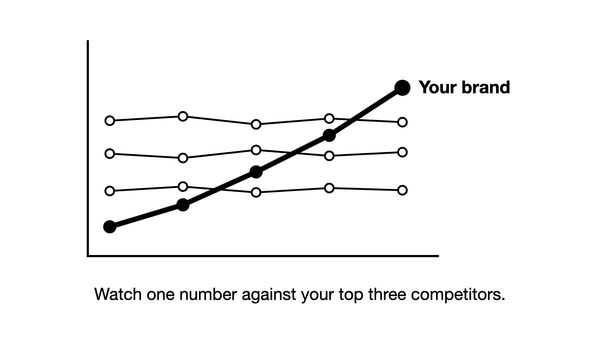
There is no fixed good score to judge a gap against. Compare yourself with your top three competitors on the same prompts, and look for your share of answers rising over about 3 months. In our experience, broad category prompts, such as "best [category] software", name more brands than narrow buyer prompts, asked when a buyer is comparing tools or about to choose. So read the two kinds of prompt separately.
How do you sort each AI answer into lost, shared, won or nobody?
Label every answer once for each rival you benchmark, with one of four outcomes:
| Outcome | What it means | What to do with its citations |
|---|---|---|
| Lost | The rival is named and you are not | Use them as evidence: they show what the engine cited when it picked the rival |
| Shared | You and the rival are both named | Keep them out of the gap evidence |
| Won | You are named and the rival is not | Note which pages carried you, so you notice if they drop out |
| Nobody | Neither you nor the rival is named | Keep them out of the gap evidence |
Your gap list is the prompts with the most lost answers, per engine. A prompt whose answers keep naming no brand is often informational, such as a "what is" question. Move it to a separate watch list, tracked for citations only and kept out of your visibility number.
Which pages did the engines cite when they named a rival instead of you?
In each lost answer, sort the cited pages into three channels:
| Channel | Examples |
|---|---|
| The rival's own pages | Its pricing page, homepage, docs, etc. |
| Community | A Reddit thread, a forum post, user reviews on a review site, etc. |
| Third-party | A listicle, an editorial review, a news article, etc. |
Narrow buyer prompts are often answered from the rival's own pricing page, homepage or docs. Broad category prompts tend to get listicles cited. To compare these pages with your own, page type by page type, see how to analyse AI citation gaps against competitors.
Check the dates before you blame Reddit threads. We looked at our data for May to October 2026, B2B brands across software and other fields. In ChatGPT, Reddit was 8.6% of the pages AI answers cited in July 2026. On 14 August 2026 it fell in one step, to 0.1 to 0.2% in September and October.
So a gap check from before 14 August 2026 that blamed Reddit threads in ChatGPT is out of date. Rerun it before you act on it.
Which queries give competitors AI visibility where you never appear?
No tool, ours included, sees the prompts you do not track or the answer a real buyer got. So read every count of lost prompts as a floor: rivals may win more prompts than your list shows.
Keep growing the set. Good places to find new prompts are sales calls, the long tail of searches in Search Console and Bing Webmaster Tools, and the lost answers themselves. Look at the segments and use cases a rival is named for, and add prompts where your set has none.
Remove a prompt only if you were tracking the wrong thing, never to tidy the list. New prompts start at whatever your visibility is on them, so adding them does not pull your number down by itself.
Why isn't your brand showing up in AI answers when competitors are?
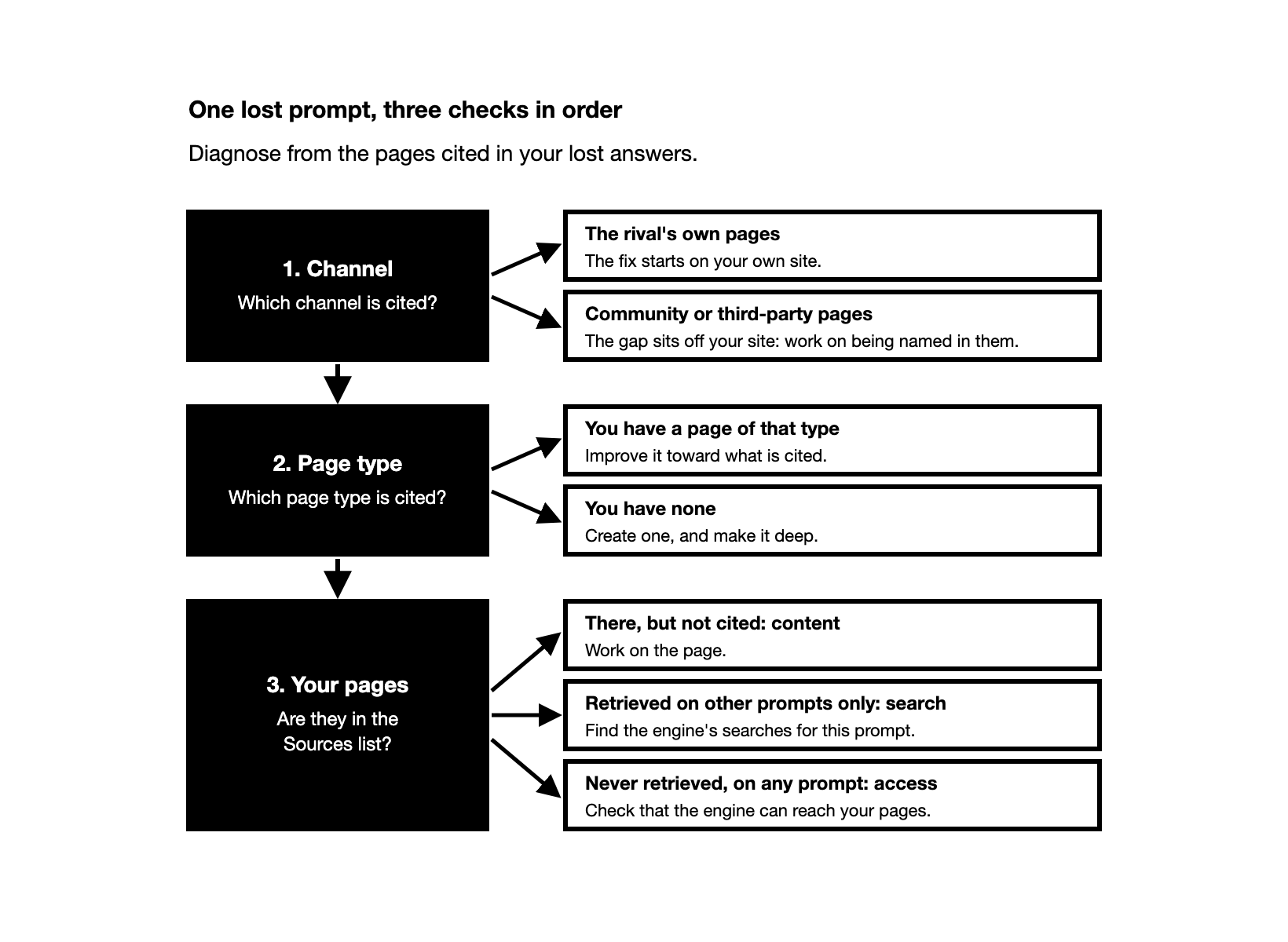
The pages cited in your lost answers point to why a rival was named instead of you. Diagnose from them, not from your own page, and check three things in order: the channel, the page type, then whether your pages are retrieved.
Which channel carried the rival into the AI answer?
Start with the channel split from your benchmark. If third-party pages (listicles, editorial reviews, etc.) or community pages (Reddit threads, forum posts, etc.) carry the rival, the gap sits off your site. Engines use the pages they cite to decide which brands to name, so work on being named in those pages. If the rival's own pages are cited, the fix starts on your own site.
Which page type does the engine cite for a prompt you lose?
Look at the type of page the engine cites for that kind of prompt, such as a pricing page, a comparison, a listicle or a guide. Compare page type to page type, because each type answers a different question: your pricing page against the cited pricing pages. Improve your page of that type toward what is cited, or create one if you have none. Make it deep, because shallow pages written to fill a gap rarely get cited.
If your page already matches the cited ones and is still not cited, treat it as an off-site gap and go back to the channel check.
Why are your pages not cited in AI answers: access, search or content?
When none of your pages is cited on a prompt you lose, there are three possible causes. The engine cannot reach your pages (access). Its searches for this prompt do not find them (search). Or it gathers them and cites other pages (content).
Look for your pages in the Sources lists of your lost answers. If they are there but not cited, it is content, and the work is on the page. If they are missing here but retrieved on other prompts, it is search: see the next section.
Check access only if none of your pages is ever retrieved, on any prompt. For AI Overviews and AI Mode, a page must be indexed and eligible to show with a snippet in Google Search. For ChatGPT search, check that your site does not block OpenAI's search crawler, OAI-SearchBot.
Server logs help only with this part. A bot fetching a page shows access, not that the engine used the page in an answer.
Why does a page that ranks well on Google not show up in AI answers?
A page can rank well on Google and still be missing from AI answers, because the engine does not simply search your keyword. It rewrites the prompt into one or more searches of its own (query fan-out), as both OpenAI and Google describe. Query fan-out shows how to find those searches. Then the engine narrows the pages those searches return and cites only a few.
We looked at our data for May to October 2026, B2B brands across software and other fields. In answers that cited at least one page, ChatGPT cited 4 to 7.5 pages per answer, depending on the month, and AI Overviews about 7 (August and September 2026).
Say your guide ranks well on Google for "[category] software". The engine may search for "[category] software for [team type]" instead, and your guide may not come up for that search. Or it comes up, is retrieved and is passed over at the citing step. The Sources list tells you which of the two it is.
What changed when your brand dropped out of an AI answer?
Start with the page that carried you: which cited page named you in the answers you used to win? If it dropped out of the citations too, the cause is at the citation level. Then check your density in what is cited now: the share of cited pages that mention your brand. If 4 of the 10 pages cited for a prompt mention you, your density is 4 in 10.
A falling density tells you where to work: on being named in the pages that replaced the one you lost.
Which AI visibility gaps should you close first?
Start with the prompts closest to a sale: the narrow buyer prompts. If you are nearly invisible there, buyers who are ready to decide rarely see you. In our experience, most brands already have a page of the type the engine cites for these prompts, such as a pricing page or docs, and it is never cited. That makes these gaps the cheapest to close, because you improve a page you already have.
Then work down this order:
- Narrow buyer prompts where you have a page of the cited type: improve that page.
- Narrow buyer prompts where you have no such page: create one.
- Category prompts where third-party or community pages carry your rivals: work on being named in them.
- Prompts that ask for something you do not sell: write the boundary into them, as in the prompt drift example above, or remove them. You were tracking the wrong thing.
Your own pages come first because they are the part you control. Being named on other sites depends on other people. That is harder for a small team, so that work usually comes later.
Can you run an AI visibility gap analysis by hand, or do you need a tool?
Checking by hand shows you roughly where your gaps are, but it cannot give you a number you can rely on. A gap analysis needs several runs of every prompt on every engine. With 20 to 30 prompts, that is hundreds of answers per round, and one round cannot show a trend. How to monitor brand mentions in AI search covers when hand checks stop being enough.
If you start by hand, log each answer in one row:
| Column | What to record |
|---|---|
| Prompt, engine, country, date | Where and when the answer came from |
| Brands named | Every brand in the answer text |
| Outcome for each rival | Lost, shared, won or nobody |
| Cited pages | Each link in the answer, marked as yours, the rival's own, community or third-party |
| Retrieved, not cited | Pages in the Sources list that the answer did not link |
A tool for gap analysis must show three things for every answer: the raw answer text, every brand it names and every page it cites. Without the raw answers you cannot check the tool, and without the citations you cannot diagnose a gap. Spot-check any tool, ours included, by running a few prompts by hand, logged out, and comparing what it recorded.
The engines' own tools, such as Google Search Console and Bing Webmaster Tools, show only their own engine and only your pages. They do not show your brand named in an answer, the prompts people asked or the answers they got. Can AI visibility be measured? covers what the engines do publish.
As of November 2026, the Zadoosh AEO platform's free trial runs 25 prompts for 7 days, with no card, on ChatGPT, Gemini, Perplexity, Copilot, AI Overviews and AI Mode. You choose the countries the prompts run from, and the Prompt Category filter lets you group prompts by product category and read each group on its own. That is enough to get a sense of your gaps: start the free trial.
What mistakes should you avoid in an AI visibility gap analysis, and how often should you rerun it?
| Mistake | Why it skews the gap list | Do this instead |
|---|---|---|
| Checking while logged in | In ChatGPT, a logged-in answer can draw on your saved memories, so it may reflect your own history | Run your checks in a logged-out session |
| Counting "vs" prompts | A "[brand] vs [rival]" prompt puts your name in the question, so the answer names you anyway | Keep it as a positioning check, outside your visibility number |
Say your visibility on a group of prompts drops 3 points in one week. We looked at our ChatGPT data for March to October 2026, B2B brands across software and other fields. Most week-to-week moves in a prompt set's visibility were noise, and the median move was about 3 points.
Act on a weekly change only when it is about 10 points or more and your set has 100 or more answers a week. Read smaller moves over a month: in the same data, a change of 3 to 6 points from one 4-week block to the next was already likely real. Which AI visibility metrics matter shows how to tell a real change from noise.
Keep the prompts running every day, one run per prompt, engine and country. Reread the gap list each month, and sooner when a weekly change passes the 10-point bar.
After a fix, keep the same prompts running and check whether the answers move. In our experience, a change takes 2 to 12 weeks to show. The first sign is usually your changed page being retrieved, then cited, and mentions tend to follow.
Frequently asked questions
Why does an AI visibility gap analysis show zero citations for a new or low-authority site? Because brands' own pages are a small share of what AI engines cite. We looked at our data for April to October 2026, all engines, B2B brands across software and other fields. Third-party pages were 80% to 86% of the pages AI answers cited, and the brand's own pages about 6%. Work on getting your own pages retrieved first, then cited. We have also seen a site only weeks old get cited, so a young domain is not locked out, though this may change as the engines change.
Can ChatGPT run an AI visibility gap analysis for you? No. ChatGPT can answer your buyer prompts, but it cannot tell you how often it names you or your rivals across many runs, or what it told other buyers. To find gaps, run your prompts many times on each engine and count the results yourself, or with a tool.
How is an AI visibility gap analysis different from an AI visibility audit? An AI visibility audit shows where you stand across engines, and its split of citations by channel gives a first sense of why. A gap analysis takes the answers you lose, one prompt at a time. It uses the pages they cite as evidence to find the channel and the page type to work on. It can reuse the audit's runs.
Why does an AI visibility gap analysis show different gaps on each engine? Each engine turns the prompt into its own searches, runs them on the web index it uses and cites its own mix of pages. We looked at our data for B2B brands across software and other fields. Brands' own pages were about 14% of what Perplexity cited (June to October 2026), but about 4% of what ChatGPT cited (April to October 2026). When you lose in ChatGPT, start the diagnosis with what other sites say about you and your rivals.