How to Do an AI Visibility Audit
An AI visibility audit measures how often AI answers name your brand, against which rivals and from which sources. Here is the method, step by step.
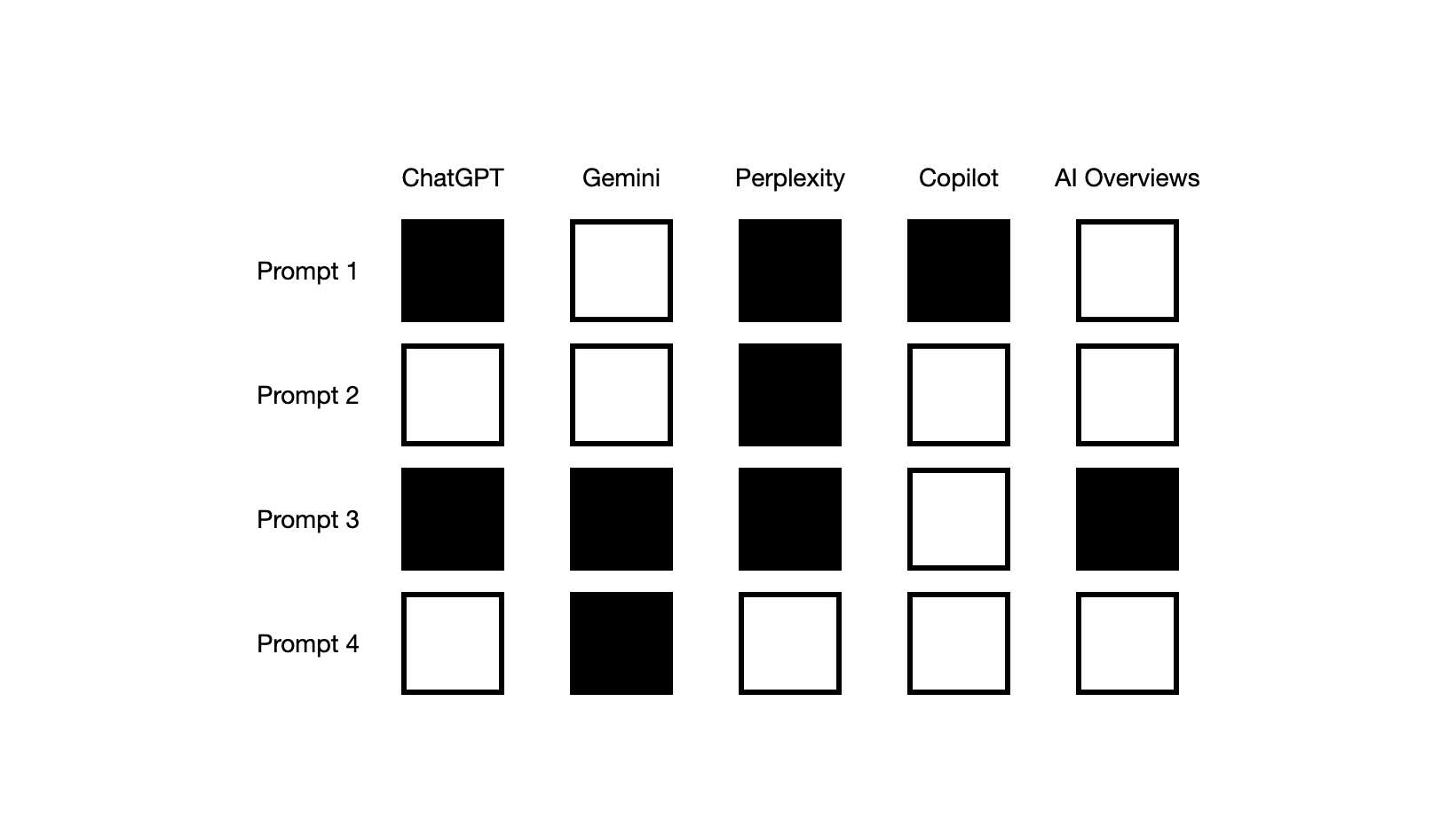
An AI visibility audit measures how often AI answers from engines like ChatGPT, Gemini, Perplexity and Google AI Overviews name your brand when buyers ask about your category, how that compares with your competitors, how the answers describe you, and which sources they draw on.
This guide is part of our guide to measuring AI visibility.
What is an AI visibility audit?
It is not an SEO audit: an SEO audit asks whether your pages rank in a list of links, an AI visibility audit asks whether an answer names you at all. It is also not ongoing tracking: the audit is your baseline, and tracking is how you see what changes after it.
Can you do an AI visibility audit by hand?
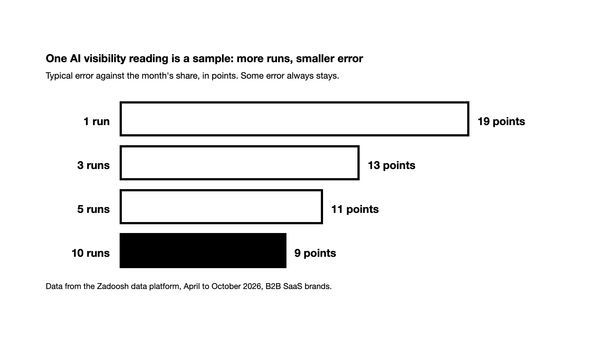
A hand check gives you a sense, not an audit. Answers change from run to run: in data from the Zadoosh data platform (April to September 2026, mostly US B2B SaaS brands), a single run landed within 10 points of a brand's share across the month only about a third of the time. An audit needs several runs per prompt, engine and country, which quickly reaches a thousand answers or more.
So use an AI visibility monitoring tool. Most have a free trial that is enough for a first audit; Zadoosh's free trial tracks up to 25 prompts.
Step 1: Which prompts should the audit cover?
Choose the prompts that matter to you: the questions a buyer asks when they are looking for a solution like yours. The most common mistake is the wrong prompts: too simple, or too informational.
Build the set from real buyer data, because no reliable source of prompt volume exists yet:
- Your ideal customer profile and the problems it brings you.
- Google keyword data, and the long tail in Search Console and Bing Webmaster Tools.
- Sales calls and support conversations, in the buyer's own words.
Start with 20 to 30 prompts, a few core category prompts first, then widen. Write them the way buyers really ask. Buyers give context over a chain of questions, so a five or six line prompt that carries a role, a company and a need is closer to real use than "best X software".
| Prompt type | Example | Keep in the visibility share? |
|---|---|---|
| Category | "We are a 200-person SaaS company looking for an employee survey tool that integrates with Slack. What would you recommend?" | Yes |
| Problem | "Our engagement survey response rates keep falling. How do other HR teams fix this?" | Yes |
| Comparison | "Compare the main employee survey tools for a mid-size company." | Yes |
| Branded | "What is [your brand] known for?" | No: a positioning check |
Group the prompts by audience segment and buying stage, so a weak segment shows up as a pattern. Our free Prompt Builder can help with a first draft of the set.
Step 2: Which geography and engines should you audit?
Choose the geography that matters to you: the countries, and where it matters the cities, your buyers are in. Answers change with location; ChatGPT, for one, can use location information for local results.
Choose the engines where your buyers really are. The usual candidates are ChatGPT, Gemini, Perplexity, Microsoft Copilot, Google AI Overviews and Google AI Mode.
Audit Google's two AI features separately. Google says AI Overviews and AI Mode may use different models and techniques, so the responses and links they show will vary. AI Overviews works more like a next-generation Google Search and often does not appear at all; AI Mode works more like ChatGPT. Our guide to measuring your brand in AI Overviews and AI Mode covers both in detail.
Step 3: How many times should each prompt run?
Collect 4 to 5 answers per prompt, per country, per engine, over at least a few days. One answer is not enough because engines rarely answer the same way twice: in the same data (April to September 2026, mostly US B2B SaaS brands), two ChatGPT or Gemini answers to the same prompt on the same day shared only about 3 in 10 of the sites they cited (why).
Run signed out or in an Unpersonalized temporary chat, so your own history does not shape the answers. When an AI Overview does not appear, record "not triggered", not "brand absent".
Step 4: How visible is your brand?
Score each prompt, per country and engine, as the share of answers that named you: named in 3 of 5 answers is 60%. Add them up for your overall visibility, but keep the breakdown, because the total hides where you are missing.
| Prompt | ChatGPT, US | Perplexity, US | AI Overviews, US |
|---|---|---|---|
| Category prompt A | 3 of 5 (60%) | 1 of 5 (20%) | Not triggered |
| Problem prompt B | 0 of 5 (0%) | 0 of 5 (0%) | 2 of 5 (40%) |
| Comparison prompt C | 5 of 5 (100%) | 4 of 5 (80%) | 3 of 5 (60%) |
An example layout, not real data.
Step 5: How do you compare with your competitors?
There is no universal good visibility number, so compare yourself with your top three competitors on the same prompts. Most AEO platforms rank you against them by share of voice: your mentions as a share of all brand mentions. Also record:
- Who is named instead of you, prompt by prompt.
- Your position when you are named: first, in the middle or last.
- The group you are placed in, such as "enterprise", "for small teams" or "budget". The wrong group is a positioning problem even when your visibility looks fine.
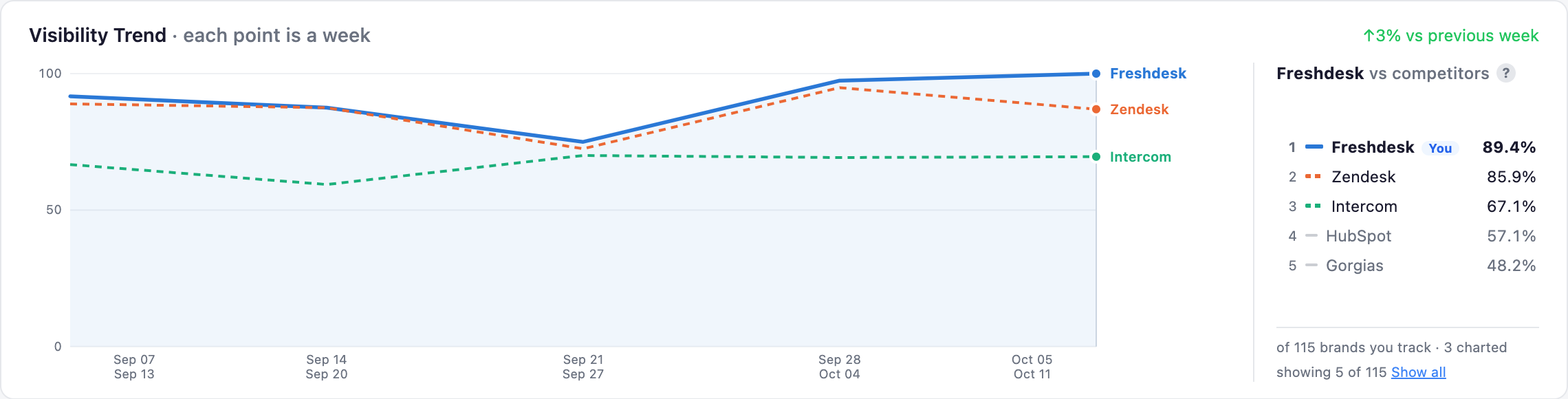
Example from the Zadoosh AI Index (public data): Freshdesk across six category prompts on ChatGPT, US, September to October 2026. Each point is a week; the ranking on the right compares the share of answers that name each brand.
Step 6: Where do the engines get their answers?
Visibility says how you are doing; the sources behind the answers say why. For each engine, sort the cited sites into three channels, as our omnichannel AEO method does:
| Channel | What it includes | What it tells you |
|---|---|---|
| Owned on-page | Pages on your own domain | Whether engines read and use your content |
| Community and user content | Reddit, Quora, YouTube and other places where users contribute | Whether people talk about you where engines look |
| Third-party publications | Competitors' pages, other vendors writing about your space, review sites, listicles, media | Whether others put you on their lists |
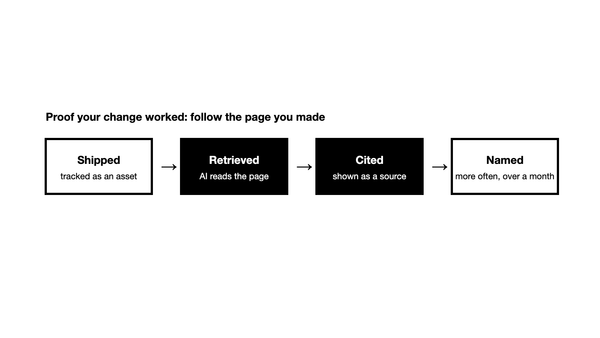
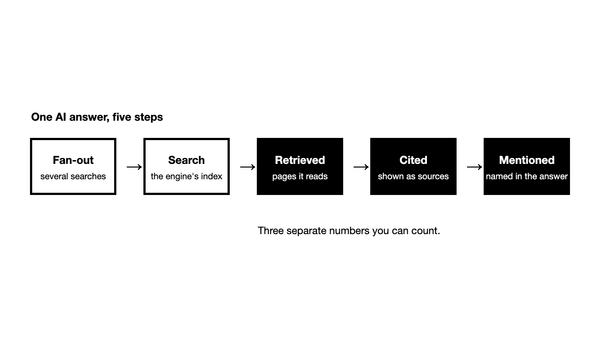
Then find where you drop out. An engine retrieves pages, cites some of them, then names brands (more on these layers):
- Not retrieved. Your pages are not in the pool the engine reads. Check its full source list where it shows one, such as ChatGPT's Sources panel.
- Retrieved, not cited. Compare your page with the type of page the engine does cite.
- Cited, not recommended. The answer names other brands. Being recommended is the goal.
- Missing from the channel that dominates. If community threads or third-party lists carry most citations and you are not in them, that is the gap.
In the example below, landing pages and listicles carry most of the citations, so a brand missing from the main listicles misses much of the answer.
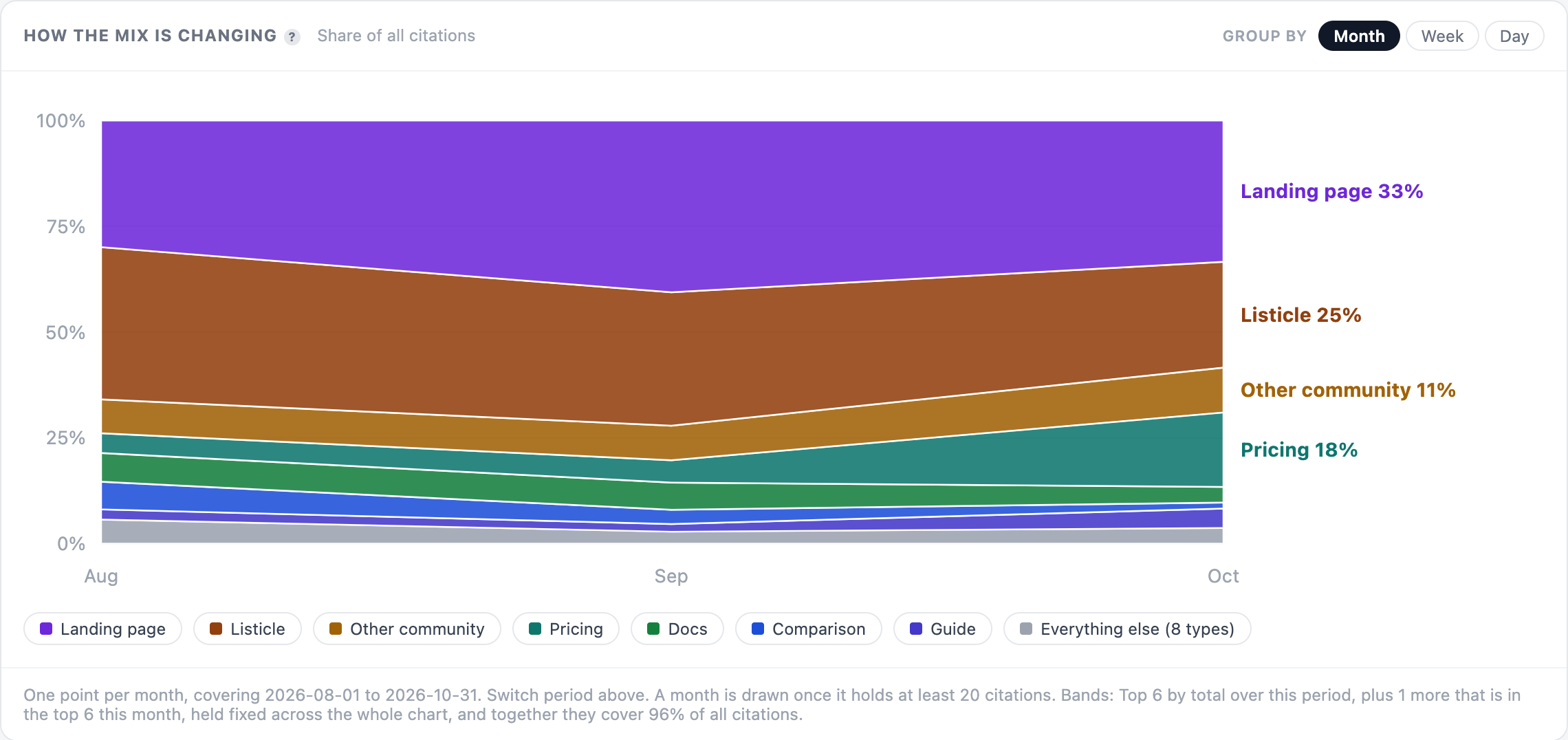
Example from the Zadoosh AI Index (public data): Freshdesk across the help desk, live chat and related categories on ChatGPT, US, September to October 2026. Share of all citations by type of page, by month.
Step 7: How do AI answers describe your brand?
Collect the phrases the answers use about you; the same four or five usually repeat. List what never comes up too, because a mention with the wrong words does not drive demand.
Record wrong or outdated facts (features, pricing, category) with the source the answer cited. OpenAI itself says citations can be incomplete, outdated, or incorrect.
Step 8: Can AI engines reach your site?
Engines can only cite pages they are allowed to read. Most AI companies run separate crawlers for search and for training, and they are controlled separately in your robots.txt file (yourdomain.com/robots.txt):
| Engine | Crawler for search answers | Crawler for training | Source |
|---|---|---|---|
| ChatGPT | OAI-SearchBot | GPTBot | OpenAI |
| Perplexity | PerplexityBot | (not used for training) | Perplexity |
| Claude | Claude-SearchBot | ClaudeBot | Anthropic |
| Google AI Overviews and AI Mode | Googlebot | Google-Extended (Gemini training and Gemini app grounding) | |
| Microsoft Copilot | Bingbot | Bing |
What to check:
- The search crawlers are allowed. OpenAI says sites that block OAI-SearchBot will not be shown in ChatGPT search answers. Blocking a training crawler such as GPTBot is a separate choice, and OpenAI says each setting is independent.
- Google's AI features follow Googlebot. A page must be indexed and eligible to show with a snippet. Google-Extended does not affect inclusion in Google Search, though it does cover grounding in the Gemini app.
- Copilot follows Bing. Bing says robots.txt controls crawl access, not indexing: a NOINDEX tag keeps a page out of Copilot, and NOARCHIVE keeps its content out of Copilot answers.
- Your CDN or firewall. Google notes crawling must be allowed by any CDN or hosting infrastructure, not only in robots.txt. Cloudflare, for one, lets every customer allow or block AI crawlers by type (search, agent, training), with new defaults for new domains from 15 September 2026.
Two free reports help here: Google Search Console counts clicks from AI features in its Performance report, and Bing Webmaster Tools' AI Performance report shows where your content is cited in Copilot. A deeper check of how ready your site is for AI search is a separate audit.
What should an AI visibility audit report include?
Keep it short enough for a leader to read in a few minutes:
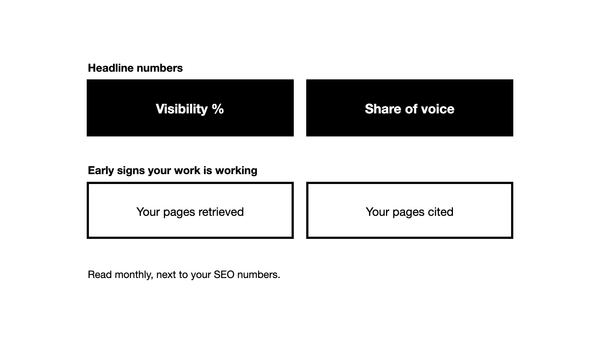
- The headline: your overall visibility percentage, your share of voice rank against competitors, and the period and engines covered.
- By engine and by prompt: where you are strong, where you are absent.
- Competitors: who is named instead of you, your position and the group you are placed in.
- Why: the citation breakdown by channel, per engine.
- Positioning: the phrases AI uses about you, what is missing and what is wrong.
- Access: any crawler or indexing blocks found.
- Next steps: the few gaps to work on first.
Most platforms generate the first three; the Zadoosh AEO platform's summary report below is one example. The rest you build from the answers and sources the tool stores.
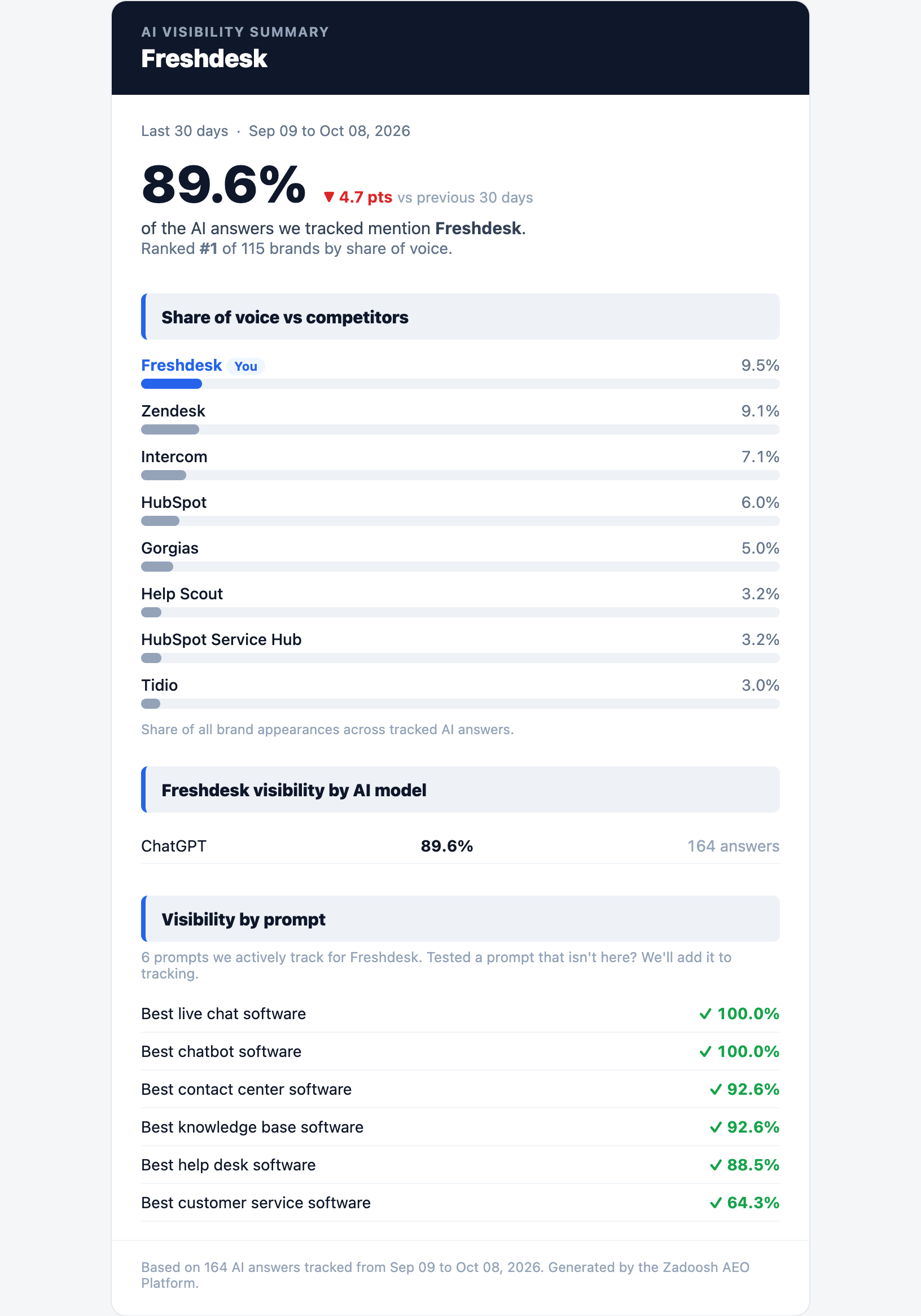
Example from the Zadoosh AI Index (public data): Freshdesk across six category prompts on ChatGPT, US, September to October 2026.
What do you do with the findings?
Start where you drop out, because each step has a different fix:
| Finding | First move |
|---|---|
| Blocked or not indexed (Step 8) | Allow the search crawlers and get the pages indexed. Nothing else works until this does. |
| Not retrieved | Check that you have a page for the prompt at all. If the engine cites guides, comparisons or listicles and you have none, create the closest one. |
| Retrieved, not cited | Bring your page closer to the type of page the engine cites, and go deeper: pages that keep getting cited tend to carry original data. |
| Cited, not recommended | Your pages are used, but others are named. Being recommended usually needs others to name you too: see below. |
| Described wrongly (Step 7) | Correct the facts on your own pages first, then on the third-party pages the answer cited. |
Do not stop at your own domain. For each prompt, look at the community threads and third-party pages the engines cite, and work to be included in them where you genuinely belong: a useful answer in the thread, a place on the list, a correct description in the review. That is the omnichannel AEO approach: your own pages, community and third-party publications, worked on together.
Work on a few prompts at a time, and judge the change on the trend over several weeks, not on the next check.
What happens after the audit?
The audit is a snapshot, and it expires: in the same data (April to September 2026, mostly US B2B SaaS brands), a brand's share moved a median 15 points over two months. So keep measuring the same prompts, ideally daily, and decide on the trend, never on one week. Rerun the full audit after a big change: a new product, a new market or a major engine update.
AI visibility audit checklist
- [ ] 20 to 30 buyer prompts, from real buyer data, grouped by segment and stage
- [ ] Branded prompts kept apart
- [ ] Countries and engines chosen by where your buyers are
- [ ] At least a few days of runs, 4 to 5 answers per prompt, country and engine
- [ ] Visibility % per prompt, country and engine, and overall
- [ ] Share of voice and rank against your top three competitors
- [ ] Who is named instead of you, your position and your group
- [ ] Cited sources by engine, split into owned, community and third-party
- [ ] The phrases AI uses about you, and wrong or missing facts
- [ ] Search crawlers allowed in robots.txt and in your CDN or firewall
- [ ] A short report, and a plan to keep measuring
Frequently asked questions
How long does an AI visibility audit take? With a monitoring tool, plan for a few days of collection, so each prompt gets 4 to 5 answers per engine and country, plus the time to read the results. By hand, the same audit means collecting and scoring hundreds of answers.
How often should you run an AI visibility audit? Once as a baseline, then again after big changes such as a new product, a new market or a major engine update. In between, keep measuring the same prompts.
Can ChatGPT audit your AI visibility for you? Not on its own. ChatGPT can only show you the answer it gives you, in your session. An audit needs many answers per prompt, across engines and countries, collected in the same way each time.
Is an AI visibility audit the same as a GEO or AEO audit? Not quite. An AI visibility audit measures how AI answers treat your brand. GEO and AEO audits usually also check whether your site and content are ready for AI search. Both start from the same visibility numbers.
What is a good AI visibility percentage? There is no universal good number. Compare yours with your top three competitors on the same prompts, and look for a share that rises over about three months.