Can AI Visibility Be Measured, or Is It Guesswork?
Yes, as a rate: run each prompt about ten times and count the share of answers that name you. That gives a rough read, never an exact figure.
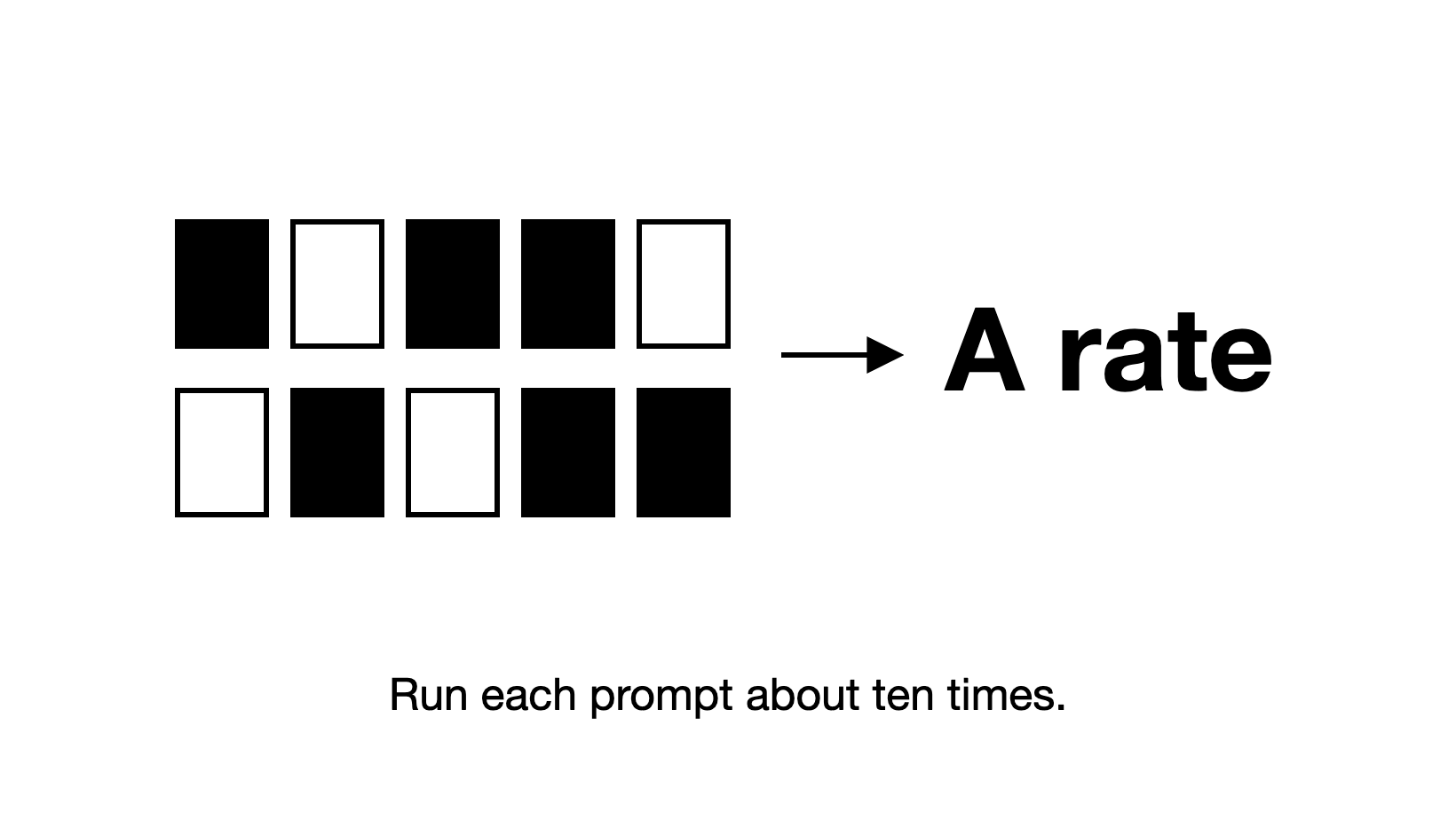
AI visibility can be measured, but only as a rate: run each prompt about ten times and count the share of answers that name you, which gives a rough read, never an exact figure.
AI visibility is how often AI engines such as ChatGPT, Gemini and Google AI Overviews name your brand when buyers ask the questions you care about. It is measured as visibility %: the share of answers to your visibility prompts that mention you. For the full method, from prompts to reporting, see how to measure AI visibility.
Is AI visibility measurable, or is it guesswork?
It is neither guesswork nor an exact science. AI visibility sits between performance marketing and brand marketing. Expecting an exact dollar value for each point is the performance-marketing mistake. Treating it as unmeasurable is the brand-marketing mistake.
AI engines answer each question with some chance built in, so one answer tells you little. Many answers to the same prompt tell you a lot. The rate across them is steady enough to track, and each extra run adds confidence, though some error always stays.
Measured this way, a real change (one bigger than the noise) stands out. We looked at data from the Zadoosh data platform for ChatGPT, April to October 2026, B2B brands across software and other fields. For prompts tracked for two months or more, the brand's share moved a median of 13 points between the first and last four weeks. Noise alone, from splitting the same weeks at random, gave a median of 4 points.
Do the AI engines publish any visibility or citation data?
Google Search Console and Bing Webmaster Tools now show how often your own pages appear or are cited in their AI answers. No engine reports how often its answers name your brand, or the prompts buyers type (November 2026). Only the engines hold real prompt counts, so every prompt volume figure you see elsewhere is an estimate.
The engines' own tools add some data. Bing Webmaster Tools shows how often Copilot and Bing cite your pages, and Google Search Console shows how often your pages appear in AI Overviews and AI Mode. They cover only your own pages on their own engine, and they do not show the prompts people asked or the answers they got.
Your analytics show only a small slice. A click on a citation may show up in your analytics as a visit from the engine, for example chatgpt.com, but buyers rarely click citations. Many AI clicks arrive without a clear source, so buyers who act on an answer later often arrive as branded search or direct traffic. That traffic cannot be tied back to the answer that sent it.
So today the way to see your AI visibility across engines is to run prompts on the engines, by hand or with a tool. Run each one many times and count the answers that name you.
Why do AI answers change from run to run?
The engine works out the intent of the question and splits it into more than one web search, called query fan-out. From the pages that come back, it retrieves the ones it judges useful and cites a few of them. It names the brands those pages support or that it knows from training.
A citation is a page an AI answer shows as a source for what it says. It can be your own page, a third-party page (a competitor's page, a listicle, etc.) or a community page (a Reddit thread, a forum post, etc.). Engines use the cited pages to decide which brands to name, which is why citations matter even when nobody clicks them.
Each run can split the question differently and pick a different set of pages. We looked at our data for ChatGPT, October 2026, B2B brands across software and other fields. ChatGPT ran a median of 2 searches per answer, and 7% of answers ran 6 or more. Different searches bring back different pages, so citations move the most, and the brands named move with them.
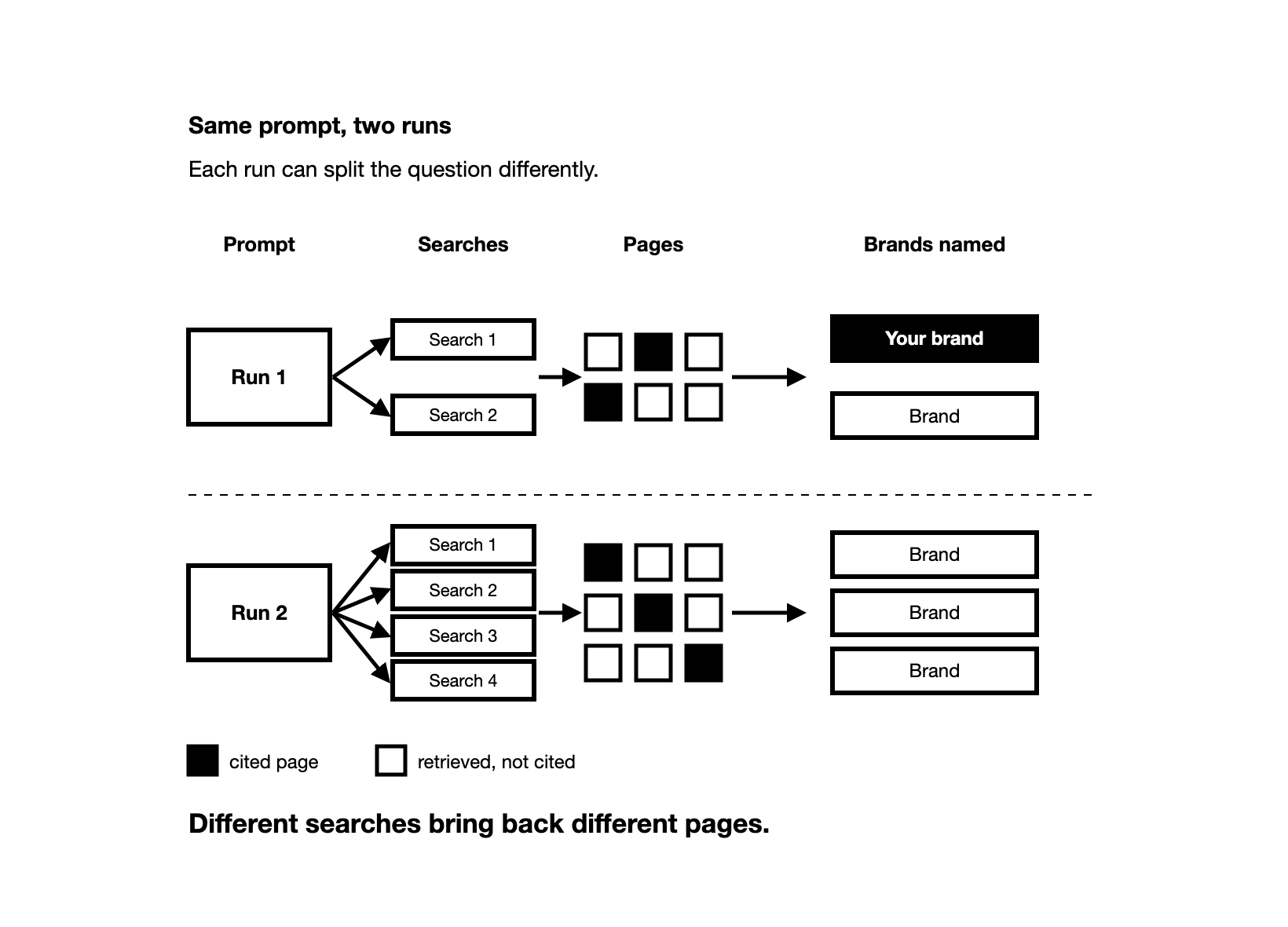
Two more causes add to this. The model writes each answer word by word with some randomness, so wording and order shift even with the same pages. And for logged-in users, personal context shapes the answer too.
If you reword a prompt and your brand disappears, the new words are rarely the reason. Usually the change added or dropped context (for example "for enterprise teams"), or you compared one run with one run, and single runs vary anyway. A minor rephrase with no new context leaves your visibility % about the same when you measure it over 10 to 20 runs.
How much do AI answers vary between runs, people and places?
Between runs of the same prompt, a lot. We looked at our data for ChatGPT, April to October 2026, B2B brands across software and other fields. On average, two runs of the same prompt on the same day shared 53% of the brands named, 31% of the cited sites and 22% of the cited pages.
In the same data, brands were steadier than citations, but far from fixed. When your own brand was named in one of the two runs, the other run named it too only about half the time. A rerun the next day differed about as much as a rerun the same day. So most daily movement is the engine answering differently, not your market changing.
Small samples make the swings look bigger. A daily number built from a handful of answers can jump between neighbouring days with nothing real behind it. That is why you collect daily but decide on the trend.
Between people, answers likely vary more, shaped by each buyer's personal context, which no tool sees.
Between markets, treat each country as a separate measurement. Engines localise answers mainly by the user's IP address. Run the same prompts on the same engines with each market's country and language: German prompts with Germany as the country for the German market, for example.
For a B2B brand, the markets and regions you sell into are the right unit, not cities. Questions that have nothing to do with location do not vary by place. Choose the geographies that matter to your pipeline and measure each one, rather than assuming one country's answers hold everywhere.
Why is one AI visibility check not a measurement?
The most common mistake is one check, big conclusion. Someone asks once, often logged in, and treats the answer as the truth.
We looked at our data for ChatGPT, April to October 2026, B2B brands across software and other fields. About seven in ten 30-day prompt windows were contested: the brand was named in some answers but not all. That is where a single check misleads. In those windows, one run came within 10 points of the 30-day share only about a third of the time.
So visibility %, or share of model, is a valid metric only as a rate across many runs, with its confidence stated. A single answer cannot be wrong or right about your visibility. It is a sample of one.
How do you get a stable AI visibility number?
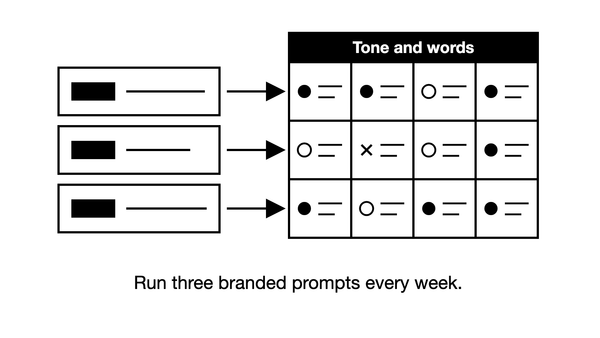
Repeat each prompt and read the rate. Tracked prompts are the questions in your prompt set that you ask AI engines again and again. Each time, you record whether the answer names your brand, and which of your pages it retrieves and cites. Choosing them well is its own job: see how to choose prompts to track.
Say your brand is named in 40% of answers this month. One run shows you 0% or 100%.
We checked how many runs it takes in our data for ChatGPT, April to October 2026, B2B brands across software and other fields. The 30-day share is the share of all of a prompt's answers over 30 days that named the brand. For contested prompts, the table shows how close a few random runs came to it. Typical error is how far off such a check usually was.
| Runs | Within 10 points | Within 20 points | Typical error |
|---|---|---|---|
| 1 | 35% | 53% | 18 points |
| 3 | 42% | 67% | 12 points |
| 5 | 49% | 79% | 11 points |
| 10 | 64% | 88% | 8 points |
How many runs to plan for:
- A first audit: 4 to 5 runs per prompt, per engine, per country, collected over at least a few days.
- Ongoing tracking: about 10 or more runs, which means one run a day per prompt, engine and market, read as a monthly trend.
- The overall number: pool every answer. Divide the answers that name you by all answers. Rates per prompt or per engine stay useful for reading one part of the set.
- On a budget: track fewer engines first. Then keep fewer prompts run daily, for example 10 prompts a day, rather than many prompts run rarely.
A hand check works the same way at a smaller scale. Run the prompt in fresh, logged-out chats and count: named in 3 of 5 runs is 60%. Five runs give a first sense of where you stand, as in a first audit.
For a firmer hand count, plan on seven or eight runs per prompt. The table above shows why: the typical error falls from 11 points at five runs toward 8 points at ten.
To save time, run in two steps. Run five times first: if the brand shows up in none or nearly all of them, the answer is clear. If it shows up in some, run five more before you judge.
Then read change at the right size. We looked at our data for ChatGPT, March to October 2026, B2B brands across software and other fields. The median weekly move in a prompt set's visibility was about 3 points, and most such moves were noise. A weekly change was likely real from about 11 points on a typical set.
So act on a weekly change of about 10 points or more, on a set with 100 or more answers a week. Read smaller changes over about a month, where a move of 3 to 6 points is already likely real. Under 100 answers a week, the same data shows a weekly change cannot be told from noise at any size.
Can you trust the data in AI visibility tools?
Yes, within limits you should know. No tool, Zadoosh included, sees a real buyer's conversation. Tools run the prompts you choose on the engines, in the most neutral way they can, and show what the engines answer today. A tool that promises "what real users see" is promising something no tool can deliver.
Tools run prompts without a buyer's login or memory, so they measure how the engine answers a buyer it knows nothing about. You can get closer to what real buyers see by writing the buyer's context into the prompt. "Best CRM" tells you little. "Best CRM for a 20-person B2B sales team moving off spreadsheets, that syncs with Gmail" shows whether you appear for the buyers you sell to.
Real buyers bring memory, custom instructions, chat history and their model tier. Reruns from one account overlap more than runs from different accounts. So real buyers likely see more variety than any tool's numbers show. Read the rate as a fair baseline, not as each buyer's exact experience.
Before you trust a tool's numbers:
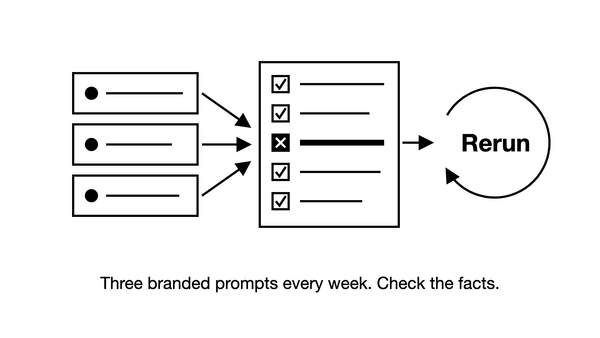
- Spot-check a few prompts by hand, in a logged-out or temporary chat with a VPN set to the tool's country, and compare with what the tool recorded.
- Prefer tools that capture answers from the engine's app. App answers are closer to what buyers see, and answers through an API can differ.
- Use only tools that show the raw answer text behind every number.
- When two tools disagree, compare what each does: prompts, engines, country, runs and how it counts a mention. Then pick one and read its trend.
Do teams track AI visibility seriously, or are they guessing?
Both happen. Guessing usually looks like the single check described above.
Teams that take it seriously run their prompt set every day and decide on the trend. A full audit by hand is no longer practical. A hand run gives a sense. An audit needs an AI visibility monitoring tool, and many tools offer a free trial that is enough for a first read.
Frequently asked questions
Does ChatGPT give the same answer to everyone? No. Even one person gets different answers across runs, and personal context likely makes answers differ more between people. One person's screenshot says little about what your other buyers see.
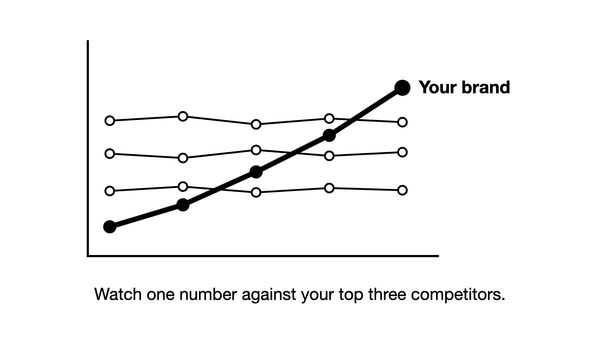
What is a good AI visibility score? There is no universal good number. Compare your visibility % with your top three competitors on the same prompts, and look for a rising share over about three months.
Can I check my AI visibility for free? Roughly, yes. Run a few buyer prompts five times each in logged-out chats and count how often you are named. For a real audit, the Zadoosh AEO platform's free trial (7 days, 25 prompts, no card, as of November 2026) runs the prompts for you.
Can AI visibility be tied to revenue? Not per mention. Many AI clicks arrive without a clear source, and buyers rarely click citations. Use visibility as the metric, and treat a "How did you hear about us?" field and questions on sales calls as directional signals.