How to Tie AI Visibility to Leads, Pipeline and Revenue
Ask every lead how they heard about you, track clicked AI citations in analytics, and report your visibility against competitors as the leading sign.
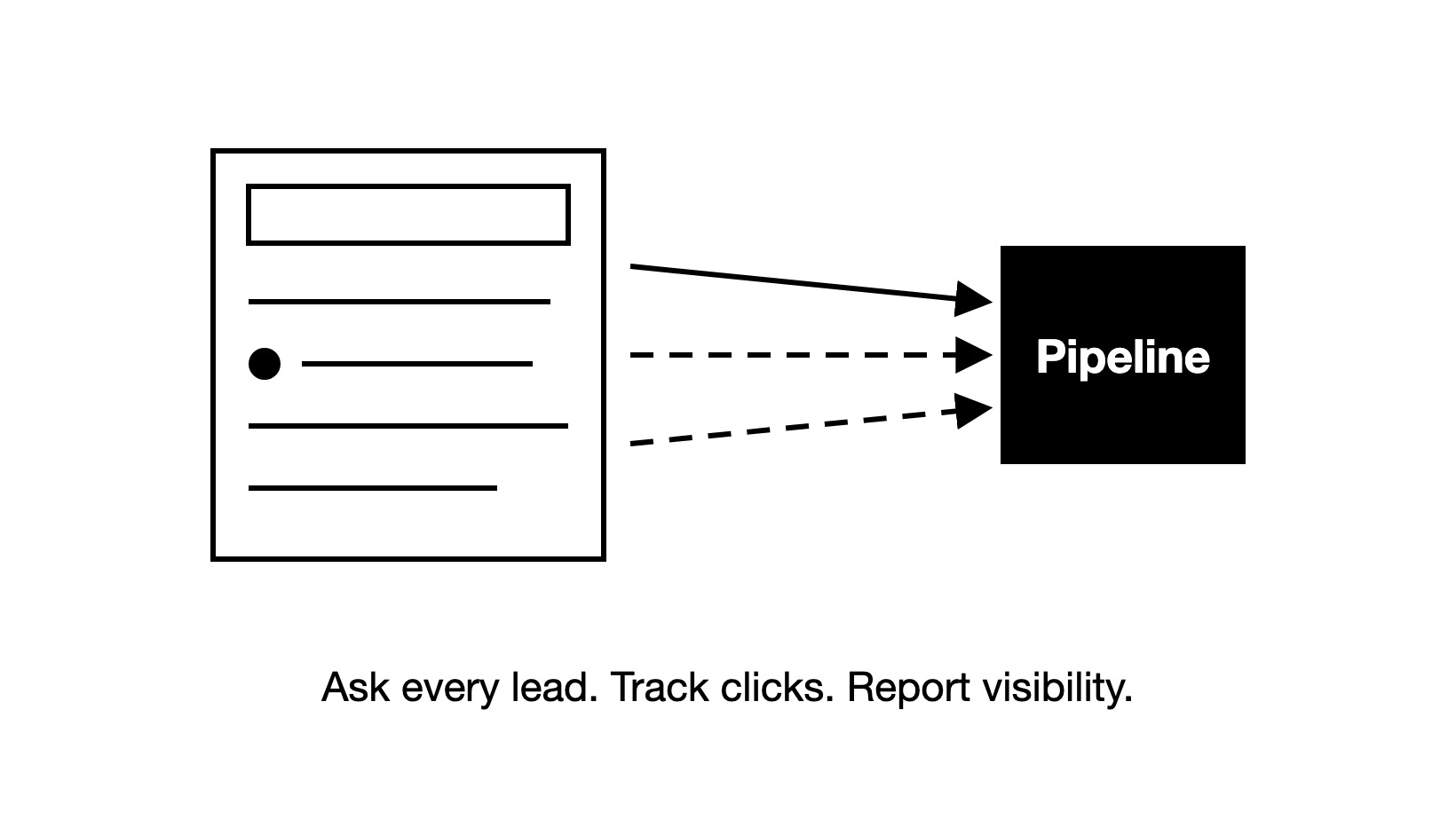
Tie AI visibility to pipeline by asking every lead how they heard about you, tracking clicked AI citations in analytics, and reporting your visibility against competitors as the leading sign.
AI visibility is how often AI engines such as ChatGPT, Gemini and Google AI Overviews name your brand when buyers ask the questions you care about. It is measured as visibility %: the share of answers to your visibility prompts that name you. Visibility prompts are the buyer questions you track that leave your brand name out, such as "best CRM for a B2B sales team" (how to choose them).
A mention is your brand named in the answer's text, with or without a link. A citation is a page the answer shows as a source. It can be your own page, a third-party page (a competitor's page, a listicle, etc.) or a community page (a Reddit thread, a forum post, etc.). Buyers rarely click citations, but engines use the cited pages to decide which brands to name (mentions and citations explained).
How does AI visibility turn into leads and pipeline?
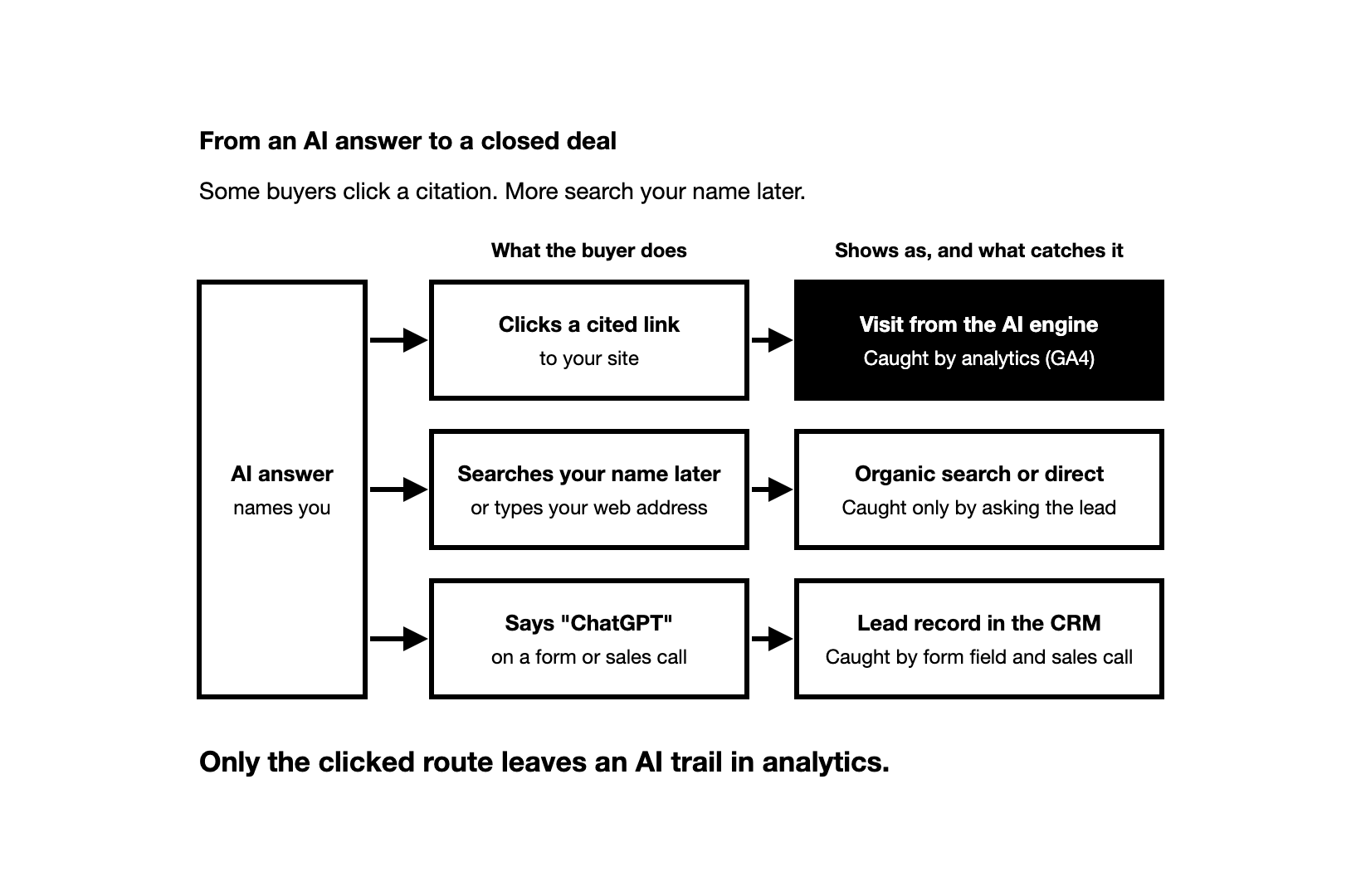
A buyer asks ChatGPT which tools fit their team, and the answer names you among a few vendors. Some buyers click a citation to your site, but more search your name on Google later or type your web address, then book a demo. Only the clicked route leaves an AI trail in analytics. The others show up as organic search or direct visits.
Demand comes only from mentions in answers to buyers looking for a solution. An informational prompt such as "What is employee engagement?" gets a definition and rarely names any brand, so visibility there brings no demand.
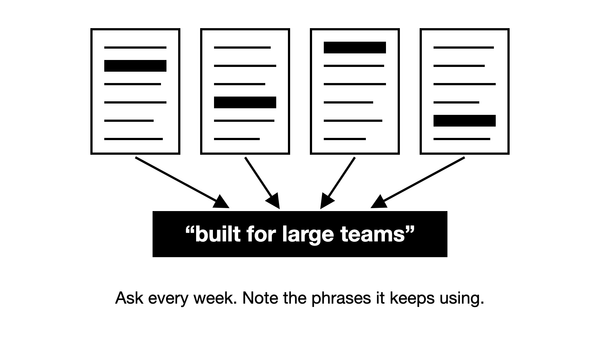
The answer also has to describe you the way you sell. If it used the wrong words for what you do, buyers arrive expecting something else, and fewer of them buy. A mention like that still counts as visibility, but it is a vanity metric.
AI visibility sits between performance marketing and brand marketing. AI answers change from run to run. Expecting an exact dollar value per mention is the performance-marketing mistake. Calling it unmeasurable is the brand-marketing mistake.
But AI visibility is narrower than brand. So when revenue jumps and new buyers credit an AI tool, you can attribute the jump.
Is anyone getting real leads from AI search?
Yes. In what we see, B2B leads from AI search are real and growing, but small in volume.
Invoca, a call tracking company, studied more than 70 million phone calls to businesses in 10 industries (PPC Land's report, 14 July 2026). Calls that came from ChatGPT became sales leads 49% of the time, the highest rate of any channel. But very few calls came from AI.
Demandbase measured visits to the B2B websites that use its platform (PPC Land's report). ChatGPT is still a small channel, at about a third of one percent of the visits measured, by PPC Land's own rough sum. But Demandbase's report of August 2026 says visits from ChatGPT to those sites grew 303% in a year, to about 2.6 million a month in June 2026.
Attribution is tying AI visibility to visits, leads and revenue. It is hard because most AI-driven visits carry no referral data, so B2B teams confirm it mainly by asking new leads how they heard about them. For ChatGPT on its own, see whether ChatGPT is a meaningful lead source yet.
Do visitors from AI answers convert better than other visitors?
For B2B, yes. In Seer Interactive's case study (June 2025), visitors from ChatGPT converted at 15.9%, against 1.76% from Google organic search (October 2024 to April 2025). That is one B2B software client's site, so check your own rate in GA4.
Online stores differ. In a study of 973 ecommerce sites (August 2024 to July 2025), Kaiser and Schulze found that ChatGPT visitors converted below organic search (PPC Land's report).
A buyer who clicks through from an AI answer has usually read a summary of the options first. They reach your site later in their research than someone clicking a search result, so more of them are ready to talk to sales.
Which sales metrics should you track next to AI visibility?
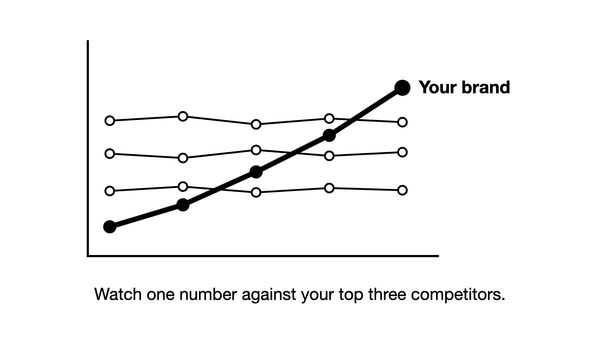
First record a baseline: your starting numbers from a few weeks of running 20 to 30 visibility prompts, before you change anything (how to build one). Record your top three competitors' visibility on the same prompts, and last quarter's numbers for the sales rows below.
Then track the early signals from your AI visibility tool (which ones matter) next to sales results. Sales follow weeks or months later, depending on your sales cycle.
A page is retrieved when an engine pulls it into the pool of pages it gathers for an answer. An AI-sourced lead came from a link in an AI answer, or told you an AI tool sent them.
| What to track | Kind of number | Where it comes from |
|---|---|---|
| Your visibility % next to your top competitors' | Early signal | AI visibility tool |
| Pages you worked on, on any site, that get retrieved and cited | Early signal | AI visibility tool |
| Visits and conversions from links in AI answers | Traffic | GA4 |
| Leads who say an AI tool sent them | Sales result | Form field and sales calls, in the CRM |
| AI-sourced leads that become opportunities, their deal size and time to close, against other leads | Sales result | CRM |
| Revenue from AI-sourced deals | Sales result | CRM |
How do you find out which leads came from an AI answer?
Ask every new lead how they found you. The share who name an AI tool is your main link between AI visibility and pipeline. Watch whether it rises month over month.
Put a "How did you hear about us?" field on every form that creates a lead. List ChatGPT, Gemini, Perplexity, Copilot, Claude, and Google AI Overviews or AI Mode among its choices. Save each answer on the lead's CRM record.
Then ask again on the first sales call. A buyer who found you through ChatGPT may still answer "Google" on the form.
Ask what the AI told them about you, too. On the call you can hear the answer a real buyer got, which no tool can show you, and whether it describes you the way you sell.
How do you track AI traffic from the first visit to a closed deal in GA4 and your CRM?
AI referral traffic is the visits that reach your site from links in AI answers (measuring it in GA4, Search Console and Bing). In what we saw from February to October 2026, the links in ChatGPT's citations carried utm_source=chatgpt.com, so you can track ChatGPT traffic by that tag.
Since 13 May 2026, GA4 has grouped many of these visits in an AI Assistant channel. Clicks from AI Overviews and AI Mode count as Organic Search (measuring those two). Google does not publish the channel's full list, and its pages for the channel do not name Perplexity. A custom channel group, your own grouping of traffic in GA4, catches the rest if you put an AI channel above Referral.
To follow a visit to a deal, pass its source into the lead's CRM record with a hidden form field. Then compare AI-sourced leads with every other lead, and read the AI counts as a floor, not a total.
Why do citations or AI visibility rise while leads stay flat?
Are your pages cited in AI answers that do not name you?
Say ChatGPT cites your pricing page, then names other vendors as its picks. Your citation count goes up, and the answer never names you.
We looked at answers that showed sources, for B2B brands across software and other fields, in data from the Zadoosh data platform. ChatGPT cited one of the brand's pages without naming the brand in 5.2% of those answers (April to October 2026). In AI Mode it was 17.5% (June to October 2026). Leads follow the mention, so judge demand by visibility %, and read citation counts as an early signal.
Did branded prompts lift your AI visibility number?
A prompt that contains your brand name, such as "Is [brand] good for remote teams?", makes the engine name you. If such prompts sit inside your visibility %, the number rises with no new demand behind it. Keep them as a separate check on how AI describes you.
Does AI describe your brand the way you sell it?
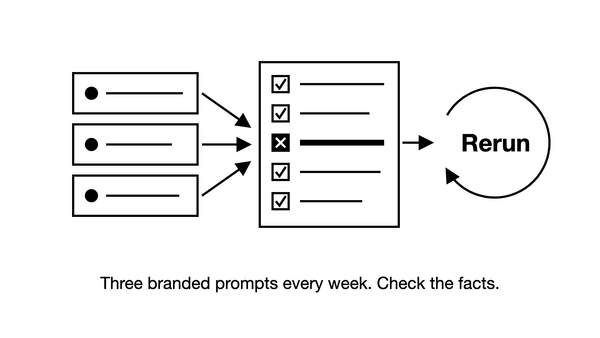
Being named, even recommended as the best fit, can still bring the wrong buyers. Check for three traps: outdated facts such as an old price, being named in the wrong kind of list, and wrong words tied to your brand. A premium product named among the "cheapest options" draws buyers who will not pay, so conversions fall while visibility rises.
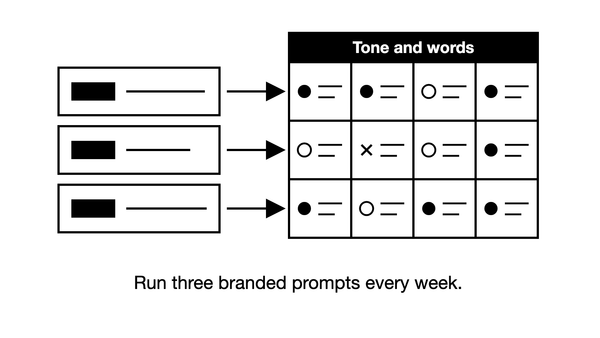
Run three branded prompts each week to catch these traps: "What is [brand]?", "[brand] pros and cons" and "Is [brand] good for [use case]?". Then fix the sources that carry old facts (how to check what AI says about you).
Do your AI visibility tool's counts undercount AI-sourced leads?
The gap between AI visibility and leads can also run the other way: more buyers name ChatGPT on your form than your tool's numbers suggest. A tool, ours included, sees only the answers to the prompts you track, never a real buyer's conversation. Real buyers also likely see more varied answers than its runs show, so its counts are a floor. Keep widening your prompt set with the words buyers use on sales calls (how complete tool data is).
How do you estimate the ROI of answer engine optimization?
Answer engine optimization (AEO), also called generative engine optimization (GEO), is the work of getting a brand into the answers AI engines write. To see whether AEO is paying back in money terms, build its ROI from the leads you can see.
| Column | What goes in it |
|---|---|
| Traced revenue | Closed deals from AI-sourced leads |
| Estimated revenue | Open AI-sourced leads × your close rate × your average deal size |
| Cost | Everything the AEO work cost in the same months, team time included |
AI-sourced leads that nobody traced are missing from both revenue columns. So the traced revenue is a floor, the least that AI answers brought in. No exact ROI multiple is possible. Report the floor, with the estimate beside it.
How do you report AI visibility and revenue to leadership?
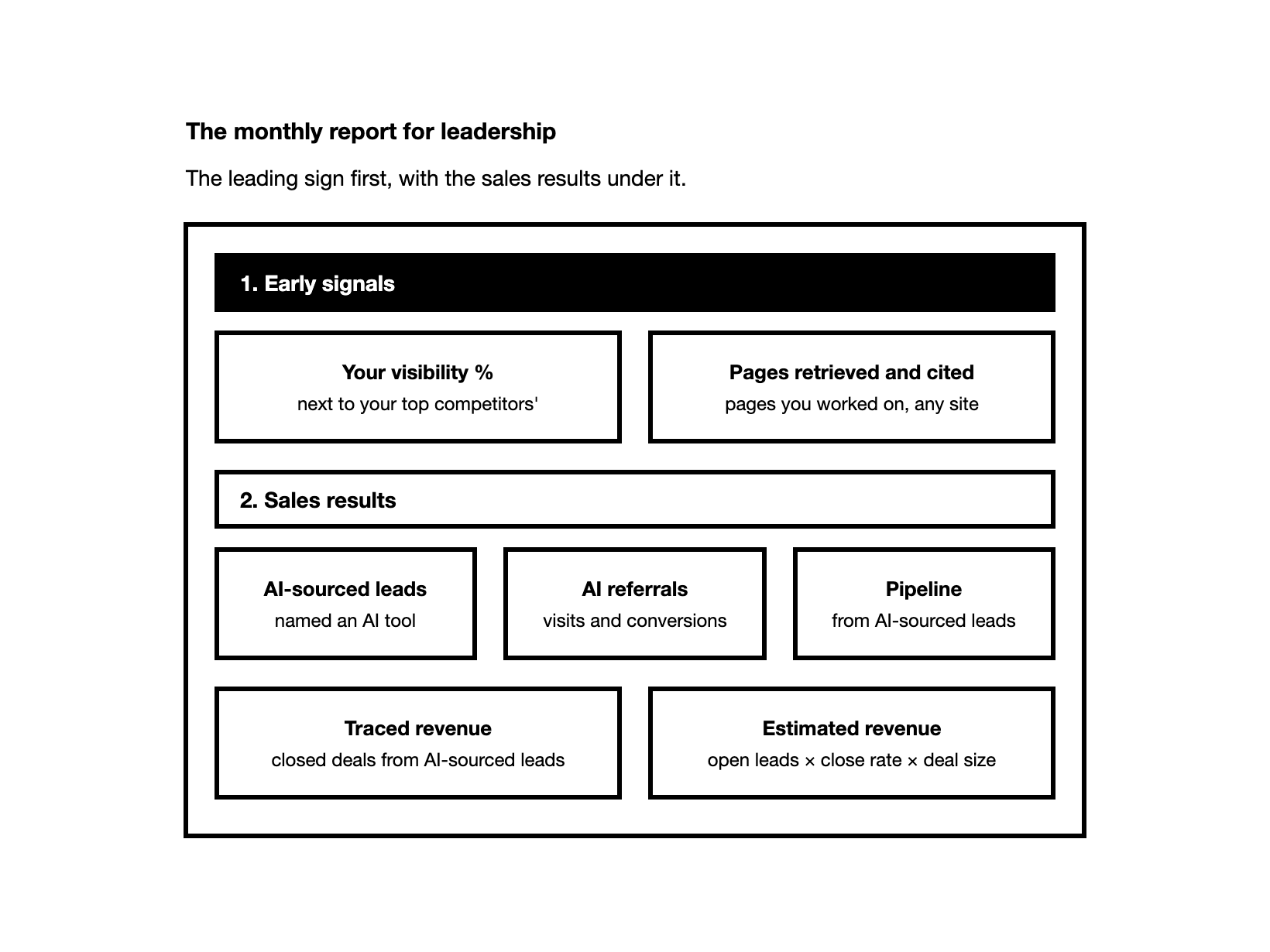
Give AI visibility its own section and KPI next to your SEO numbers in the monthly report. Add a quarterly summary for the CFO with the revenue table above. Open your first report by explaining that AI visibility sits between performance and brand marketing, so nobody judges it by cost per click.
Set directional targets, not a fixed percentage: rising visibility and a closing gap to your top competitors over the quarter. Put that gap first, as the leading sign, with the sales results under it.
List the pages you worked on that started being retrieved and cited this month, on your site and on others. Leadership then sees the work taking effect before leads move.
To see which channel drove a rise in visibility, compare the share of cited pages from your own site, community and third-party pages before and after. For what else the report should include, see what goes in the monthly AI visibility report.
Frequently asked questions
Do visitors from Perplexity or Gemini convert as well as visitors from ChatGPT? Not in Seer Interactive's case study of one client. From October 2024 to April 2025, its visitors converted at 15.9% from ChatGPT, 10.5% from Perplexity, 5% from Claude and 3% from Gemini, against 1.76% from Google organic. One client's site is not a pattern, so compare the engines in your own GA4 data.
Can AI answers send you leads if none of your own pages is cited? Yes. A mention can come from a third-party page, a community page or what the model learned in training, and the buyer needs only your name to find you. That is why visibility % counts every mention, whatever page it came from.
How long should you track before judging whether AI visibility brings leads? Collect visibility data daily from the start, but judge leads over a quarter. Self-reported AI leads come in small numbers, so one month can swing on a few demos.
Can an AI visibility tool show which deals came from AI answers? No. A tool shows what the engines answer to the prompts you track, not who bought. Deals come from your forms, sales calls and CRM. The tool adds the leading sign, your visibility against competitors, which you set next to those sales numbers. As of November 2026, the Zadoosh AEO platform's free trial runs 25 prompts for 7 days, no card.