AI Search Visibility Benchmarks: Is There a Good Score?
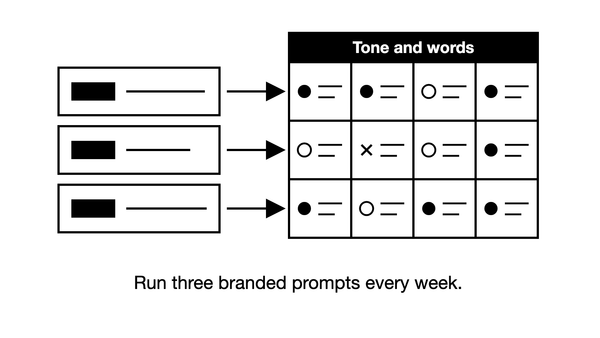
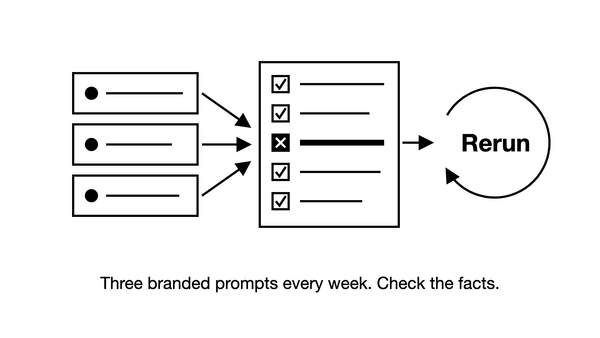
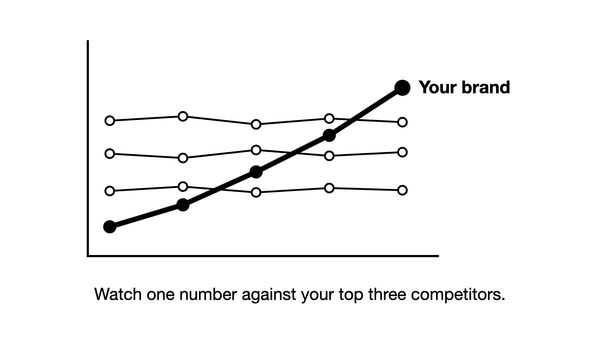
Not reliably: there is no universal good AI visibility score, so benchmark against your top three competitors on the same prompts and watch the trend.
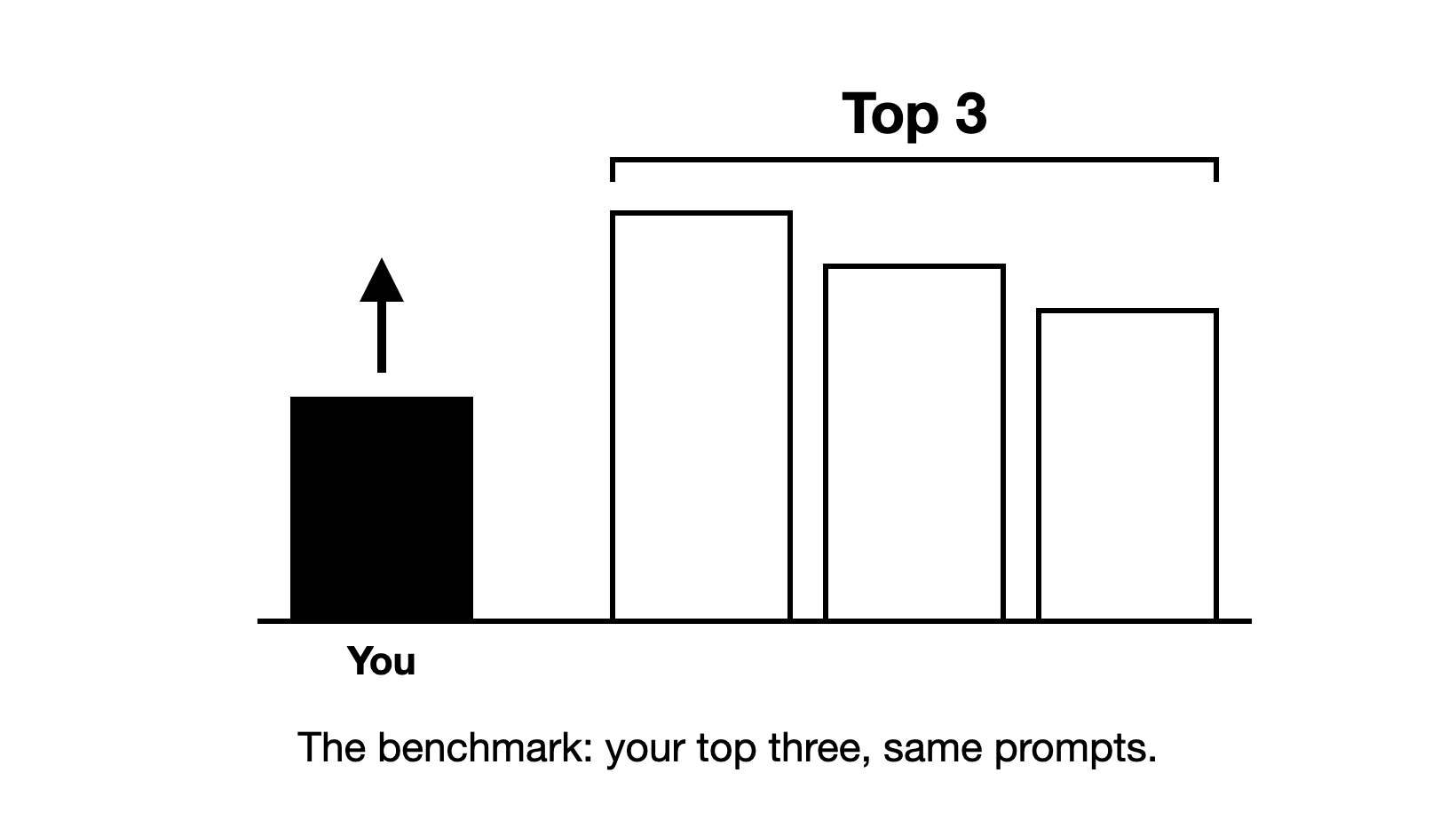
Not reliably: there is no universal good AI visibility score, so the useful benchmark is your top three competitors on the same prompts, and whether your share rises over about a month.
AI visibility is how often AI engines such as ChatGPT, Gemini and Google AI Overviews name your brand when buyers ask the questions you care about. Visibility prompts are buyer questions that do not name your brand, such as "best CRM for a 20-person B2B sales team". AI visibility is measured as visibility %: the share of answers to your visibility prompts that mention you.
Are there industry benchmarks for AI search visibility?
Published benchmarks exist, but none can tell you what score your brand should have. A visibility % only describes the setup it came from.
Say two brands are each named in 25% of answers. One tracks a short category prompt, such as "best CRM software", in the US. The other tracks long buyer prompts about its own niche, in three countries. The numbers match, but they measure different things.
Whether 25% is good depends on how often AI names the other brands in those same answers, and categories differ here. In some, a few leaders are named in almost every answer. In others, the answers spread across many brands. The same 25% can be a strong result in the second kind of category and a weak one in the first.
Fixed bands, such as "above 30% is strong", fail because they ignore your category and your prompts. So start with a different question: which brands does AI name instead of you, and how often?
Is there an AI visibility index for your industry?
An AI visibility index is a published table that scores the brands in a category on how AI answers treat them. Several companies publish one, and so do we. Some indexes count only how often each brand is named. Others combine that with where the brand appears in the answer, how positively it is described or which pages are cited, into one score.
As of October 2026, the Zadoosh AI Index scores each tool in a category by the share of tracked ChatGPT answers that name it. A tool counts only when its name appears in the answer text.
Use an index like this to see which brands lead your category in ChatGPT. Do not treat it as a score to hit, because it is built differently from your own tracking.
| Setting | The index | Your own tracking |
|---|---|---|
| Engines | ChatGPT only | The engines your buyers use |
| Country | The US | The countries you sell in |
| Prompts | One main prompt per category | Your own visibility prompts |
| What it counts | Answers that name each tool in the category | Answers that name your brand |
Check the same settings in any other index before you rely on it, including how it decides that a brand was named. If your brand is missing from an index, read its prompt before you decide that AI ignores you. A broad prompt can drift into a neighbouring market, and answers about that market are unlikely to name you.
Do AI search visibility benchmarks from 2025 still apply?
Not to today's answers. A benchmark describes the engines in the months it was collected, and the engines keep changing what they cite and whom they name.
We looked at data from the Zadoosh data platform, April to October 2026, B2B brands across software and other fields. Noise means the change you see when you rerun the same prompts and nothing real has changed. We compared each prompt's first 28 days with its last 28 days. Between the two, the share of ChatGPT answers naming the brand moved by a median 13 points, against about 4 points from noise alone.
Compare your numbers only with numbers collected in the same months, on the same engines.
Why can't you compare AI visibility scores from different tools?
Every tool and every published index builds its number its own way. Say one tool shows your brand at 30% and another shows 18%. Both can be right. Two numbers compare only when these six things match.
| What must match | Why it changes the number |
|---|---|
| What the number is | A share of answers and one score that combines several signals measure different things. |
| Prompts | In our experience, broad category prompts name more brands than narrow buyer prompts, so one brand can get a very different share on each. |
| Engines | Each engine builds its own answers, so a number combined across several engines is not comparable with a ChatGPT-only number. |
| Countries | ChatGPT may use your approximate location from your IP address, so a US number and a UK number describe different markets. |
| Runs per prompt | A run is one answer to one prompt. OpenAI says the same question may get different answers, so one run shows a brand at 0% or 100% and a share needs many runs. |
| What counts as a mention | Tools decide differently whether a brand named only inside a link or a source list counts. |
If two tools disagree, pick one, read its trend and check a few prompts by hand. Our guide to how AI visibility tools work shows how to check a tool's numbers.
How do you benchmark AI visibility against competitors on the same prompts?
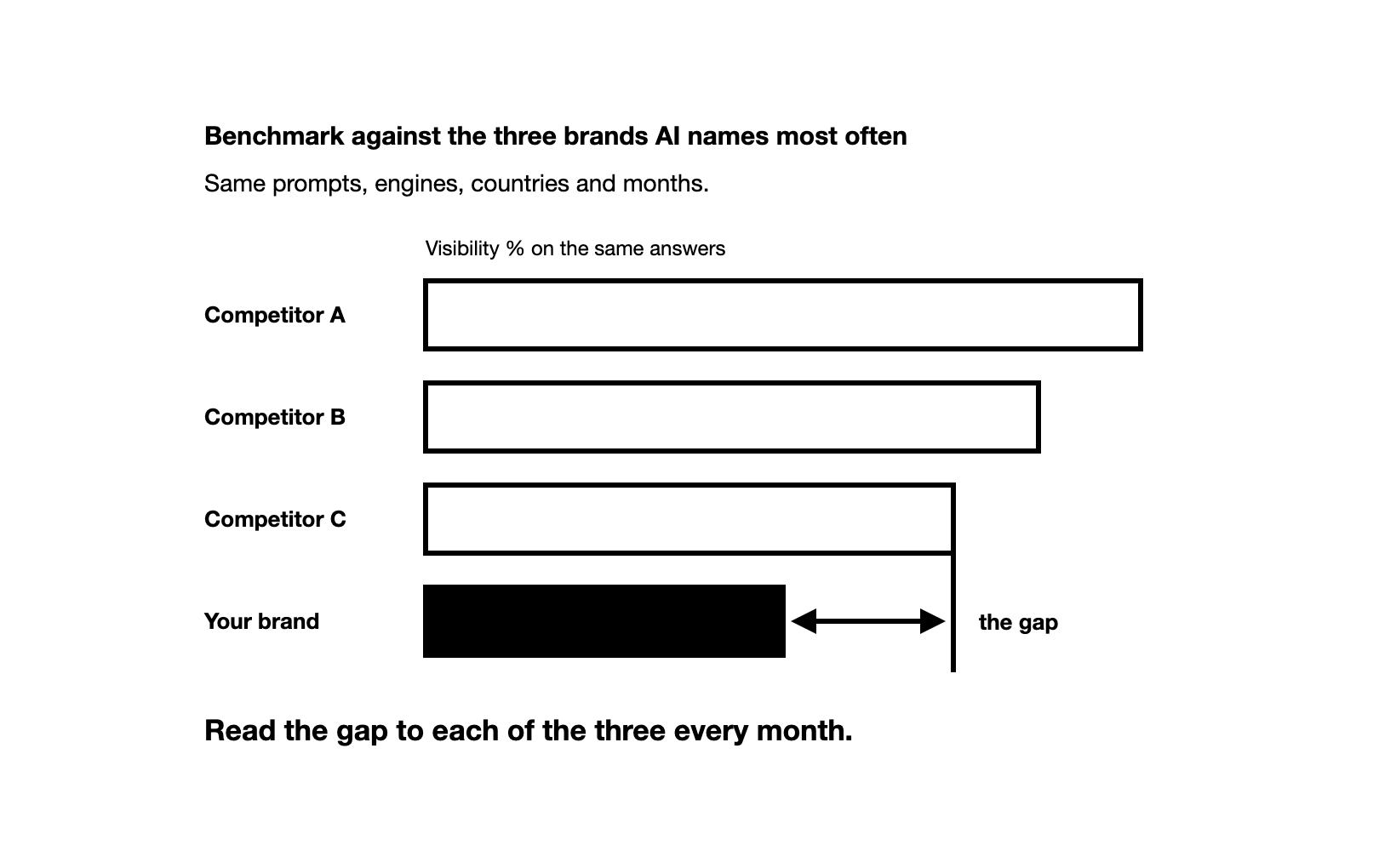
Benchmark against the brands AI actually names for your prompts, not the rivals you assume matter. The three it names most often are the ones to measure yourself against, on the same prompts, engines, countries and months. In our experience, a category's top three change little from month to month, so they make a steady benchmark.
If rivals you expected never show up, review your prompts first: they may be too generic. If you appear near the front of most answers and those rivals still do not appear, you are winning.
Compare each brand's visibility % on the same answers, or use share of voice: your mentions as a share of all brand mentions in those answers. Tools define share of voice differently, so never mix one tool's figure with another's. Our guide to AI visibility metrics shows how to calculate both.
Read the gap between you and each of the three every month. A closing gap is progress even in a month when every brand's number falls. If your number rises but the gap widens, your competitors are gaining faster than you.
How do you set an AI visibility baseline and a target?
What should an AI visibility baseline include?
A baseline is your starting numbers, recorded over a few weeks of running your prompt set before you change anything. It is what makes a later change mean something.
- Choose your prompts, engines and countries, and keep them the same. How to choose which prompts to track covers the prompts.
- Run each prompt 4 to 5 times per engine and country over a few days. That gives you a first read.
- Keep running each prompt once a day per engine and country. With 10 or more runs per prompt, you have a baseline to track against.
- Record visibility % for you and each of your top three competitors, from the same answers, so your baseline is a gap as well as a score. Note the dates, prompts, engines and countries behind it.
If you have no tool yet, a free trial is enough for a first read. As of November 2026, the Zadoosh AEO platform's free trial runs 25 prompts for 7 days, with no card. It covers ChatGPT, Gemini, Perplexity, Copilot, AI Overviews and AI Mode, from the countries you choose.
When you add prompts later, report two numbers: one on all prompts and a like-for-like one on the original set. New prompts start at whatever your visibility is for them. So the all-prompts number can rise or fall for reasons that have nothing to do with your work.
Should an AI visibility target be a fixed lift, such as 3x?
No. A multiple depends on where you start. From 2% of answers, a 3x lift takes you to 6%. From 40%, a 3x lift is out of reach, because no brand can be named in more than every answer.
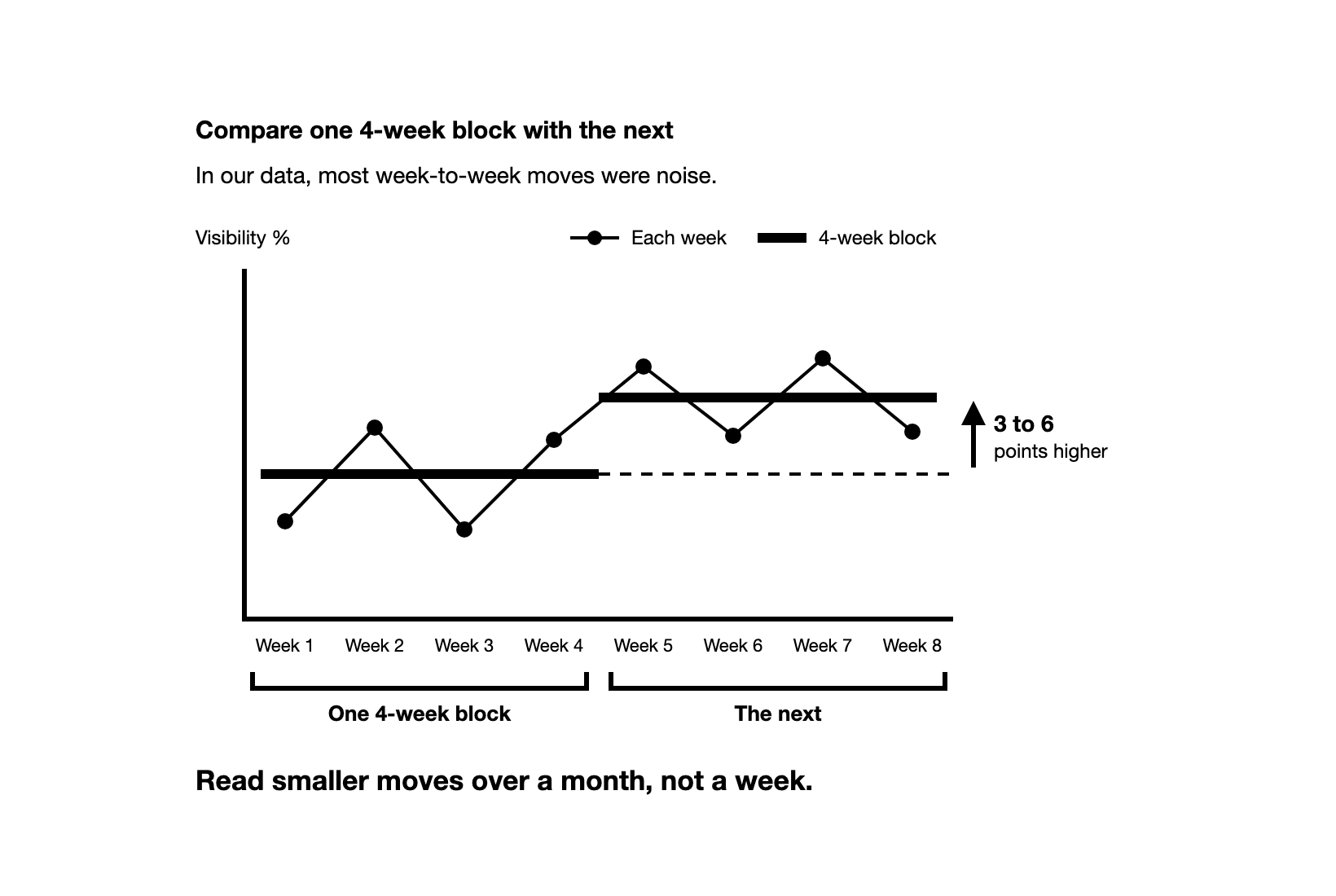
Set targets as directions instead. Your visibility should rise from month to month, and the gap to your top three competitors should close over a quarter. A rise of 3 to 5 points in a month is a good sign.
We looked at ChatGPT data from the Zadoosh data platform, March to October 2026, B2B brands across software and other fields. Comparing one 4-week block with the next, changes of 3 to 6 points were already likely real.
Can AI visibility really double in two weeks?
It can, from a low start. But check the size of the move in points before you believe it. Going from 5% to 10% doubles your share, yet it is only a 5-point move.
How much one week can tell you depends on how many answers your prompt set collects in a week. That is your prompts times countries, times seven days of daily runs, counted for one engine at a time. For example, 15 prompts in one country, run daily in ChatGPT, give 105 answers a week.
In the same ChatGPT data (March to October 2026), most week-to-week moves in a prompt set's visibility were noise: the median move was about 3 points. A weekly change was at least 80% likely to be real from about 11 points across all prompt sets. On sets with 100 to 299 answers a week, a change was likely real from about 7 points. Under 100 answers a week, no weekly change could be told from noise.
Look at your numbers every few days. Act on a weekly change only when it is about 10 points or more, on a set with 100 or more answers a week. Read smaller moves, like that jump from 5% to 10%, over a month.
In our experience, work to raise your visibility usually starts to show within 2 to 12 weeks. Before you credit a rise to your work, check that your top three competitors did not rise by the same amount. Our guide shows how to prove a change in AI visibility is real.
Frequently asked questions
Should you benchmark AI visibility engine by engine? Set your target on the number combined across the engines you track, and read each engine on its own to see where you trail. Read AI Overviews and AI Mode apart as well, because they are different products (how to measure your brand in AI Overviews and AI Mode). One engine on its own has fewer answers, so its number swings more from week to week. Read per-engine numbers over a month.
How often should you update the competitors in your AI visibility benchmark? Check which brands AI names each month, and add any brand that starts showing up often. If your tool counts share of voice against the competitors you track, adding or removing one changes your share even when nothing else moved. Note the date of each change in your report.
What should you benchmark when AI names your brand in almost no answers? Benchmark the leaders anyway: their share is the gap you need to close. Sort the pages AI cites in their answers: their own pages, third-party pages (a listicle, a review article, etc.) and community pages (a Reddit thread, a forum post, etc.). The group that carries most of their citations is where to start, beginning with prompts where one of your pages is already close to what AI cites. When the pages you create or improve start being cited, your work is being picked up. That sign usually comes before your brand is named more often.
Can an agency compare AI visibility across its clients? Not by putting their scores side by side. Each client's number comes from its own prompts, category and markets. Benchmark each client against its own top three competitors, then compare clients on whose gap is closing.