How to Measure AI Visibility: Metrics and Method
You measure AI visibility by asking AI engines your buyers' questions many times and recording how often your brand is mentioned, cited and recommended.
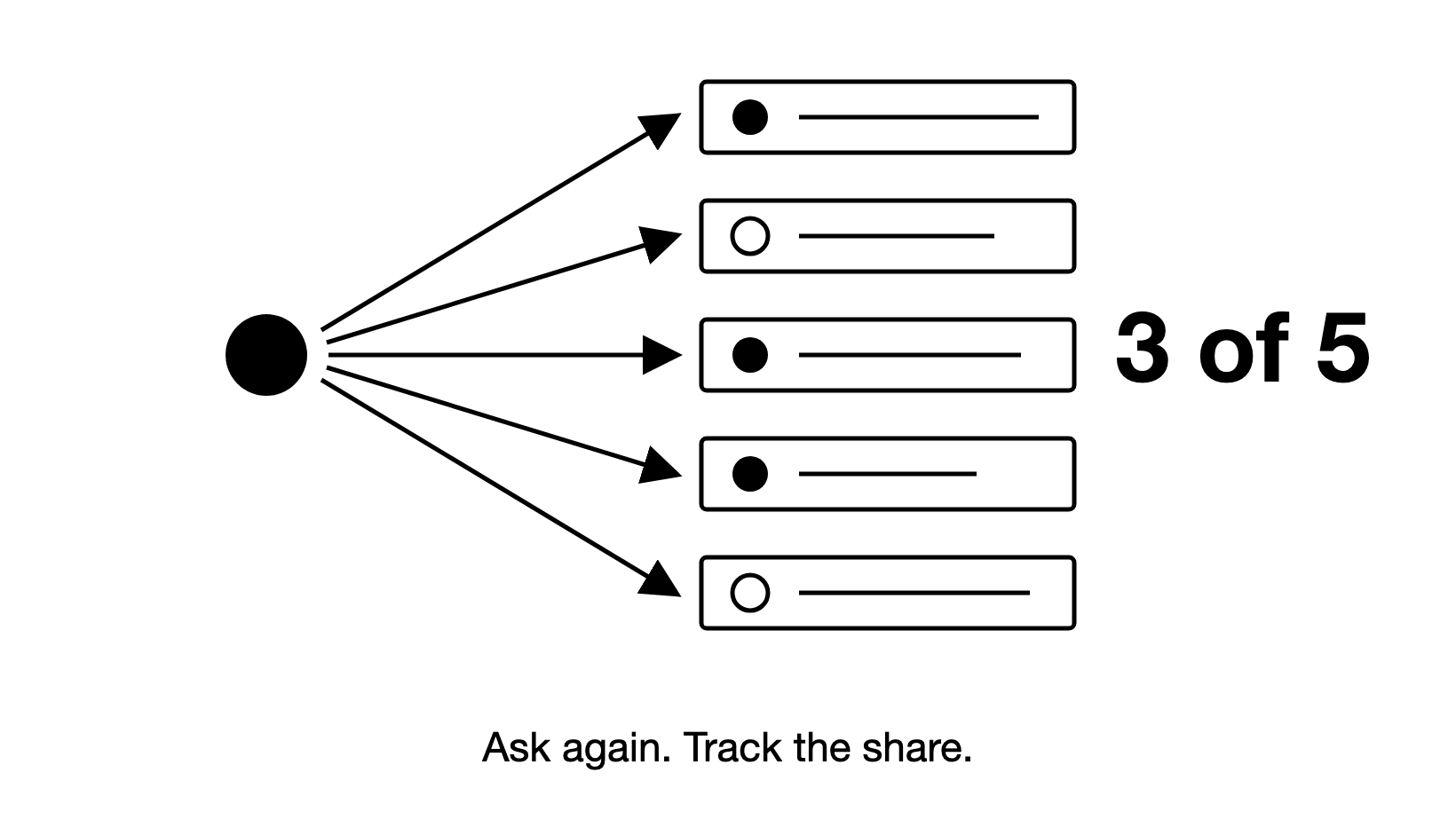
You measure AI visibility by asking AI engines the questions your buyers ask, many times over, and recording how often your brand is mentioned, cited and recommended in the answers.
Search rankings told you where you stood on a list of ten links. AI answers do not work that way. ChatGPT, Gemini, Perplexity, Copilot and Google's AI Overviews and AI Mode write a fresh answer each time, name a handful of brands and cite a handful of sources. Your brand is either in that answer or it is not, and the answer can change the next time someone asks.
This guide is the map of the whole job: the method in short, then one section for each part of it, with a link to the detailed guide where we have one.
The method in short
- Pick buyer-intent prompts: the questions a buyer asks when looking for a solution, not your brand name.
- Check from a clean session: logged out, in a private window, with personalisation off.
- Run each prompt many times: about ten runs give a rough read; more give a better one.
- Record what matters: whether your pages are retrieved and cited, whether your brand is mentioned and recommended, and who is named instead.
- Set a baseline, then keep collecting: as often as you can, ideally daily, and decide on the trend over weeks, never on one week of data.
Two jobs: demand and positioning
Measuring AI visibility does two different jobs, and it helps to know which one you are doing.
- Demand: is your brand named and recommended when a buyer asks AI for a solution? This is what brings buyers to you.
- Positioning: what does AI say about your brand? You check the answers, look for patterns and the words AI uses to describe you, then change your content so AI describes your real positioning.
Neither is more important than the other, but they are not the same. They also connect: when AI mentions you with the wrong words, the mention does little for demand, because people arrive at your site expecting something different.
Measuring AI visibility is neither performance nor brand marketing
AI visibility sits between the two. If you come from performance marketing, do not expect an exact number with a dollar value attached to it: the answers are probabilistic, so every number is an estimate. If you come from brand marketing, do not treat it as something that cannot be measured: it can, as a share of answers measured over many runs.
What should you measure in AI answers?
Six things are worth recording for every answer:
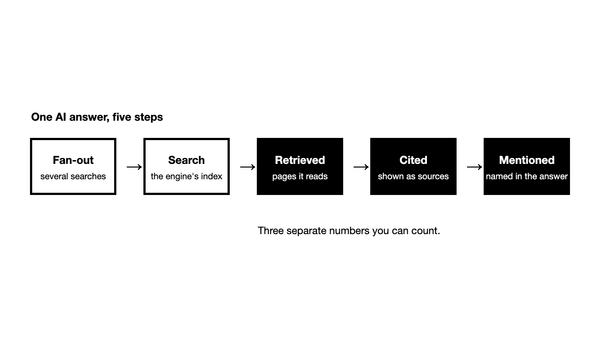
- Retrieval: did the engine pull one of your pages into the pool of sources it read for the answer? Where an engine shows its full source list, this is visible: ChatGPT's Sources panel, for example, shows "cited sources and other relevant links", more than the citations in the text.
- Citation: does the answer itself cite one of your pages?
- Mention: is your brand named at all?
- Recommendation and position: is your brand suggested, and is it named first, third or last?
- Sentiment and accuracy: is what the answer says about you positive and correct?
- Competitors and sources: which other brands are named, and which sites are retrieved and cited instead of yours?
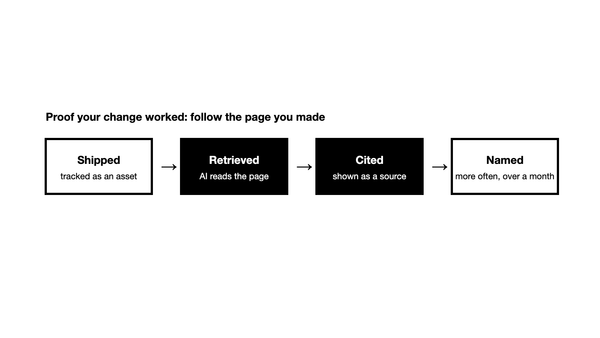
Think of the first four as layers. An engine first retrieves sources, then cites some of them in the answer, then names brands. Retrieval is the wider pool that citations come from, and being recommended is what moves the needle: it is what visibility really means. So follow the layers in order: if your pages are not retrieved, start there; if they are retrieved but not cited, aim to be cited; if you are cited, aim to be recommended.
What each of these means, and how to count it: mentioned, cited and retrieved.
Why one check proves little
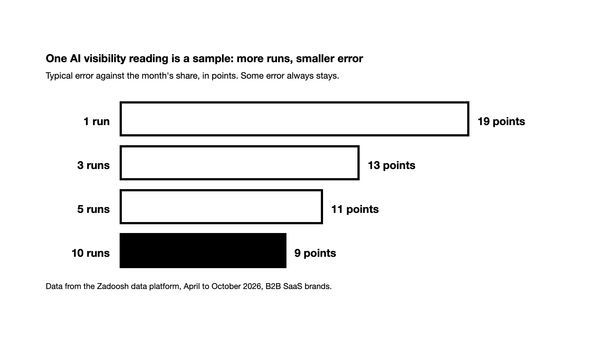
Every answer is generated on the spot, so measuring means sampling: running the same prompts many times and reading the pattern. In data from the Zadoosh data platform (April to September 2026, mostly US B2B SaaS brands), a brand was named in some answers to a prompt and left out of others in about 8 in 10 monthly periods. A single check came within 20 points of the brand's monthly share only about half the time; ten checks did so nearly 9 times in 10.
The share also moves over time. In the same data, a brand's share for the same prompt moved by a median of 15 points between the first and last four weeks of a two-month period, about four times what chance explains. Confidence today expires, so the checks have to be repeated. For the full picture, see does ChatGPT give everyone the same answer.
How do you check if your brand shows up in AI answers?
You can start by hand today, with no tool:
- Write 20 to 30 buyer questions. Use the words a buyer would type, not your product name. "What is the best [category] tool for [use case]?" tells you far more than "What is [your brand]?"
- Ask each question in the engines your buyers use. At minimum ChatGPT and Google (where AI Overviews and AI Mode appear), then Gemini, Perplexity, Copilot and Claude if they matter in your market.
- Use a clean session. Log out or open a private window. In ChatGPT, a temporary chat can be set to "Unpersonalized", which leaves out your memories and custom instructions.
- Ask each question several times, and record each answer, not just the first.
- Record the five measures above in a simple sheet: prompt, engine, date, mentioned, cited, recommended, position, competitors named, sources cited.
Checking by hand teaches you how the answers behave, and it is the right way to start. Treat what you see as a sense of where you stand, never as a verdict.
Which prompts should you track?
The prompts you choose decide what your numbers mean, and choosing the wrong ones is the most common mistake.
- Track buyer-intent prompts. What matters is whether your brand shows up when a buyer is looking for a solution. Prompts that are too simple, or purely informational ("what is X"), tell you little about that.
- Keep branded prompts out of the visibility share. "Is [brand] good?" inflates your score, because the engine almost always names you when you name yourself. Check them briefly anyway: they show what AI says about you by name, which is a positioning check.
- Cover the buyer's journey. Mix problem questions, category questions ("best X tools") and comparison questions ("X vs Y").
- Group prompts by topic, so you can see where you win and where you are absent instead of one blended score.
- Keep the set stable. If you change prompts every month, you cannot tell a real change from a different question.
Two more habits make the prompts closer to what buyers really ask. First, start with category prompts such as "best X", then add the context that matches the buyers you serve: their role, company size and need. More words alone change little; context that serves you shows whether you appear for your own segment. Our guide to choosing which prompts to track goes step by step.
Second, build the set from what you know about your buyers: your ideal customer profile, the long tail of searches in Search Console and keyword data, and the questions that come up on sales calls. Start with a few core category prompts and widen the set once you start getting cited.
AI engines do not publish the questions people ask the way search engines publish keyword data, so start from your search keywords, sales calls and the questions customers actually ask.
What should your tracking sheet look like?
One row per prompt, per engine, per run. A simple sheet is enough to start:
| Date | Prompt | Engine | Run | Mentioned? | Cited page | Recommended? | Position | Named instead | Sites cited |
|---|---|---|---|---|---|---|---|---|---|
| 6 Oct | best CRM for a 20-person sales team | ChatGPT | 1 | Yes | none | No | 4th | Rival A, Rival B | g2.com, a listicle |
| 6 Oct | best CRM for a 20-person sales team | ChatGPT | 2 | No | none | No | none | Rival A, Rival C | reddit.com |
From the rows, work out each share per prompt and per engine: how many of the runs named you, cited you and recommended you.
How do you set a baseline?
A baseline is what makes a later change mean something. Before you change anything, run your prompt set for a few weeks and record the shares per prompt, per engine and per country. Label every number with how many runs it rests on, so nobody reads a share from two runs as a result. Then compare like with like: the same prompts and engines, 30 days before and 30 days after a change. A careful first baseline is an audit: here is how to do an AI visibility audit.
How to tell whether a change you made worked: did your AEO/GEO change really work?
Which AI visibility metrics matter?
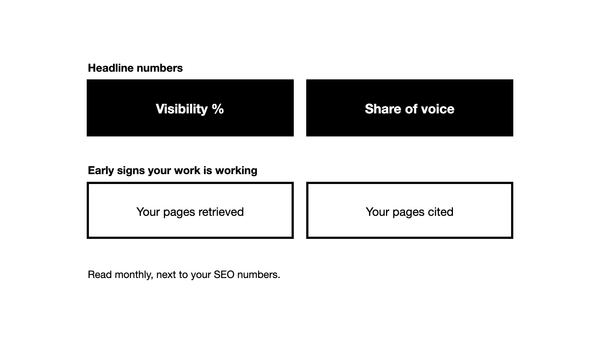
Most teams need these, read together:
- Mention rate: the share of answers that name your brand.
- Citation rate: the share of answers that cite your pages.
- Retrieval rate: where an engine shows its full source list, the share of answers that retrieved your pages, cited or not. A low citation rate with a high retrieval rate means the engine reads you but uses others.
- Share of voice: your mentions as a share of all brand mentions across your prompts, compared with competitors.
- Average position: where you appear when you are named.
What is a good AI visibility score? There is no universal good number. Compare yourself with your top three competitors on the same set of questions, and look at the trend: a share that rises over about three months is good. A single score on a dashboard also hides what sits under it: which prompts, which engines and how many runs.
Which of these to report, and how: AI visibility metrics.
How do you track which sources AI cites?
Engines that search the web before answering link to their sources, and recording those links over time tells you two things:
- Which of your pages get cited, and for which prompts.
- Which other sites get cited instead, such as review sites, listicles, Reddit threads and competitors' pages. That list shows where your off-page work should go.
ChatGPT, for example, may search the web on its own when a question benefits from current information, and OpenAI notes its results and citations can be incomplete or outdated. Cited sources are also the part of an answer that changes most: in our data (April to September 2026, mostly US B2B SaaS brands), two ChatGPT answers to the same prompt on the same day shared only about 3 in 10 of the sites they cited.
How do you see AI traffic in your analytics?
Some AI visits are easy to see and some are hidden.
- Referral traffic. ChatGPT adds
utm_source=chatgpt.comto the links it shows, so those visits appear in Google Analytics as chatgpt.com referrals. Visits from other AI tools usually show up as referrals too. A custom channel group for AI sources stops them disappearing into "Referral". - Google's AI features. Clicks from AI Overviews and AI Mode are counted inside your normal web search traffic in Search Console, mixed with ordinary results. Search Console's generative AI performance reports show how often your pages appear in those features, with impressions only, not clicks, and Google first rolled them out to a subset of sites.
- Hidden traffic. Many AI apps send no referrer, so those visits show up as "Direct". People also read an answer, remember your name and search for you later.
Expect AI referral numbers to undercount the real influence. Pair them with a "How did you hear about us?" field on your forms.
How do you check what AI says about your brand?
Being named is not enough if the answer gets your pricing, features or category wrong. For your most important prompts, read the answers, not just the counts: is the description accurate and current, is the tone positive or negative compared with competitors, and are you placed in the category you want to own? Spotting a wrong answer early matters, because fixing it means changing the sources the engine relies on.
To check your positioning, look across many answers, not one. Which words does AI use to describe you, and which category does it put you in? Do those match how you position yourself? If not, change your own content, and the sources AI relies on, so they describe your real positioning, then check whether the words change over the following weeks.
When an answer is wrong, start from the sources, not from your own page. Look at the sources the engine retrieved as well as the ones it cited: the wrong fact or old description can come from a retrieved page that never shows as a citation. That source is where the fix starts, whether it is a review site, a directory, an old article or a page of your own. Record it next to the answer, and check the same prompt again over the next weeks to see whether the engine has picked up the corrected source.
How do you connect AI visibility to leads and revenue?
Visibility is worth tracking because it eventually moves the business. Three steps make the link visible:
- Set a baseline before any optimisation work, so you can show a change later.
- Follow AI visits to conversions, not just visits: signups, demo requests and deals. Google also suggests tracking conversions and time on site alongside Search Console.
- Ask buyers directly. A self-reported "Where did you hear about us?" field catches what analytics misses.
Treat the result as directional, not as an exact dollar value per mention.
How much can you trust AI visibility numbers?
Trust them as trends, not as exact readings. The full answer is in can you trust AI visibility data? Before acting on a change, check three things:
- Enough runs. A swing measured on one or two runs per prompt is mostly noise.
- Same prompts, same engines. A changed prompt set or a new engine can move a score with nothing real underneath.
- What users actually see. Tools collect answers through browsers or APIs, logged in or out, from one country. Spot-check by hand from a clean session.
Then keep checking. The engines change how they find sources and the world changes the real answer, so a number you trust today needs re-checking next month. How often depends on the question: a fixed fact barely changes, while "best X" and comparison questions need checks every week or month.
Does it differ by AI engine?
Yes. Each engine changes at its own pace, so read them separately and never average them into one number. If you are not sure which engines your buyers use, ask them on sales calls and in your sign-up form, and start with those. In our data (ChatGPT and Gemini: April to September 2026, mostly US B2B SaaS brands; Perplexity and Copilot: March to September 2026, and AI Overviews and AI Mode from June, mostly US brands), comparing each day's answer to the same prompt with the next day's:
| Engine | Cited sites kept the next day | Brand named again the next day |
|---|---|---|
| ChatGPT | about 1 in 4 | about 4 in 10 |
| Gemini | about 1 in 4 | about half |
| Perplexity | about 7 in 10 | about 1 in 3 |
| Microsoft Copilot | about half | about 6 in 10 |
| Google AI Overviews | about half | about 6 in 10 |
| Google AI Mode | fewer than 4 in 10 | about 4 in 10 |
Google's two AI features need their own approach. Google says AI Overviews and AI Mode may use different models and techniques, and they behave differently: AI Overviews works more like a next-generation Google Search, AI Mode more like ChatGPT. Here is how to measure your brand in AI Overviews and AI Mode.
Should you track by hand or with a tool?
Start by hand to learn how the answers behave and which prompts matter. Once you need many prompts, repeated runs, several engines and history over time, manual checks break down: automate the runs or use a tool built for it. Before choosing one, ask:
- How does it collect answers: browser, API, logged in or out, which countries?
- How many times does it run each prompt, and how often?
- Can you see the full answer and every cited link behind each number?
- Does it show each engine separately, with history over time?
- Can you choose your own prompts and competitors?
If you want to see how brands in your category show up in AI answers today, the Zadoosh AI Index is free to browse.
Frequently asked questions
How often should I check my AI visibility? Collect as often as you can, ideally daily with a tool, and look at it every day or every few days. Decide on the trend over several weeks, never on one week of data, and keep collecting, because the engines and the answers change over time.
How many times should I run each prompt? About ten runs give a rough read. In our data (April to September 2026, mostly US B2B SaaS brands), ten runs came within 20 points of a brand's monthly share nearly 9 times in 10; one run was 20 points or more off half the time.
How many prompts should I track? Start with 20 to 30 buyer-intent questions, then adjust to your brand. A smaller set of the right prompts, run many times, beats a large set run once.
What is a good AI visibility score? There is no universal number. Compare yourself with your top three competitors on the same questions, and look for a share that rises over about three months.
Can I measure AI visibility for free? Yes, by hand. Ask your buyer questions in each engine from a clean session, repeat each several times, and record the results in a sheet. It works for a few dozen prompts and becomes slow beyond that.