Did Your AEO/GEO Change Really Work?
Your AEO change worked when the pages you made get retrieved and cited and visibility rises over a month against rivals. How to check each step.
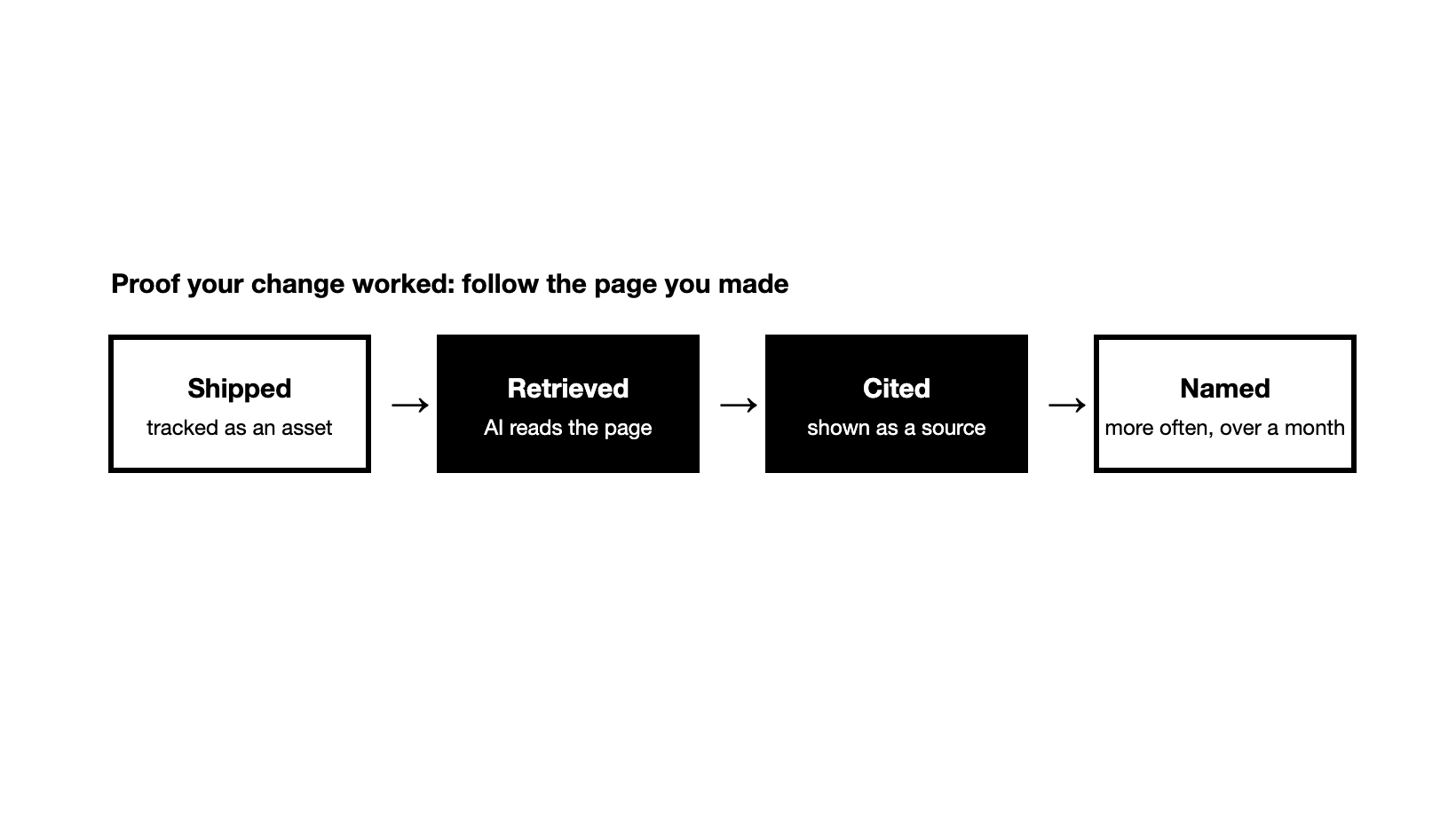
Your AEO change worked when the new pages and placements you created start being retrieved and cited, and your visibility rises in a steady direction over about a month against competitors who did not move; if nothing you made is being picked up, the change came from somewhere else.
This guide is part of our guide to measuring AI visibility.
Why is it hard to tell whether your work moved AI visibility?
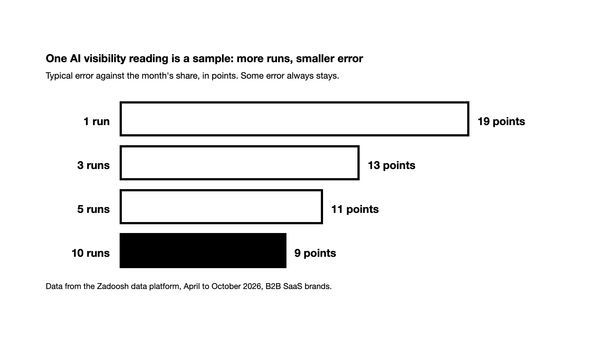
Because AI visibility moves on its own. Every answer is generated fresh, so the same prompt names your brand in some runs and not in others, and the engines keep changing how they find sources. In data from the Zadoosh data platform (April to October 2026, B2B SaaS brands), a brand's share on a single prompt moved a median of 5 points between two four-week windows from noise alone. Over two months the share itself moved a median of 15 points, and about 4 in 10 prompts (38%) moved more than 20 points, against 7% for noise.
Engines keep changing and other brands keep working, so a rising line alone cannot show that your work caused it. The proof is your new pages being retrieved, then cited.
Step 1: What exactly did you change, and when?
Record each new page, placement or post as an AEO asset in a tracking platform from the day it goes live: what changed, the URL, the channel (your own site, community or third-party) and the prompts it targets. Weeks later, that record connects what you shipped to each shift in AI results, and it is the list of URLs you check in the next three steps, since each page you made is its own evidence.
An AEO platform like Zadoosh can track this for you: add each page, placement or post you create to My AEO Assets, and it shows where AI engines retrieve and cite it (which prompts, engines and countries) and emails you the first time it is retrieved or cited.
Step 2: Are the pages you made being retrieved?
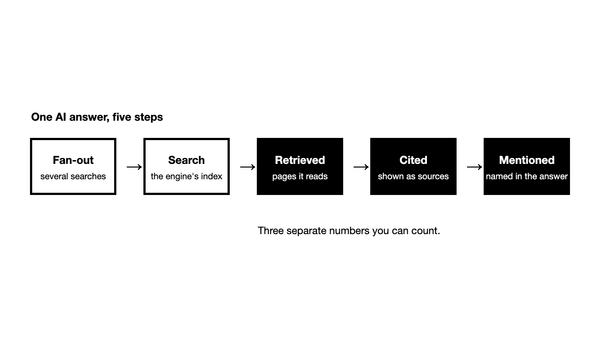
Retrieved means the engine pulled your page into the pool of pages it read for the answer. ChatGPT lists that pool under Sources; the links inside the answer are the ones it cited. Run the prompts each new page targets and look for its URL in that list. Do this for every asset you track, not only pages on your own site: a listicle you were added to or a community thread you joined counts too.
Record the first date you see each URL retrieved, and on which prompts and engines. This is the clearest early sign that your work reached the engine. What can go wrong: none of your pages ever appear. Then whatever moved your visibility came from somewhere else, and it is worth checking whether AI engines can reach your site at all.
Step 3: Are they being cited?
A page shown as a source in the answer is a stronger signal than retrieval: the engine used it. Track it per URL across the prompts it targets, and read it over weeks, because citations come and go between runs. We give no timeline for when an on-page change gets picked up; read the history over about a month before you conclude anything.
Step 4: Is your brand being named more often?
Mentions, your brand named in the answer, come last. Engines use the sources they cite to decide which brands to name, so your pages and placements being cited is how mentions usually follow. But a mention can also come from a page you never touched, or from what the model already knows. Mentions going up with nothing of yours retrieved or cited is weak proof of your work.
Step 5: Is visibility rising against your competitors?
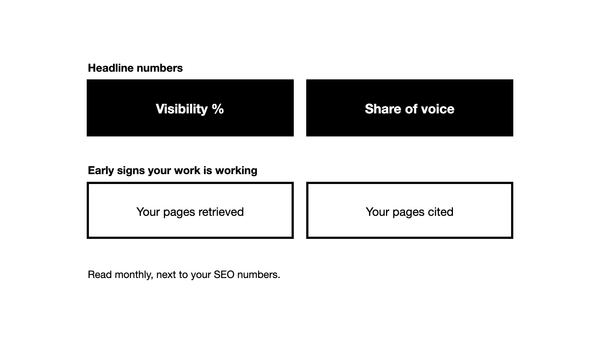
Read your visibility % (the share of answers that name you, pooled across all your prompts) as a direction over about a month: up, down or flat. As a rule of thumb from our own work, an average rise of 3 to 5 points in a month is a good sign; week to week inside the month, expect it to bounce. The rule is for the pooled number, never one prompt, since a single prompt moves about 5 points on noise alone. Collecting daily and deciding on the trend is covered in the main guide.
Then compare with your top competitors on the same prompts: the brands AI actually names, not the ones you assume. If you rose and they stayed flat, the gap closed, which is what your work should do. If everyone rose in the same weeks, suspect something that touched the whole category.
What can go wrong: you added prompts during the month. New prompts change the mix of questions behind the number, so it can move up or down, which is a change in what you measure, not in performance. Report the number on the original prompts next to the all-prompts number.
Step 6: Which channel drove the change?
To see whether your content or your off-page work (Reddit, PR, listicles) drove it, split the pages AI cites for your prompts into three channels: your own site, community, and third-party publications (review sites count as third-party). Compare each channel's share of cited pages before and after your work, never its share of answers. The channel that grew is the likely cause, and it should match the channel of the assets you tracked. The audit guide explains the channels in Step 6, and What is Omnichannel AEO? explains why all three matter.
Do holdout prompts or engine updates prove anything?
They add context, not proof. A holdout, or control group, is a set of prompts your change should not touch, watched to see whether they move too. An engine update check looks for all brands moving at once on one engine.
Both have limits. Once you optimise prompt by prompt, almost every prompt is one you are working on, so a clean holdout is hard to keep. And engine changes lift some sets of prompts and leave others alone, so untouched prompts moving, or staying still, proves little either way.
Use them as a hint. The test that holds up is Steps 2 to 4: a page you made, retrieved, then cited, then mentions following.
What can these checks tell you, and what can they not?
They can show that your work reached the engines. When specific pages are retrieved and cited for the prompts you targeted, visibility is rising against competitors and the channel you worked on is growing, the signals are strong enough to claim your work moved visibility. That is a case you can put in front of a client or a CFO, and they can check part of it themselves by running a prompt and finding your page in ChatGPT's Sources.
They cannot attribute credit cleanly to each change when several ship together, and they cannot show what a real buyer saw, because no tool sees a buyer's own conversation. Report the result as evidence that points one way, not as an exact figure for each change.
Frequently asked questions
How long should I wait before judging an AEO change? There is no fixed timeline for when an engine picks up a change. Watch whether the new page gets retrieved and cited, and read your visibility trend over about a month before you conclude anything.
How big does a change in AI visibility need to be before it is real? Read the direction rather than chasing a threshold. An average rise of 3 to 5 points in a month across all your prompts is a good sign. A single prompt is too noisy to judge: in our data (April to October 2026, B2B SaaS brands), one prompt moved a median of 5 points between two four-week windows on noise alone.
Why did my AI visibility suddenly drop? Start from the citations, not your page. Find the cited sources that used to bring your brand into the answer and check whether they dropped out. If they did, the cause is at the source level: see what is cited now and how many of those pages name you.
Can I tell which single change moved my AI visibility? Rarely, if several changes shipped together. The closest you get is page by page: a page you made that starts being retrieved and cited for the prompts it targets is evidence for that page.
How do I measure whether PR or brand mentions affected AI visibility? Treat each placement as a page. Check whether the article is retrieved and cited for your prompts, whether mentions of your brand follow, and whether the third-party share of cited pages grew.