Does ChatGPT Give Everyone the Same Answer?
No. ChatGPT can answer the same question differently for different people, and for the same person twice. Here is why, and what it means for your brand.
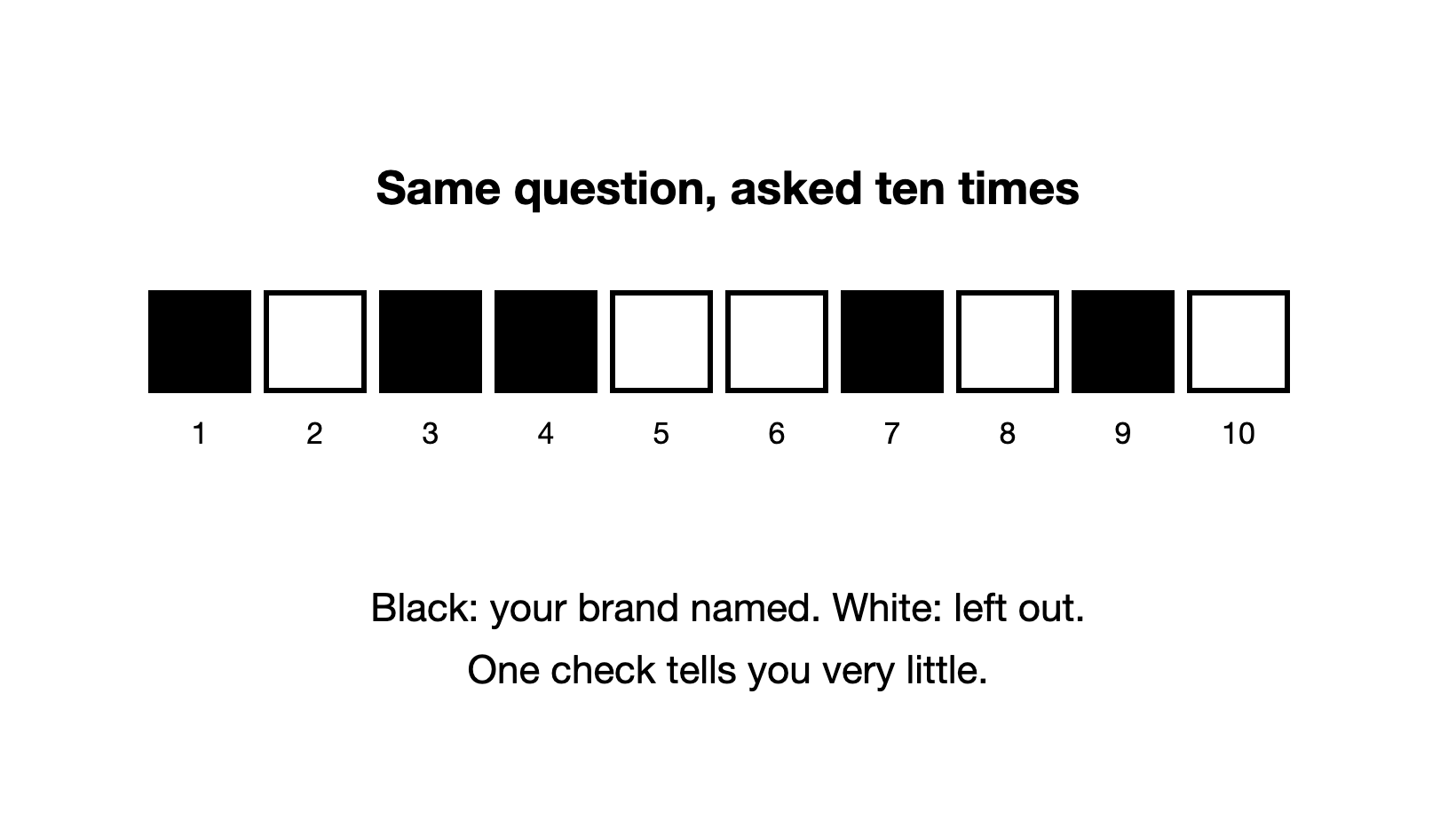
No: ChatGPT can give different people different answers to the same question, and it can give the same person a different answer the next time they ask.
That matters more than it sounds if you care about how AI talks about your brand. A buyer who asks ChatGPT for "the best project management tools" may see your brand named. Their colleague, asking the same question a minute later, may not.
This guide explains why answers change, whether it is just you or everyone, and what our own data shows about how much brand mentions move from one answer to the next. It is part of our guide to measuring AI visibility.
Why does ChatGPT give different answers to the same question?
There are four main reasons, and OpenAI's own documentation describes each of them.
1. The model does not pick the same words every time. ChatGPT writes an answer word by word, choosing from likely options rather than copying a stored reply. OpenAI says its models are "non-deterministic by default", so outputs may differ from one request to the next, and even developers who fix every setting in the API face "a small chance that responses differ".
2. The system behind it changes. OpenAI says it updates the configuration of the infrastructure that serves its models a few times a year, and that this can change outputs. The answer you saw last month was produced by a slightly different system than the one answering today.
3. Your own context shapes the answer. When Memory is on, ChatGPT can remember preferences and details from your past chats and decides which of them are relevant to a response. Custom instructions apply to every chat. Memory can even feed into the search ChatGPT runs, for example by adding your location.
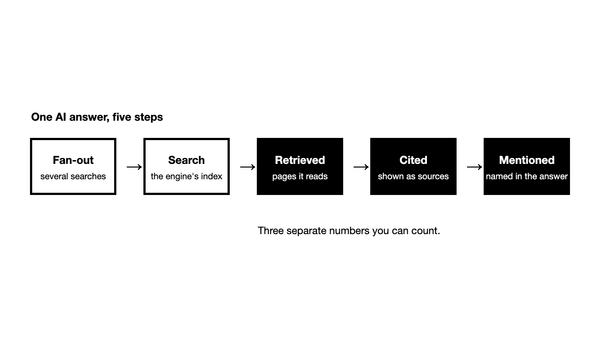
4. Live search brings in different pages. For questions that benefit from current information, ChatGPT may search the web on its own. When it does, it typically rewrites your question into one or more search queries, and the pages it finds can differ from one search to the next.
How much the answer changes depends on the question. A fixed fact, such as "What is the capital of India?", comes back the same almost every time. Questions with many reasonable answers, such as "best CRM for a small team" or "top alternatives to a well-known tool", vary much more, because several brands fit and the model picks among them.
Is it just you, or does everyone get a different answer?
Both. Two people get different answers partly because of their own context: memory, custom instructions, and the approximate location ChatGPT infers from an IP address. But even with all personal context removed, the same question asked twice can come back with a different answer, because of the first and fourth reasons above.
This is why checking ChatGPT from your own account says little about what a cold, unpersonalised buyer sees. If you have spent months asking it about your company, your own tests carry context about you that a buyer's first question does not. To get the least biased view, check from a clean session: an incognito window, logged out, with personalisation off. OpenAI's temporary chat can be set to "Unpersonalized", which leaves out your memories and custom instructions.
How much do brand mentions change between answers?
This is the question that matters for a brand. In data from the Zadoosh data platform (April to September 2026, mostly US B2B SaaS brands), we compared AI answers to the same prompts and tracked whether a given brand was named.
Two answers to the same prompt on the same day often disagree. When we asked the same prompt on the same engine twice on one day, the two answers shared only about 3 in 10 of the sites they cited. The first brand named changed in about 4 of 10 reruns. And when a brand was named in one answer, the rerun named it less than half the time.
For most prompts, a brand is a sometimes-answer. In about 8 in 10 of the monthly periods we looked at, the tracked brand was named in some answers to a prompt and left out of others. For about 2 in 10, the brand was always named or never named.
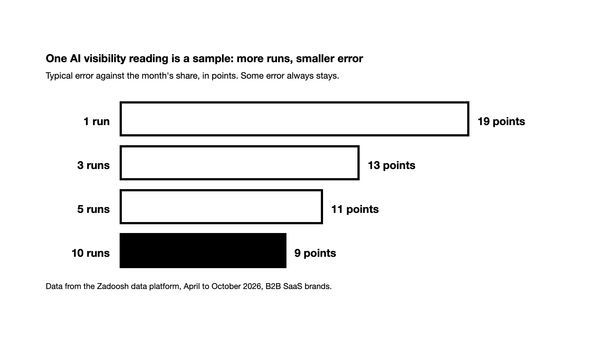
One check is close to a coin flip. For those prompts, we compared the share of answers naming the brand in a few random runs against its share across the whole month:
| Runs you check | Within 10 points of the month's share | Within 20 points | Typical error |
|---|---|---|---|
| 1 | about 1 in 3 | about half | 21 points |
| 3 | 4 in 10 | about 2 in 3 | 12 points |
| 5 | about half | about 3 in 4 | 12 points |
| 10 | about 6 in 10 | nearly 9 in 10 | about 9 points |
So a single check is wrong by 20 points or more half the time. Ten runs get you a rough read, and more runs narrow the error further, but never to zero. Think of it as confidence, not certainty: the more times a prompt is tested, the more confident you can be in what you see.
And the share itself moves over time. In the same April to September 2026 data, comparing the first four weeks with the last four weeks of a two-month period, a brand's share for the same prompt moved by a median of 15 points, and 4 in 10 prompts moved by more than 20 points. Chance alone would explain about 4 points. Over a single week, the brands named changed little in our data; over a month or two, they changed a lot.
That second finding is easy to miss. Even 100 runs today cannot tell you what ChatGPT will say about your brand next month. The engines change how they find and rank sources, and the world changes the real answer: new products launch, reviews come out, pages change. Confidence today expires.
Is it the same on other AI engines?
Yes, wherever an engine writes a fresh answer, and our data shows it for every engine we have enough answers from.
Gemini. In a smaller set of Gemini answers (April to September 2026), two answers to the same prompt on the same day shared only about 2 in 10 of the sites they cited. The first brand named changed in about a third of reruns, and when a brand was named in one answer, the rerun named it only about 4 times in 10.
Google AI Overviews and AI Mode. Google says AI Overviews and AI Mode may use different models and techniques, so the answers and links they show vary. In our data (May to October 2026, mostly US B2B SaaS brands), the two shared only about 1 in 4 of the sites they cited for the same prompt on the same day. Each also changes on its own: AI Overviews kept about half of its cited sites from one day to the next, and about a third after a week.
So is an AI Overview appearance real, or personalised to you? Google does not publish how far it personalises AI Overviews, so treat one appearance the way you would treat one ChatGPT answer: check it again, from a clean session, before you count it.
Every engine we track, day to day. Comparing each day's answer to the same prompt with the next day's answer shows how much each engine changes from one day to the next. In data from the Zadoosh data platform (ChatGPT and Gemini: April to September 2026, mostly US B2B SaaS brands; Perplexity and Copilot: March to September 2026, and AI Overviews and AI Mode from June, a small group of mostly US brands):
| Engine | Cited sites kept the next day | Brand named again the next day |
|---|---|---|
| ChatGPT | about 1 in 4 | about 4 in 10 |
| Gemini | about 1 in 4 | about half |
| Perplexity | about 7 in 10 | about 1 in 3 |
| Microsoft Copilot | about half | about 6 in 10 |
| Google AI Overviews | about half | about 6 in 10 |
| Google AI Mode | fewer than 4 in 10 | about 4 in 10 |
Perplexity is the most interesting case. It kept most of its sources from one day to the next, yet when it named a brand one day, it named that brand again the next day only about a third of the time. Steady sources do not mean steady brand mentions.
We do not track Claude, so we cannot say how much its answers change.
What this means if you measure AI visibility
Treat a manual check as a sense, never a verdict. Checking once, often logged in, and treating the result as the truth is the most common mistake we see. A manual check tells you roughly how your brand shows up. It does not tell you your visibility.
Measure a share, across many runs. Ask the same prompt several times and record the share of answers that name your brand, cite your site, and name it first. Ten runs give a rough read; more give a better one.
Repeat the checks on a schedule. Because the engines and the world keep changing, re-run your prompts at regular intervals. How often depends on the question: a fixed fact needs no repeat beyond a second run to catch a hallucination, while "best X" and comparison questions need checks every week or month.
Read the trend, not the latest number. Look at several weeks of history before you act on a change, so you react to a real shift and not to one unlucky run.
Automate it, or use a tool built for it. Doing this by hand across many prompts, several engines and repeated runs gets slow fast. If AI visibility matters to your brand, automate the runs, or use a reliable AI visibility tool that runs each prompt repeatedly, keeps the full answers and cited links, and shows history over time.
The core of it is simple: stay on top of your data. AI answers are probabilistic and keep changing, so the brands that track them regularly are the ones that see a real shift when it happens.
Frequently asked questions
Does ChatGPT give the same answer to everyone? No. The same question can get different answers from different people and from the same person on a second try, because ChatGPT generates each answer fresh, uses your memory and settings, and may search the web differently each time.
Why does ChatGPT give different answers to the same question? Its models are non-deterministic by default, OpenAI updates the system behind them, your memory and custom instructions shape the reply, and live web search can bring in different pages.
Does ChatGPT recommend the same brands to everyone? Not reliably. In our data (April to September 2026, mostly US B2B SaaS brands), when a brand was named in one answer, a rerun of the same prompt on the same day named it less than half the time.
How many times should I ask ChatGPT the same question to check my brand? At least about ten times for a rough read, from a clean, logged-out session. In our data (April to September 2026), ten runs landed within 20 points of a brand's monthly share nearly 9 times in 10, while a single run was off by 20 points or more half the time.
Does a logged-out ChatGPT give the same answer as my account? Not necessarily. Your account adds memory, custom instructions and saved details such as location. A temporary chat set to "Unpersonalized" or a logged-out session removes most of that.