AI Visibility Metrics: Which Ones to Track and Why
Track visibility % and share of voice as a monthly trend. A small team should first get its own pages retrieved and cited, and keep its SEO metrics alongside.
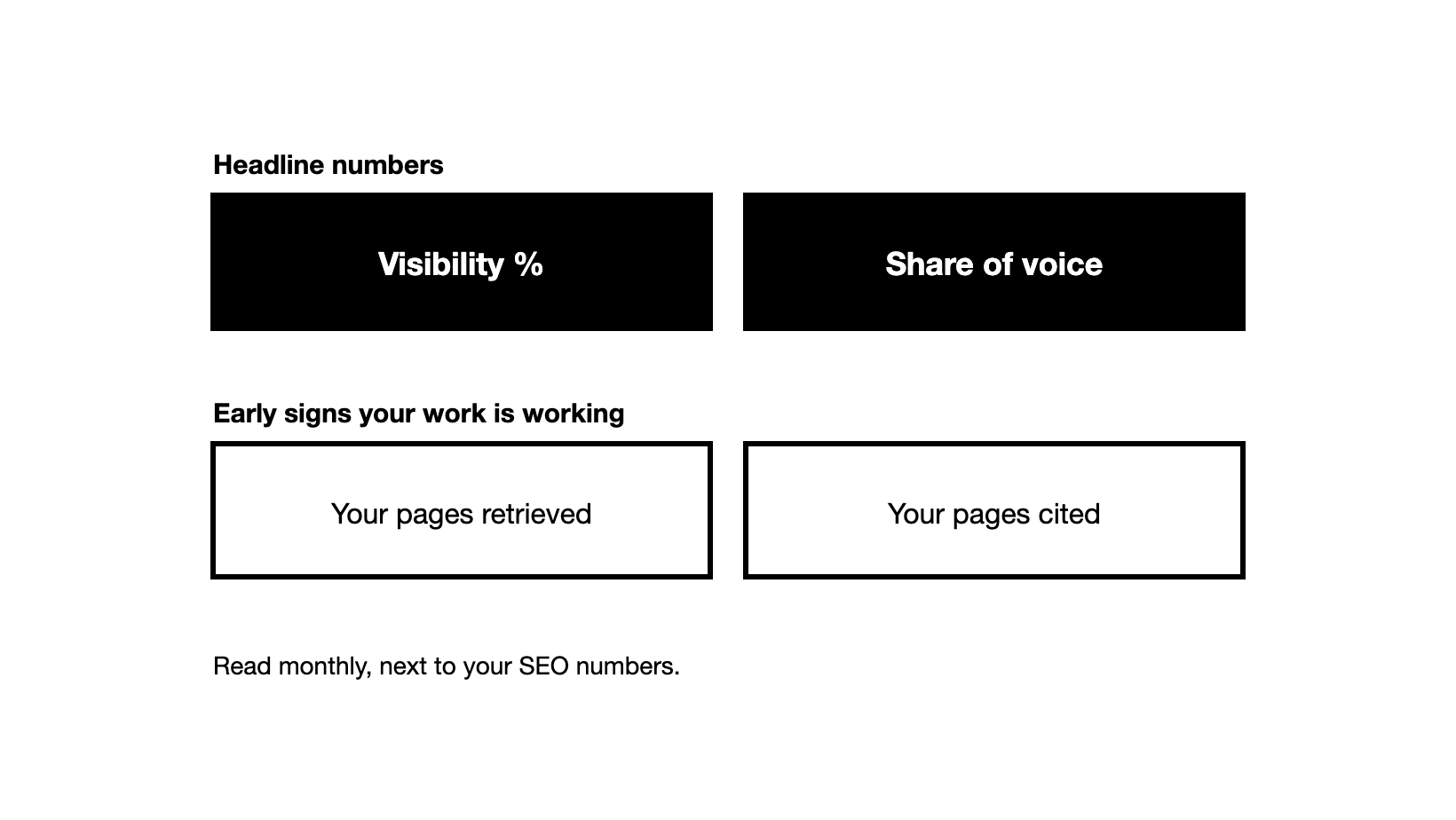
The AI visibility metrics to track are two headline numbers, visibility % (the share of AI answers that mention your brand) and share of voice (the answers naming you, as a share of the answers naming you or a competitor), read as a monthly trend; a small team should first work on what it controls, getting its own pages retrieved and cited, and keep its SEO metrics alongside.
This guide is part of our guide to measuring AI visibility. It covers the metrics step of the method: once you have chosen your prompts, engines and markets and collected the answers, which numbers you read from them.
Which AI visibility metrics should you track?
Measuring success beyond traditional rankings comes down to two numbers: visibility % and share of voice. The rest either explain why those two moved or check that they mean what you think. Here is the set, and the job of each.
| Metric | What it counts | Its job |
|---|---|---|
| Visibility % | Answers that mention your brand, divided by all answers collected | Headline: are you in the answer? |
| Share of voice | Answers naming you, as a share of answers naming you or a competitor | Headline: how do you compare? |
| Your pages retrieved | Answers whose source list includes a page of yours | What a small team moves first |
| Your pages cited | Answers that show a page of yours as a source | What a small team moves next |
| Position | Where you appear when you are named | Add once visibility is decent |
| Sentiment and accuracy | How the answer describes you, and whether the facts are right | Positioning checks |
| SEO metrics | Rankings, organic traffic, Search Console impressions, branded search | Keep alongside |
Being "recommended" is not on the list. For measuring, any mention counts as visibility; how warmly an answer recommends you is a quality question you read in the answer text.
How do you calculate visibility %?
Visibility % is the share of AI answers that mention your brand. Count every answer you collected in the period, count the ones that name you, and divide. Pool all the answers across prompts, engines and countries; do not average per-prompt percentages, which gives a prompt with a handful of answers the same weight as one with hundreds.
Say you track 20 prompts on three engines in one country, with one answer per prompt per engine each day. Over a month that is well over a thousand answers. If 3 in every 10 of them name you, your visibility is 30%. (An example, not real data.)
The pooled number is the headline, but it hides where you are missing. Break it down by engine and by prompt: a prompt that names you in none of its answers needs different work from one that names you in most of them.
Prompt coverage is the share of your tracked prompts where you appear at least once in the period. It is a useful second read of the same answers, because it shows whether your visibility is spread across the buyer's questions or sits in a few. It stays secondary, because one appearance in a month of answers counts as covered.
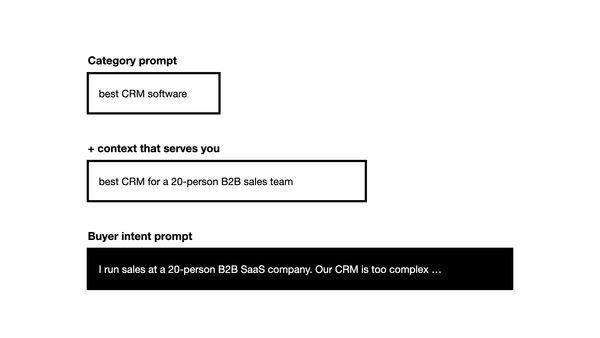
What goes into the denominator decides what the number means. Count only prompts a buyer asks when looking for a solution like yours. Leave informational prompts out, because they rarely name any brand, and keep prompts that name your brand in a separate group, because they show how AI describes you, not whether you show up. Here is how to choose which prompts to track.
What is share of voice, and how is it different from visibility %?
Share of voice is the answers that name you, as a share of all the answers naming any brand you compare with. Visibility % asks whether you are in the answer; share of voice asks how much of the conversation is yours.
Continue the example. For every 10 answers, 3 name you and rival A, 3 name rival A alone, 3 name rival B alone and 1 names no brand. So 9 answers name at least one of the three brands, and 3 of them name you: your share of voice is 33% while your visibility is 30%. If rival B dropped out of its 3 answers and they named no brand instead, your share of voice would rise to 3 in 6, or 50%, with your visibility unchanged.
Compare yourself with the brands AI actually names, not the ones you assume are your competitors. If rivals you expected never show up, your prompts may be too generic. When the two lists match and you appear near the front, you are winning.
Why read them as a monthly trend?
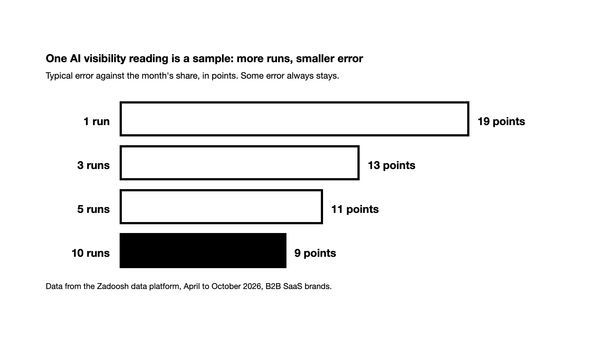
AI answers vary from one run to the next, so one check proves little: the same prompt can name different brands the next time you ask (why ChatGPT gives different answers). Collect one answer a day per prompt, per engine and per market, and read the numbers over a month.
About ten answers per prompt gives a rough read; more answers narrow it, never to certainty. A daily line swings. A monthly trend shows the direction.
Read change directionally. Over about a month, is visibility going up or down? A rise of 3 to 5 points in a month is a good sign; smaller moves in between are usually fluctuation.
This also answers whether share of voice is more stable than a Google rank. Answer to answer it is less stable, because the engine writes each answer again. It becomes stable only as a share over many answers, which is why you report the trend and not the latest reading.
On a tight budget, track fewer engines and keep the prompts and the daily runs. A few prompts run daily tell you more than many prompts run rarely.
What should a small team track first?
A small team should first work on what it controls: its own pages. Next to the two headline numbers, track whether your pages are retrieved and cited for the prompts you care about.
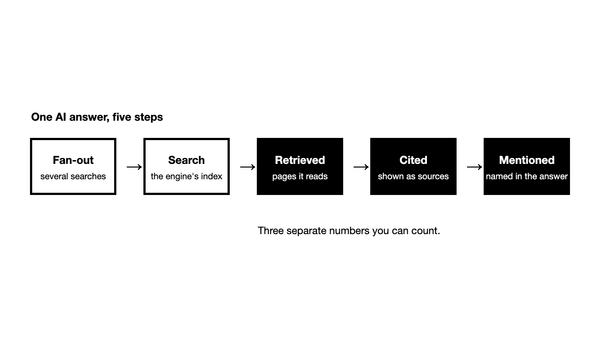
Three terms matter here, and each counts something different:
- Retrieved: the engine ran its searches and pulled your page into the pool of pages it read for the answer. ChatGPT calls this list its sources: when it searches the web, open the Sources section to see every page it found.
- Cited: in general, any page the answer shows as a source, whether yours, a listicle or a Reddit thread. As a metric, "your pages cited" means a page from your own domain shown as a source. In ChatGPT, the links inside the answer are the cited ones.
- Mentioned: your brand is named in the answer. A mention can come from anywhere: your pages, third-party pages, community threads or what the model learned in training.
Retrieval and citation are about your own URLs, so your own content work moves them directly. Mentions also depend on community and third-party pages, which take more time and people to influence. So a small team works in that order: get its pages retrieved, then cited, and lets mentions follow from more than its own site.
This is an order of work, not a ladder. A brand can be mentioned with no page of its own retrieved, and a retrieved page may never be cited. Know which one a number measures before you act on it.
To count retrieval, check each tracked answer for any of your URLs in its full source list; the share of answers that include one is your retrieval rate. Where an engine shows only the links it cited, you can count citations but not retrieval.
Pages you do not own still matter. Buyers rarely click citations, but engines use the cited sources to decide which brands to name, so the third-party pages cited for your prompts are part of how you get mentioned. The AI visibility audit shows how to split cited sources into your own site, community and third-party publications.
Which metrics are leading and which are lagging?
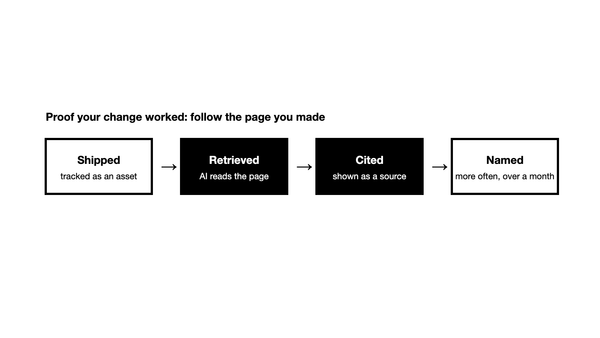
Your pages being retrieved and cited move first, visibility % and share of voice follow, and traffic, leads and revenue come last. Read them in that order when you judge whether your work is paying off.
This order assumes you start with on-page work. If you also work on third-party publications and community at the same time, the same order holds for those pages: first whether the page you worked on is retrieved and cited, then whether you show up in the answer.
- Leading: your new or updated pages retrieved, then cited, for the prompts they serve.
- Headline: visibility % and share of voice, read monthly against your top competitors.
- Lagging: branded search, AI referral traffic, and leads who say they found you through AI.
The clearest proof that your work caused a change is a page you created or earned (your own, a third-party listicle, a community thread you joined) being retrieved, then cited, then mentions following on the prompts it serves. If nothing you did is retrieved or cited, the change came from elsewhere.
Visibility rising on prompts you never worked on proves little either way. Engine updates lift some sets of prompts and not others, so untouched "holdout" prompts give weak context at best, and once you optimise prompt by prompt they matter even less.
Which supporting metrics are worth adding?
Add these once the headline numbers are running. Each answers a narrower question:
- Position: where you appear when you are named. AI answers have no fixed positions 1 to 10, and the order changes between answers, so position is noisy. Track it only once your visibility is decent.
- Sentiment: whether answers describe you positively, neutrally or negatively, tracked weekly next to visibility.
- Accuracy: a fact checklist (pricing, features, category, who it is for, company facts) checked monthly and after any change. When a fact is wrong, fix the sources that carry it.
- Branded checks: three prompts run weekly: "What is [brand]?", "[brand] pros and cons" and "Is [brand] good for [use case]?". They test positioning and stay out of visibility %.
- Citation share by channel: of the pages cited for your prompts, the share from your own site, community and third-party publications. Count cited pages, not answers. Compared before and after, it shows which channel drove a change.
- Citation freshness: when each of your pages was last cited. A page that stops being cited is the signal to check which source replaced it.
A single composite AI visibility score is not on the list. It blends several of these into one figure, so before you report one, ask what is inside it: which prompts, which engines, how many answers. There is no universal good score; compare with your top three competitors on the same prompts and look for a rising share over about three months.
Which SEO metrics should you keep?
Keep the SEO metrics that still tell you something, side by side with AI visibility: rankings, organic traffic, Search Console impressions and branded search. AI visibility does not replace organic traffic as a measure of content success. It adds a channel your SEO report cannot see.
There is a second reason to keep them. Google says a page must be indexed and eligible to show with a snippet in Search to appear as a supporting link in AI Overviews or AI Mode, so the work behind your rankings is also the entry ticket to Google's AI features.
Link counts and domain authority do not measure AI visibility. When a founder asks whether the work is paying off, answer with visibility and share of voice against competitors as the headline numbers, and with how new leads say they found you, through a "How did you hear about us?" field on your forms.
Branded search is worth watching as a lagging signal: people read an answer, remember a name and search for it later. It moves for many reasons, so treat a rise as directional, not as proof.
AI referral traffic and AI-referred conversions belong in the same report, with a caveat: much of it shows up as Direct, and Google counts clicks from AI Overviews and AI Mode with your normal web search traffic. Our main guide explains how to see AI traffic in your analytics.
Can every metric be measured in every AI engine?
No. Mentions and share of voice can be read in any engine, because they come from the answer text. Your pages cited needs an engine that shows its sources, and retrieval needs the full list of pages it found, which ChatGPT shows in its Sources section. Read each engine separately rather than blending them.
| Engine | Mentions and share of voice | Your pages cited | Retrieved |
|---|---|---|---|
| ChatGPT | Yes | Yes, links in the answer when it searches the web | Yes, the Sources section |
| Google AI Overviews | Yes | Yes, the links shown with the overview | Only where a full source list is recorded |
| Google AI Mode | Yes | Yes, the links shown with the answer | Only where a full source list is recorded |
| Perplexity | Yes | Yes, its listed sources | Only where a full source list is recorded |
| Gemini | Yes | When the answer shows sources | Only where a full source list is recorded |
| Microsoft Copilot | Yes | Yes, its linked sources | Only where a full source list is recorded |
| Claude | Yes | When it searches the web and shows sources | Only where a full source list is recorded |
Three notes on the table. Measure AI Overviews and AI Mode as different products, not head to head; here is how to measure your brand in AI Overviews and AI Mode. Claude belongs on the list because B2B buyers increasingly use it, so check whether your tool covers it before you rely on it.
Meta AI, Grok and DeepSeek are worth a check if your buyers use them. The same metrics apply, and the cited and retrieved columns depend on what each shows.
How do you report AI visibility?
Report it monthly, as its own section and KPI next to your SEO numbers rather than folded into them. Then a drop in clicks is not read as a drop in visibility, or the other way round. Agencies report the same set to clients.
The monthly report covers four things:
- Visibility % and share of voice against your top competitors, as a trend, broken down by engine.
- Your pages retrieved and cited: the pages you created or worked on (your own site, a third-party publication, a community post) that started being retrieved and cited for the prompts they serve.
- Citation share by channel: of the pages cited for your prompts, the share from your own site, community and third-party publications, against the month before. The channel whose share grew is the likely cause of a change.
- SEO numbers: rankings, organic traffic, Search Console impressions and branded search.
Show your pages retrieved and cited even when visibility has not moved yet. They are the early win: a clear sign the work is working, before visibility % and share of voice follow.
Set directional targets: rising visibility and a closing gap to your top competitors over a quarter, not a fixed percentage. Each quarter, give the CFO or whoever signs off the budget a summary: where visibility and share of voice stand against competitors, how the gap moved, and how many new leads say they found you through AI.
Which AI visibility metrics mislead?
Most bad readings come from a few habits:
- A count without the answer text. A mention in the wrong list, such as "cheapest options" for a premium product, counts the same as a strong recommendation. Read a sample of the answers behind every number.
- One check. A single run, often logged in, treated as the truth.
- Informational and branded prompts inside visibility %. Both move the number without telling you whether buyers find you.
- Classic SEO numbers relabelled. Click-through rate, bounce rate and domain authority are not AI visibility metrics. They describe your site, not AI answers.
- Technical completeness read as selection. A site can pass every technical AEO check and still not be named. Real-world selection by the engines shows up only in visibility on buyer questions.
- "What real buyers see." No tool has access to a real buyer's conversation. What you measure is what engines answer today to the buyer questions you chose, which is why those questions must be the ones buyers ask.
Frequently asked questions
What are the most important AI visibility metrics? Visibility % (the share of answers that mention your brand) and share of voice (the answers naming you, as a share of the answers naming you or a competitor), read as a monthly trend. A small team should also track whether its own pages are retrieved and cited.
What is the difference between visibility % and share of voice? Visibility % compares the answers naming you with all the answers collected. Share of voice compares them with the answers naming you or a competitor. A rival dropping out of answers raises your share of voice without changing your visibility.
Should I track AI visibility separately from SEO? Track it as its own section and KPI, next to your SEO numbers. Keep rankings, organic traffic, Search Console impressions and branded search, because AI visibility adds to them rather than replacing them.
How often should I check AI visibility metrics? Collect answers daily, one per prompt, engine and market, and decide on the monthly trend. A single check or a single week can mislead.
What is prompt coverage? The share of your tracked prompts where your brand appears at least once in the period. It shows how widely your visibility is spread across buyer questions, and works as a second read next to visibility %.
Can I track AI visibility in Claude? Yes. Mentions and share of voice come from the answer text, so they work in Claude as in any engine, and cited pages can be counted when it searches the web and shows sources. Check whether your tracking tool covers Claude before relying on it.