
Case studies / CultureMonkey · AI visibility report · Published 2026

How CultureMonkey went from 1 in 4 AI answers to more than 1 in 3, with Zadoosh's omnichannel AEO approach

In 120 days, CultureMonkey went from being named in about 1 in 4 AI answers to more than 1 in 3. It got there with an omnichannel approach, working its own pages, 48 off-page placements earned by Zadoosh on third-party publications, and its community assets against the same prompts at once.

Customer CultureMonkey
120 days · 20 May to 16 Sep 2026 · 5 engines
Now shows up in More than 1 in 3 AI answers on the topic (38.5% in the last 30 days), up from about 1 in 4 (23.6%) in the first 30 days of the 120-day window.
Most-cited domain in the category #1 Most-Cited Vendor domain Across Zadoosh’s tracked employee engagement prompt set. culturemonkey.io is cited as a source more often than cultureamp.com, qualtrics.com, or any other vendor in the category.
Off-page placements by Zadoosh 1 in 4 Of every AI answer that names CultureMonkey, roughly one in four also cites an asset placed through this programme: 48 earned placements on third-party publications, across three content themes.
Real prompts tracked 20 → 451 Seed prompts expanded into the fan-out queries AI engines actually run behind the scenes.

At a glance

01 CultureMonkey’s own domain is most-cited vendor domain across Zadoosh’s tracked employee-engagement prompt set.
02 Alongside that, 48 off-page placements earned by Zadoosh across three content themes have been cited 878 times in tracked AI answers, reaching prompts the brand’s own pages do not.
03 Overall brand visibility is climbing too: CultureMonkey now appears in more than 1 in 3 tracked AI answers (38.5%), up from about 1 in 4 (23.6%) at the start of the 120-day window.
04 Against the category leader, the gap narrowed from 47% to 34% over the same 120 days, while that leader held flat.
05 The mechanism is simple. When an AI answer cites any CultureMonkey-connected source, the brand gets named 55% of the time. When it cites none, 8%.
06 That same tracking also pinpointed exactly where CultureMonkey is still invisible, turning a vague goal to improve AI visibility into a short, fixable list.
The challenge

An old, crowded category, and AI now decides who gets mentioned

Employee engagement software is a decade-old category dominated by Culture Amp, Qualtrics, Workday Peakon, Gallup and Lattice, brands with years of content and analyst mindshare built for a world where ranking on Google page one was enough. That world is gone.

Buyers now describe their problem to ChatGPT or Perplexity in a full paragraph and expect a shortlist back, and a page-one Google ranking no longer guarantees a seat in that answer.

CultureMonkey needed to know, prompt by prompt and engine by engine, exactly where it stood against that incumbent content, which meant it first needed a way to measure AI answers, not search rankings.

The approach

How CultureMonkey sees its AI visibility

CultureMonkey tracks 20 real, buyer-phrased prompts, not head-term keywords, but the language a CHRO or People Analytics Lead actually types into an AI assistant, across ChatGPT, Copilot, Gemini, Google AI Overviews and Perplexity, using Zadoosh's AEO platform. Because AI engines silently expand one prompt into dozens of related searches before answering, that tracking also maps the fan-out: 20 seed prompts unpack into 451 tracked query variants a simple keyword tracker would miss entirely.

Every citation behind those answers is also classified by channel, as an owned page, an earned off-page placement or a community asset, so instead of one blended visibility score, CultureMonkey gets a map of exactly where its presence is strong, where it is borrowed, and where it is still absent. Work then runs across all three channels at once rather than betting on any single one. The findings below are what that map turned up.
“We didn’t want AI visibility to become another marketing vanity metric. What mattered to us was understanding, with precision, where CultureMonkey was entering the buyer’s consideration set, which sources were earning that visibility, and where we were still absent. Zadoosh helped turn what initially felt like a fuzzy new channel into something measurable and actionable. That clarity has allowed us to move with far greater precision.”

Senthil Kumar Muthamizhan Founder & CEO, CultureMonkey
Exhibit A

Closing the gap on an entrenched leader

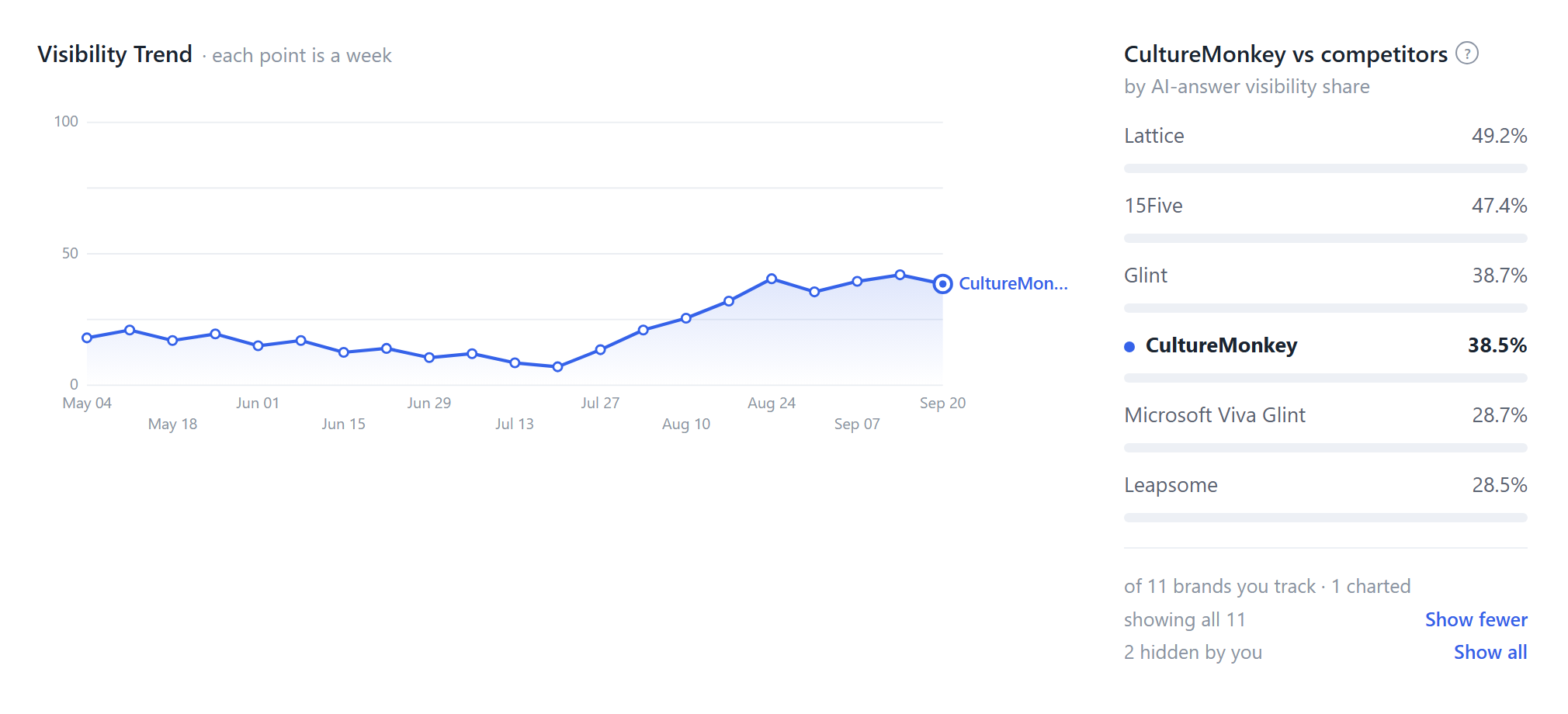
This is the visibility trend straight from CultureMonkey's workspace, one point per week since tracking began. The shape is the story: flat through early summer, a dip in July, then a step up through August and September. The panel beside it ranks CultureMonkey against the other brands it tracks.

Weekly visibility trend for CultureMonkey from May to September 2026, flat through June, dipping in July and rising through August and September to 38.5%, beside a panel ranking it against Lattice, 15Five, Glint, Microsoft Viva Glint and Leapsome
Visibility trend, weekly, all-time, from the CultureMonkey workspace.

Month by month, against the category leader:

Month
CultureMonkey
Culture Amp
Gap
May 2026
24.6%
71.7%
-47.1
June 2026
24.7%
67.8%
-43.1
July 2026
19.9%
65.5%
-45.6
August 2026
35.5%
71.9%
-36.3
September 2026
38.6%
72.3%
-33.7

CultureMonkey also overtook Leapsome, which led it by 19% in May and now trails by 10%, and has narrowed to within 11% of Lattice and 9% of 15Five. Culture Amp and Qualtrics did not decline over the period. The gap closed because CultureMonkey climbed.

Being straight about where this sits

CultureMonkey is not yet the most-named brand in its category. Among the 11 brands tracked it currently ranks 8th on mention rate. The case for the approach is the direction of travel and the citation lead described next, not the standing.

Exhibit B

Already number one on citations

Mentions are the lagging indicator. Citations are the leading one, because a challenger gets named when an engine has a source to name it from. On that measure CultureMonkey already leads the category it is still climbing:

Vendor domainCitation appearances
culturemonkey.io the brand’s own domain 5,451
cultureamp.com 4,339
qualtrics.com 3,469
gallup.com 2,791
workday.com 2,379
quantumworkplace.com 1,981

Across 1,175 domains and 77,234 tracked citation appearances, culturemonkey.io is cited more often than any other vendor in the category. That is the asset the mention rate is being built on.

Appearances counts every time a domain's page was cited in a tracked AI answer, across all engines, all-time. Subdomains are rolled into their parent domain, so each company is counted once. The ranking covers vendor domains; community and review platforms are tracked separately and shown in Exhibit D.

Exhibit C

Visibility depends on which engine, and which buyer

A single blended score would have hidden this. The same brand over the same 90 days is mentioned nearly four times as often on Copilot as on Google AI Overviews:

EngineMentionAnswers
Copilot 64.4% 780
Gemini 48.0% 741
ChatGPT 25.2% 5,304
Perplexity 21.7% 653
Google AI Overviews 17.1% 672

Where CultureMonkey wins is not random

Of the ten detailed buyer-scenario prompts tracked, the two describing a frontline, deskless or multilingual workforce are the two CultureMonkey dominates: 82.1% and 25.9% mention rate. No other scenario clears 13%.

That pattern is consistent with CultureMonkey's product differentiation around frontline, deskless and multilingual workforces, and it tells CultureMonkey precisely which buyer it already owns and which it still has to earn.

Exhibit D

Why citations are the lever

Most visibility tools stop at whether you were mentioned. Splitting each answer by whether it cited a CultureMonkey-connected source shows why mentions happen at all:

What the AI answer citedNamedAnswers
An owned CultureMonkey page 58.7% 3,103
An earned off-page placement 52.1% 634
A community asset (Reddit, YouTube) 46.0% 605
Nothing connected to CultureMonkey 8.3% 4,354

Presence is the lever, and the surface barely matters.

Every channel clears the bar by a wide margin. This is why the work runs across all three at once, and it is the whole argument for closing the gap by building citable sources.

By raw volume the three channels look very different:

Channel
Citations
Assets
Owned, culturemonkey.io
5,451
108 distinct pages
Earned off-page placements
878
48 placements
Community, Reddit and YouTube
760
9 assets

All-time figures. Owned out-cites the off-page programme roughly six to one, which is the point: the placements are not there to outgun the brand's own site, they are there to reach answers the site does not reach.

Results

What was built, and what moved

Alongside the measurement, 57 assets were placed across the three channels: 46 earned authority pieces, 2 listicle insertions, 6 community threads and 3 video assets, spanning three content themes.

The lag is visible in the data. Publishing surged in July, and visibility fell that month. August and September are when it landed. Placements take weeks to be picked up, so the step-up follows the push by roughly a month:

Month
Assets live
Visibility
Gap to leader
May
1
24.6%
-47.1
June
8
24.7%
-43.1
July
33
19.9%
-45.6
August
47
35.5%
-36.3
September
57
38.6%
-33.7

Of every AI answer that names CultureMonkey, roughly one in four (22.9%) also cites an asset placed through this programme. Comparing like with like inside a single prompt, answers that cite a placed asset name CultureMonkey far more often than answers that do not. On the survey-vendors prompt it is 64% against 48%. On survey-companies, 69% against 46%. On Culture Amp alternatives, 47% against 27%.

The headroom is equally clear. Only 46.6% of tracked answers cite any CultureMonkey-connected source at all.

The other half of the category conversation is still open field, which is where the remaining 34% of the gap sits.

Methodology

All figures are pulled from the Zadoosh AEO platform.

Windows The headline comparison covers 120 days, 20 May to 16 September 2026. Baseline is the first 30 days of that window (20 May to 18 June) against the last 30 (18 August to 16 September). The trailing 90-day window used for the engine table is 19 June to 16 September 2026, over which visibility averaged 30.0%. Category benchmark and fan-out counts are all-time through 18 September 2026.
Prompts 20 real buyer-phrased prompts, expanding to 451 tracked fan-out query variants.
Engines ChatGPT, Copilot, Gemini, Google AI Overviews and Perplexity.
Mention rate The share of sampled AI answers naming a brand, measured per prompt and engine, then rolled up. AI engines do not return identical answers on repeat queries, so all figures are samples and describe trends rather than exact counts.
Domain ranking Subdomains are rolled into their parent domain, so each company is counted once. The vendor ranking excludes community and review platforms.
Channel attribution Comparisons between answers that cite a CultureMonkey-connected source and those that do not describe an association, not a proven cause. A cited page that names the brand naturally raises the chance of a mention. The within-prompt comparisons control for differences in prompt difficulty.

Common questions about this data

What does AI-answer mention rate measure? The share of tracked AI answers, across ChatGPT, Copilot, Gemini, Google AI Overviews and Perplexity, that name a brand in response to a fixed set of real, buyer-phrased prompts, rolled up over a stated window.
Which AI engines are tracked here? ChatGPT, Microsoft Copilot, Google Gemini, Google AI Overviews and Perplexity.
What is a query fan-out, and why does it matter? AI engines silently expand one seed prompt into many related searches before composing an answer. Tracking only the seed prompt understates real exposure. CultureMonkey’s 20 seed prompts expanded into 451 distinct tracked fan-out queries.
Why measure citations separately from mentions? Established brands get named in AI answers from what the model already knows, often with no source behind it. A challenger is usually named only when an engine has a citable source to name it from. Citations therefore move first, and mentions follow, which is exactly the pattern in Exhibits A and B.
What does omnichannel mean in this context? Work running across three citation surfaces at once: the brand’s own pages, earned off-page placements on third-party publications, and community assets such as Reddit threads and video. Exhibit D shows why all three matter.

© 2026 Zadoosh · AI Visibility Report, CultureMonkey · Data as of 17 September 2026

See where your own brand stands

Run the same prompt-level, cross-engine visibility check on your brand or your client's.

https://